A team led by Columbia University has shown a new way for machines to grow, heal and adapt by absorbing parts from other robots. The approach, called robot metabolism, is described in a paper published in Science Advances on 16 July 2025. The researchers say it could lead to self sustaining robot ecologies that build and repair themselves without human intervention.
What is robot metabolism
The idea is simple to state and challenging to achieve. True autonomy, the team argues, means robots must be able to look after their bodies as well as make decisions. Robot metabolism sets two rules. First, growth and repair must be achieved using only the abilities of the robots themselves or help from other robots of the same kind. Second, the only outside provision is energy and compatible robot parts. No external machinery and no new types of components are allowed.
How the building blocks work
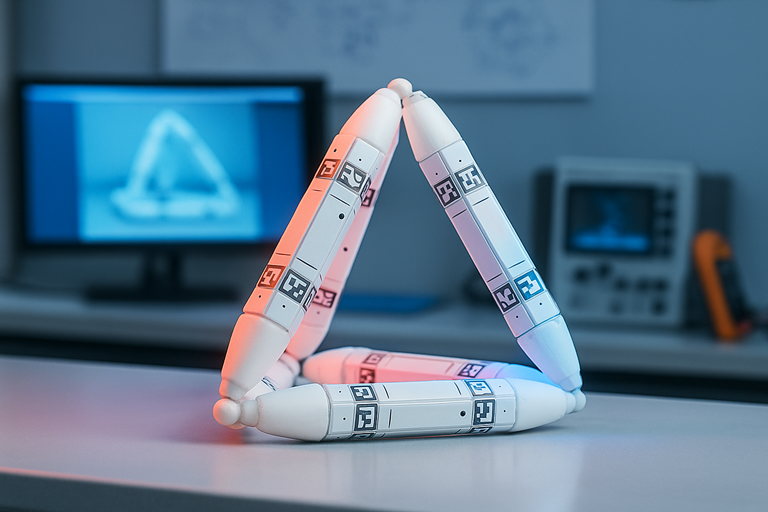
At the heart of the system is a bar shaped module called a Truss Link. Each link can expand and contract, roll, and attach to others using spherical magnetic connectors at its ends. A single link can only shuffle in one dimension. When several connect, they form shapes that can move across floors and over obstacles. Because the connectors work at many angles, the links can snap together quickly and reconfigure just as fast.
From flat shapes to moving machines
The team staged a sequence that began with separate links, then a triangle and a three pointed star. Those shapes combined into a diamond with a tail that folded into a tetrahedron. In a further step, the tetrahedron picked up an extra link and used it like a walking stick. That changed its gait and increased its downhill speed by more than 66.5 per cent. The researchers also showed assisted reconfiguration. A tetrahedron perched above a narrow slot reached down to lift a flat pattern so that it could become a second tetrahedron. When a link with a depleted battery detached, the robot found a spare and integrated it to restore function.
Why the work matters
Robot intelligence has advanced rapidly, but robot bodies are still mostly closed systems that cannot grow or repair themselves. Biology points to another route. Living organisms reuse building blocks, heal damage and adapt to their surroundings. By copying that modular approach, robot metabolism could enable long lived machine teams that cope with uncertainty, from collapsed buildings to remote planetary surfaces where resupply is hard.
Limits and next steps
These are early demonstrations under controlled conditions. The robots were teleoperated and the shapes were deliberately simple. Friction and surface effects made some formations harder in the real world than in simulation. The team plans lighter and cheaper hardware, richer sensing and large scale simulation to learn control policies for assembly, locomotion and repair. They stress the goal is practical resilience, not science fiction scenarios of self reproducing machines.
Study details
The research is reported as Robot metabolism toward machines that can grow by consuming other machines by Philippe Martin Wyder and colleagues, including Hod Lipson at Columbia University. The paper appeared in Science Advances on 16 July 2025. The authors say robot metabolism offers a physical counterpart to advances in artificial intelligence by letting machines change their bodies as well as their minds.