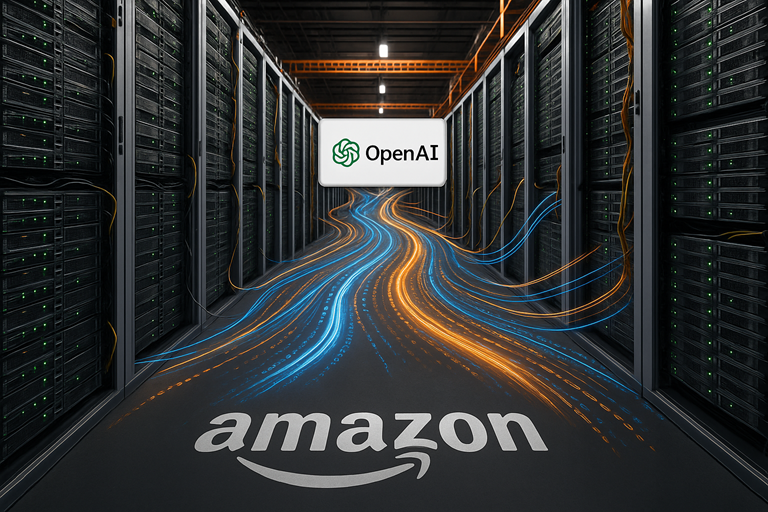
OpenAI, the company behind ChatGPT, has signed a seven-year, $38 billion deal with Amazon Web Services (AWS) to power the next stage of its artificial intelligence growth. The agreement marks one of OpenAI’s biggest shifts away from long-time partner Microsoft and highlights the tech industry’s growing hunger for computing power.
A huge investment in cloud capacity
Under the deal, OpenAI will begin running its workloads immediately on AWS infrastructure, using hundreds of thousands of Nvidia graphics processors. These chips will train and run the company’s AI models, including future versions of ChatGPT. The first phase will rely on existing AWS data centres, with Amazon building additional capacity through 2026 and beyond.
Dave Brown, vice president of compute and machine learning at AWS, said the deal involves “completely separate capacity” being built for OpenAI, allowing the company to scale without disrupting other customers.
The agreement gives OpenAI access to some of the most powerful computing hardware available, including Nvidia’s new GB200 and GB300 chips. Amazon’s own Trainium chips could also play a role later in the partnership.
Powering the AI boom
The deal is part of OpenAI’s vast infrastructure push, as the company seeks to develop what chief executive Sam Altman has called “frontier AI”, systems capable of reasoning and problem-solving on par with humans.
Altman has previously said OpenAI aims to invest around $1.4 trillion to build up 30 gigawatts of computing resources, roughly enough to power 25 million American homes. He added that scaling such systems requires “massive, reliable compute”, describing the partnership with AWS as critical to bringing advanced AI “to everyone”.
The scale of OpenAI’s ambitions has sparked both excitement and concern. Analysts warn that the energy demands of such computing projects are enormous and could strain global power supplies unless matched by significant investment in renewable energy.
A boost for Amazon
For Amazon, the deal represents a major win. Its cloud division, AWS, has faced growing competition from Microsoft and Google in the AI space. The agreement with OpenAI re-establishes AWS as a leading infrastructure provider at a time when cloud growth has slowed.
Investors responded positively. Amazon shares hit an all-time high after the announcement, rising nearly 5 percent and adding around $140 billion to its market value.
Matt Garman, chief executive of AWS, called the agreement “a strong endorsement” of Amazon’s technology, saying its infrastructure would serve as “a backbone” for OpenAI’s global expansion.
Challenges ahead
The sheer scale of OpenAI’s spending has raised eyebrows on Wall Street. Alongside the AWS contract, the company has committed to $250 billion in Microsoft Azure services and $300 billion with Oracle, in addition to deals with Google. Some analysts have questioned how the loss-making company will fund such enormous commitments, even as its annualised revenue is expected to hit $20 billion by the end of the year.
Critics also warn that the industry’s rapid buildout of AI capacity could outpace both energy availability and economic returns, fuelling fears of a technology bubble.
Still, OpenAI’s diversification of cloud partners signals a new phase of independence. Following its recent corporate restructuring, the company is now free to work with multiple providers. Many see the move as a step toward an eventual public offering that could value OpenAI at up to $1 trillion.
As the AI race intensifies, the partnership between OpenAI and Amazon underscores a simple truth: the future of artificial intelligence will depend as much on power and infrastructure as on algorithms and ideas.