Gravis Robotics has announced a major push to bring autonomous earthmoving equipment into mainstream construction, following a new round of funding worth 23 million dollars and a string of high profile industry partnerships. The Swiss based company, founded in 2022 as a spin out from ETH Zurich, says it is now positioned to lead the global shift towards intelligent, automated excavation.
The investment, co led by IQ Capital and Zacua Ventures, will support the company’s expansion across Europe, the United States, Latin America and Asia. With systems already operating in seven countries, Gravis claims to have one of the broadest deployments of autonomous excavation technology anywhere in the world.
How the technology works
At the centre of Gravis’s approach is a retrofit kit designed to turn standard excavators and loaders into autonomous or semi autonomous machines. The Rack, as the system is known, integrates cameras, lidar, GPS and onboard computing with the machine’s hydraulics. These sensors allow the equipment to “feel the soil”, detecting variations in ground conditions and adjusting digging strategies in real time.
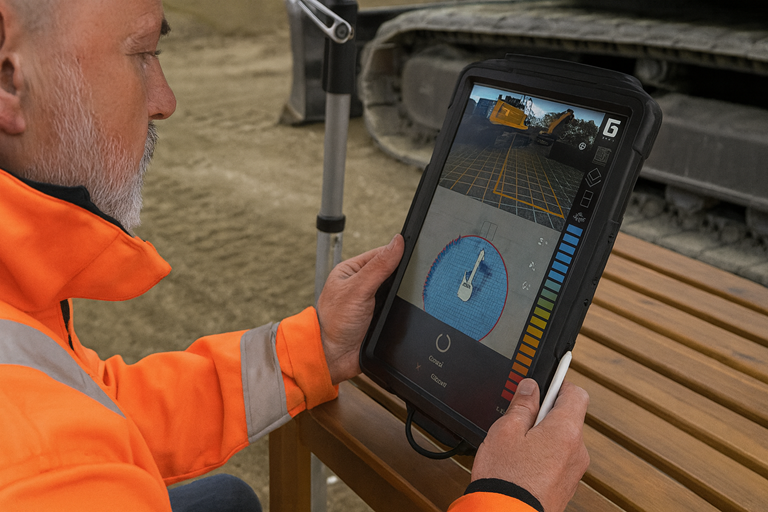
A companion tablet, the Slate, presents operators with a live 3D visualisation of the site. It shows which areas need cutting or filling and updates continuously as work progresses. Operators can switch at any moment between manual control, augmented control and full autonomy.
The company says this intelligence allows machines to handle complex, constantly changing sites, from trenching and bulk earthworks to grading and material handling. By combining autonomy with operator augmentation, Gravis aims to increase output by around 30 per cent while reducing rework and improving safety.
Ensuring safety on live sites
Safety, long seen as a barrier to automation in construction, is central to Gravis’s pitch. Autonomous functions are designed to remove operators from hazardous environments and prevent accidents caused by fatigue or inconsistent manual operation.
Multiple sensing systems allow equipment to detect obstacles, adjust to terrain and avoid unexpected hazards. The Slate interface also gives operators an immediate understanding of machine behaviour, helping them intervene quickly if required. Industry partners, including Holcim and Taylor Woodrow, report that the system improves both control and predictability on active sites.
Retrofitting existing fleets
One of Gravis’s key selling points is its focus on retrofit technology rather than bespoke autonomous machines. Construction fleets vary widely across contractors, regions and OEMs, and Gravis says its learning based control system can adapt to different hydraulic behaviours, even between machines of the same model.
This flexibility enables contractors to upgrade existing fleets rather than replace them. The company has already deployed integrated systems with OEMs such as Develon and has partnered with the UK’s largest plant hire provider, Flannery, to offer rental excavators pre fitted with the Gravis Rack.
A growing global footprint
Deployments range from quarry operations with Holcim to the UK’s first large scale autonomous excavation trial at Manchester Airport, led by Taylor Woodrow. Gravis argues that its European base has been an advantage, allowing it to meet demanding cross border standards and scale quickly in international markets.
With its latest funding and a rapidly expanding partner network, the company believes autonomous earthmoving is now ready for widespread adoption. As CEO Ryan Luke Johns puts it, the fastest route to autonomy is to deliver productivity today, helping human teams work more efficiently while building the data needed for future fully autonomous systems.