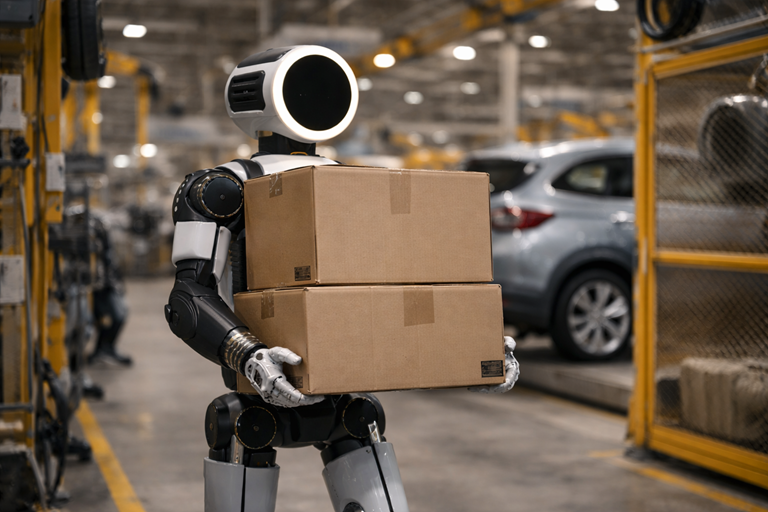
Boston Dynamics has confirmed that its humanoid Atlas robot is now ready to enter production, marking a significant milestone for one of the world’s most recognisable robotics projects. The announcement was made at CES 2026, where the company presented the latest version of Atlas as a product designed for real industrial work rather than research demonstrations.
The development places Atlas ready for production at the centre of growing global interest in humanoid robots and their potential role in manufacturing, logistics and other physically demanding industries.
From research project to industrial tool
Boston Dynamics has been developing Atlas for more than a decade. First revealed in 2011 as part of a US defence funded research programme, the robot became widely known through online videos showing it running, jumping and performing complex movements.
The production ready Atlas represents a shift in focus. The robot is now fully electric, moving away from earlier hydraulic designs, and has been engineered for reliability and repeatability in factory environments. According to the company, Atlas can lift around 50 kilograms, reach up to 2.3 metres and operate in temperatures ranging from minus 20 to 40 degrees Celsius. It can work autonomously, be remotely operated, or guided using a tablet based interface.
Boston Dynamics chief executive Robert Playter described the robot as the most capable system the company has built to date, saying it represents a step towards long term ambitions for humanoid robots in industry.
Where Atlas will be used first
The first large scale deployments of Atlas will take place within Hyundai Motor Group, which owns a majority stake in Boston Dynamics. Hyundai plans to begin using Atlas in its car manufacturing plants from 2028, starting with tasks such as parts sequencing and internal logistics.
One of the initial sites is expected to be Hyundai’s Metaplant in Savannah, Georgia. Over time, the company says Atlas could take on more complex responsibilities, including component assembly and handling heavy or repetitive work.
In parallel, Google DeepMind will receive Atlas robots as part of a new partnership. The aim is to integrate DeepMind’s Gemini Robotics artificial intelligence models with Boston Dynamics’ hardware, allowing the robots to learn new tasks more quickly and adapt to changing environments.
Rising interest in humanoid robots
The move to put Atlas into production comes amid increasing competition in the humanoid robotics sector. Companies including Tesla, Amazon and several Chinese manufacturers are investing heavily in robots designed to work in spaces built for humans.
Hyundai has indicated that it hopes to scale Atlas production significantly, with plans to manufacture up to 30,000 robots a year from 2028. Analysts say this suggests strong confidence that demand for humanoid robots will grow as labour shortages, safety concerns and productivity pressures increase.
However, experts also caution that the technology remains expensive and complex, and that proving long term reliability in busy factory settings will be critical.
Impact on jobs and employment
The prospect of humanoid robots working on factory floors has raised concerns about job losses. Hyundai has acknowledged these fears but says Atlas is intended to complement human workers rather than replace them outright.
The company argues that robots will be used initially for physically demanding or potentially dangerous tasks, reducing strain and injury risk for people. It also points to new roles created around robot supervision, maintenance and training.
As Atlas ready for production moves from announcement to reality, its real impact on employment is likely to depend on how widely it is adopted and how effectively companies balance automation with human work. For now, the arrival of Atlas on factory floors marks a notable moment in the evolution of industrial robotics.