Across Europe, a quiet construction revolution is gathering pace. From student housing in Denmark to compact homes in Luxembourg, 3D printed houses are increasingly being presented as a potential answer to rising costs, labour shortages and the urgent need for affordable housing.
Recent projects suggest the technology is moving beyond experimental one off builds and into larger scale developments that could reshape how homes are delivered in the future.
Denmark Completes Europe’s Largest 3D Printed Development
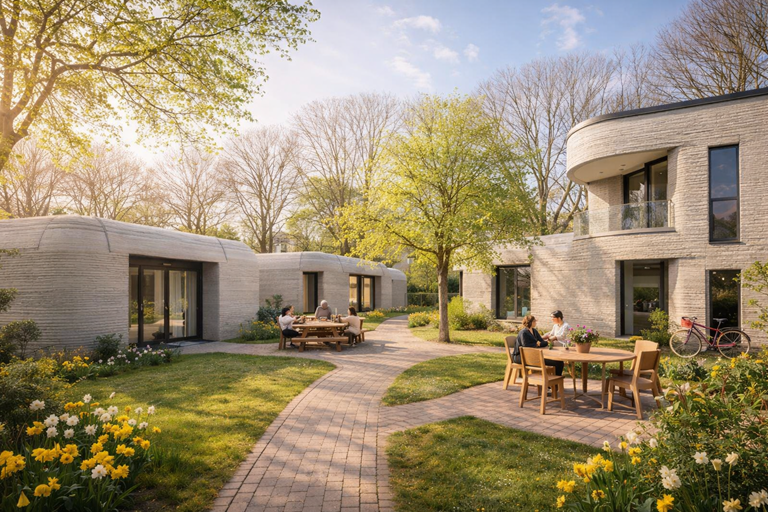
In the Danish town of Holstebro, Europe’s largest 3D printed housing project has now been completed. Known as Skovsporet, or The Forest Trail, the development consists of 36 student apartments arranged across six low rise buildings.
Commissioned by NordVestBO, an affordable housing provider, and built by 3DCP Group using COBOD’s BOD 3D construction printer, the project demonstrates how additive manufacturing can be applied at neighbourhood scale. The printer extrudes a cement based material layer by layer to form the structural walls, with each apartment ranging between 431 and 538 square feet.
What sets Skovsporet apart is speed. While early units took several weeks to print, productivity improved dramatically as the project progressed. By the final building, more than one apartment was effectively being printed per day, with a single structure completed in just five days. The entire printing operation was overseen by a three person team, highlighting the reduced labour requirements of 3D printed houses.
Design, Light and Liveability
Despite their automated origins, the apartments were designed to feel warm and liveable. Created by SAGA Architects, the homes feature slanted ceilings, large roof windows and generous natural light. Plywood and glass finishes soften the textured concrete walls, while each unit includes a kitchen, study space, lounge, bathroom and sleeping area.
The buildings sit around a landscaped shared courtyard with walking and cycling paths, reinforcing the idea that 3D printed housing can be both functional and visually appealing.
Sustainability and Material Efficiency
Environmental impact was a central consideration. Skovsporet was printed using a low carbon concrete mix, and the additive process deposits material only where it is structurally required, significantly reducing waste compared with traditional construction.
Careful site planning also preserved around 95 percent of existing trees, showing how large scale 3D printed houses can coexist with sensitive landscapes rather than replacing them.
Lessons from Luxembourg’s Tiny House Experiment
Elsewhere in Europe, architects are exploring how 3D printed houses could unlock difficult or overlooked sites. In Luxembourg, ODA Architects’ Tiny House Lux project tests whether compact, high performance homes can be delivered on narrow plots woven into established neighbourhoods.
Working with Coral Construction Technologies, the team used a mobile printer capable of printing standard concrete on site. Printing took around a week, with the full build completed in roughly four weeks. Digital fabrication allowed features such as storage cavities and bathroom fittings to be integrated directly into the printed walls, cutting labour and waste.
A Step Towards Affordable Housing
While questions remain around long term costs and regulation, these projects show clear momentum. As 3D printed houses scale up, advocates argue they could help address housing shortages by building faster, using fewer workers and reducing environmental impact.
For now, developments like Skovsporet suggest that 3D printed housing is no longer just a concept, but a practical tool being tested in real communities across Europe.