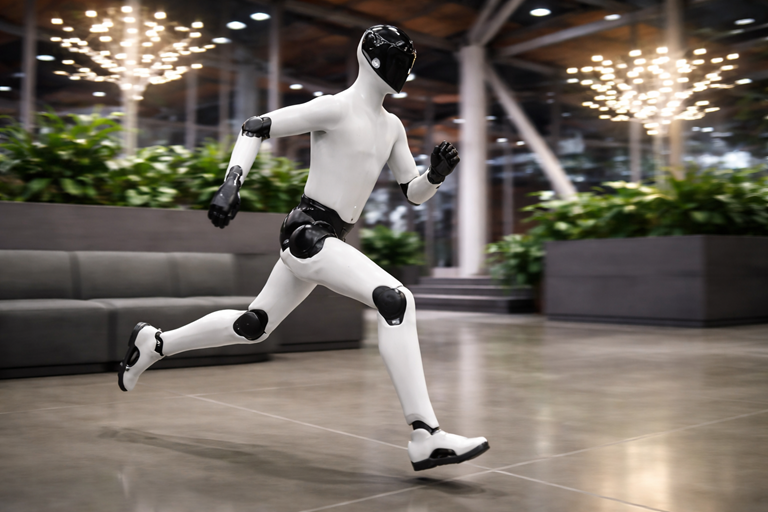
A US built humanoid robot has taken a major step towards moving like a human after new footage showed it running smoothly at near jogging speed. The latest demonstration from Figure Robotics highlights how rapidly humanoid machines are improving and signals what could come next for robots designed to work alongside people.
The video, shared by Figure AI’s founder, shows the company’s third generation robot accelerating quickly, changing direction smoothly and braking sharply while running indoors. These movements mark a significant shift away from the slow, cautious walking that has long defined humanoid robots.
Breaking a long standing limitation
For years, speed has been one of the biggest challenges in humanoid robotics. Most general purpose humanoids move at little more than a brisk walking pace, typically around three to four miles per hour. Figure 03 was previously listed at a modest 2.7 miles per hour, putting it firmly in that category.
However, the new footage suggests a very different reality. Visual estimates and a later update from Figure AI indicate the robot may be running at up to 6.5 miles per hour, placing it at the upper end of human jogging speed. Crucially, the robot is clearly seen with both feet off the ground at the same time, which technically defines running rather than fast walking.
This kind of movement requires advanced balance and control, as the robot must manage moments of instability while airborne and land safely without falling.
How Figure made it possible
According to Figure AI, the breakthrough comes from a combination of lighter hardware and more capable software. The robot is controlled by an onboard neural network developed by the company’s Helix team, allowing it to coordinate motors, balance and movement in real time.
Figure 03 is around nine percent lighter than its predecessor, improving its power to weight ratio. Its actuators can operate faster while maintaining high torque, which is essential for rapid acceleration, sudden stops and tight turns.
These improvements are not just about speed. The same systems that allow the robot to run also enable faster and more precise object handling, a key requirement for real world work.
Built for homes and factories
Standing five feet eight inches tall, Figure 03 is designed as a production ready robot for both industrial and domestic use. It features improved sensors and more flexible hands with fingertip pressure detection sensitive enough to handle delicate items such as glassware.
This combination of fine motor control and high speed movement is unusual in humanoid robots, which often excel at one but not the other. It positions Figure 03 as a serious contender in a rapidly expanding market.
A growing rivalry
The running demo also comes amid intensifying competition. Tesla recently released footage of its Optimus robot achieving a new speed record, prompting comparisons across the industry. Analysts have also drawn parallels with advanced machines such as Boston Dynamics’ Atlas, long seen as the benchmark for robotic agility.
Figure AI’s founder, Brett Adcock, says the gap between human and robotic movement is closing rapidly.
For Figure AI, the next step is clear: turning impressive demonstrations into reliable everyday capability. If current progress continues, running humanoid robots on factory floors and in homes may soon move from novelty to normality.