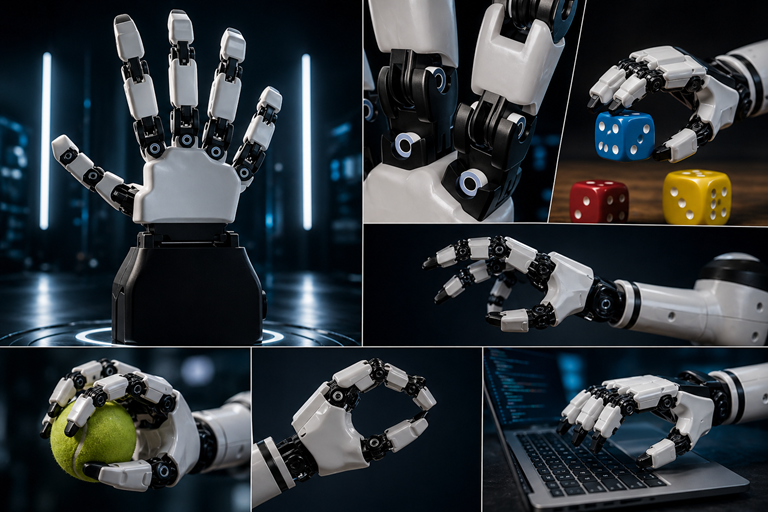
A team of researchers has unveiled the ORCA robotic hand, an open source platform designed to bring advanced robotic manipulation within reach of more laboratories and developers.
The system is a tendon driven, anthropomorphic robotic hand with 17 degrees of freedom, including 16 across the fingers and one at the wrist. Its structure mirrors the proportions and joint layout of a human hand, including an opposable thumb, enabling it to interact with everyday objects designed for human use.
The ORCA robotic hand also integrates tactile sensing and is built largely from 3D printed components. According to the researchers, the total bill of materials is under 2,000 Swiss francs, significantly lower than many comparable systems.
Why it was created
The researchers argue that while artificial intelligence has advanced rapidly, hardware remains a major bottleneck in dexterous robotics. Many existing robotic hands are expensive, bulky and require specialist maintenance, limiting their accessibility.
The ORCA robotic hand was developed to address this gap. By focusing on affordability, reproducibility and robustness, the project aims to allow researchers to begin experimenting with dexterous manipulation quickly, potentially within a single day.
Its human like design also makes it easier to use datasets based on human hand movements, supporting modern approaches such as imitation learning.
How to build the ORCA hand
A key feature of the ORCA robotic hand is its accessibility. The full system can be assembled by one person in under eight hours using a combination of 3D printed parts and widely available off the shelf components.
All design files, including CAD models, software and assembly instructions, are openly available. The platform includes detailed guides, visual references and repair instructions to support replication.
The design incorporates several features to simplify both assembly and maintenance. These include joints engineered to safely dislocate under excessive load rather than break, as well as tendon routing and tensioning systems that reduce wear and improve consistency.
How it is controlled
The ORCA robotic hand is designed to support a range of control approaches used in modern robotics research. These include teleoperation, imitation learning and reinforcement learning.
In one demonstration, researchers trained 4,096 simulated versions of the hand in parallel using reinforcement learning. The resulting control policy was then transferred directly to the physical system without additional tuning, enabling the hand to reorient a tennis ball.
The anthropomorphic design also simplifies the process of mapping human hand movements to the robot, making it suitable for data driven control methods.
Where it is being used and results so far
Experiments suggest the ORCA robotic hand can operate reliably over extended periods. In a continuous pick and place task, it completed more than 2,000 grasping cycles over seven hours with no hardware intervention and no tendon slack or rupture.
In a separate reliability test, the hand performed more than 2,250 grasping cycles over two and a half hours without motor shutdown or degradation in performance. Researchers also report that the system can withstand over 10,000 cycles of continuous operation, equivalent to roughly 20 hours, without hardware failure.
Importantly, these tests were typically concluded by the researchers rather than due to system faults.
Advantages for robotics and education
The ORCA robotic hand offers a combination of low cost, open access design and robust performance. Its modular structure and use of 3D printed parts allow damaged components to be replaced easily, reducing downtime.
By providing a shared and accessible hardware platform, the project aims to improve reproducibility across research and accelerate collaboration in dexterous manipulation and machine learning.
The researchers suggest the system could be particularly valuable in education and smaller laboratories, where cost and complexity have traditionally limited access to advanced robotic hardware.