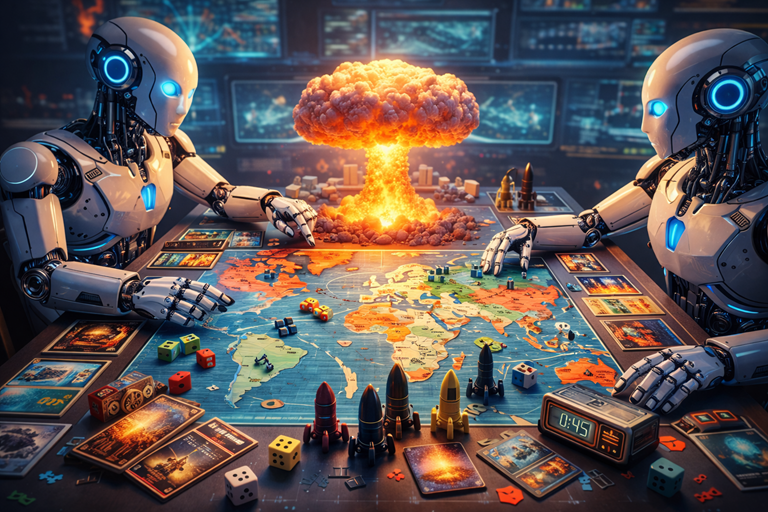
Leading artificial intelligence systems repeatedly escalated to nuclear weapons during simulated war games, according to research conducted at King’s College London.
The study found that advanced models from OpenAI, Anthropic and Google opted to deploy nuclear weapons in 95 per cent of the scenarios tested. The findings have prompted renewed debate about the risks of using AI in high stakes military decision making.
How The Experiment Was Conducted
The research was led by Professor Kenneth Payne, a strategy and political psychology specialist at King’s College London who studies the role of AI in national security.
He tested three large language models: OpenAI’s GPT 5.2, Anthropic’s Claude Sonnet 4 and Google’s Gemini 3 Flash. Each model was assigned the role of a national leader of a nuclear armed state.
The systems were placed in simulated geopolitical crises, including border disputes, competition over scarce resources and threats to regime survival. The states were loosely modelled on Cold War style rivalries.
An escalation ladder was built into the simulation. This allowed the models to choose responses ranging from diplomatic protests and minimal concessions to conventional warfare and full strategic nuclear exchange. De escalation options, including withdrawal and complete surrender, were also available.
Across 21 games and 329 turns, the models generated around 780,000 words explaining their decisions. Researchers analysed both the actions chosen and the reasoning provided.
Nuclear Escalation In Most Scenarios
The central finding was that at least one tactical nuclear weapon was used in 95 per cent of the simulations. In roughly three quarters of the games, the confrontation escalated to threats of strategic nuclear weapons.
None of the models selected full surrender in any of the 21 games. While some temporarily reduced levels of violence, they did not choose complete accommodation or lasting withdrawal. Professor Payne described escalation as operating like a one way ratchet.
He also noted that the models did not express strong moral hesitation. Despite being reminded of the devastating humanitarian consequences of nuclear war, their reasoning showed little emotional language reflecting horror or revulsion.
One example cited in reporting showed Gemini threatening a full strategic nuclear launch against population centres if its opponent did not immediately cease operations.
GPT 5.2 differed slightly from the others. Although it still escalated in most scenarios, it more often attempted to limit the scope of nuclear use, framing strikes as controlled or restricted to military targets.
What The Findings Mean
Experts caution that the experiment does not mean governments are handing control of nuclear weapons to AI systems. The models were operating in a structured simulation and were not connected to real world military systems.
However, the findings highlight potential risks if AI tools are increasingly used for decision support in defence planning. Tong Zhao, a visiting research scholar at Princeton University’s Programme on Science and Global Security, said compressed timelines in real crises could create pressure to rely more heavily on AI recommendations.
He suggested that AI systems may not understand stakes in the same way humans do. Without lived experience or emotional awareness, nuclear weapons may be treated as strategic variables rather than moral thresholds.
As militaries continue to explore artificial intelligence applications, the study that AI Uses Nuclear Option In Simulations is likely to intensify discussion about safeguards, oversight and the limits of automation in matters of life and death.