For decades, robots have been brilliant at repetition. On factory floors they weld, lift, and assemble with tireless precision. But move them into a kitchen or living room and the story changes. Homes are unpredictable: toys scattered on the floor, glasses balanced on a shelf, a jumble of objects in a drawer. Teaching a robot how to handle all that has always meant painstaking programming or hours of demonstrations.
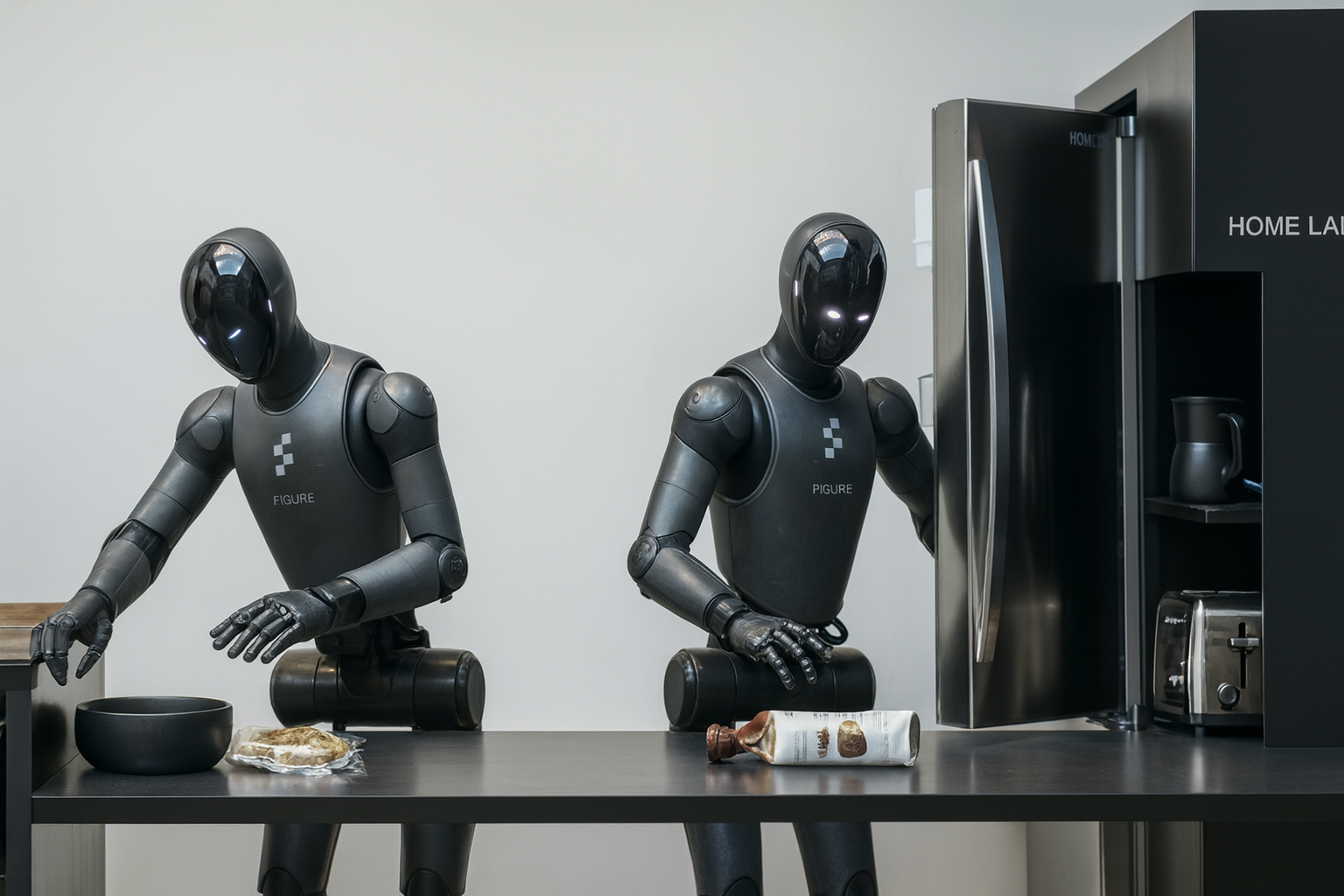
Now comes Figure 02, a humanoid robot with a new kind of “brain” called Helix. Instead of memorising fixed routines, Helix allows the robot to see, understand, and act in a unified way. You don’t need to script every motion — you can simply ask.
Two minds in one machine
Helix is inspired by psychology’s idea of two kinds of thinking. System 2 is the slow, deliberate planner. It looks at the world through the robot’s cameras, listens to natural language instructions, and works out what needs to happen. System 1 is the fast, reactive partner. It takes System 2’s plan and executes it at lightning speed, adjusting hundreds of times a second to keep movements smooth and accurate.
Together, they give the robot both strategy and reflexes. Ask it to “pick up the desert item” and it can spot a toy cactus in a pile of objects and know what to do, even if it’s never seen one before.
Seeing, understanding, and moving as one
What sets Helix apart is how tightly it integrates vision, language, and movement. The robot’s cameras, body sensors, and your spoken or written instructions all flow into a single system. That means the robot isn’t just recognising pixels on a screen or repeating a stored motion. It’s grounding abstract concepts in real-world action.
What this makes possible
The results are impressive. Figure 02 can control its entire upper body — 35 separate joints in the wrists, fingers, torso, and head — all at once. Two robots can even share the same Helix “hive mind” and work together, handing objects back and forth without special training. And because the system runs on small, efficient processors inside the robot, it’s ready for real-world use rather than being stuck in the lab.
Why it matters
Robots like Helix-powered Figure 02 represent a shift from machines that repeat tasks to machines that can learn on the fly. They bring the flexibility of AI language models into the physical world.
That doesn’t mean we’ll suddenly have robot butlers. Questions of safety, privacy, and trust still loom large. But it does suggest a future where robots can cope with the same everyday messiness that humans take for granted.
For now, Figure 02 shows us what happens when you give a robot not just hands and eyes, but something resembling common sense. It’s a glimpse of a world where telling a machine what you want is enough for it to figure out the rest.