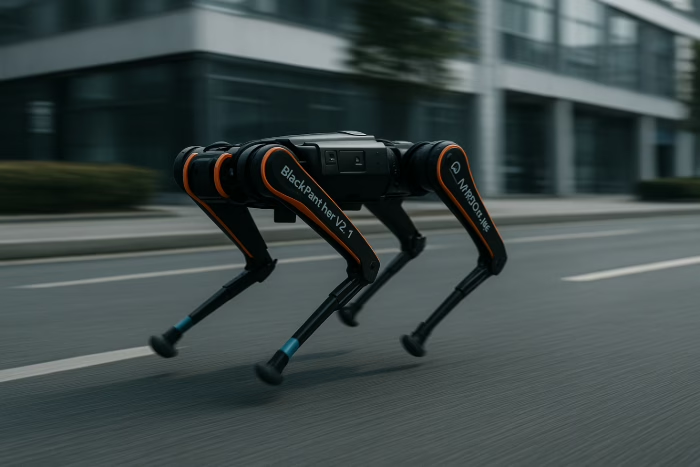
China has unveiled a four-legged robot capable of sprinting at nearly the speed of the world’s fastest humans — a major step forward in robotics research. The Black Panther 2.0, developed by Zhejiang University’s Humanoid Innovation Institute in partnership with Hangzhou-based startup Mirror Me, has been recorded reaching speeds of up to 10 metres per second.
At a demonstration in Wuhan, the 38 kg machine reportedly completed 100 metres in 13.17 seconds, reaching a top speed of 9.7 m/s. That’s faster than most human sprinters, though still short of Usain Bolt’s 9.58-second world record. Even so, it surpasses the performance of previous robots such as Boston Dynamics’ WildCat, which reached about 8.8 m/s.
Inspired by Nature
The Black Panther 2.0 takes its design cues from nature’s quickest animals. Researchers studied the movements of jerboas — small desert rodents with powerful hind legs — and black panthers to design a frame combining agility, strength and balance.
Its carbon-fibre shins, modelled on the jerboa’s limbs, increase stiffness by 135 per cent while adding only 16 per cent in weight, according to Zhejiang University. Special cheetah-inspired “running shoes” are said to boost ground grip by 200 per cent.
Springs fitted to each knee act as shock absorbers, recycling energy like tendons in real animals. Combined with high-power-density electric motors, the system allows the robot to maintain smooth, natural movement at speed.
A technical overview published by JEC Composites confirms the use of lightweight composite structures to reduce mass and enhance durability — key factors in achieving high-speed motion.
Powered by Artificial Intelligence
According to Xinhua News Agency, the robot employs artificial intelligence and machine-learning algorithms to adapt its gait in real time. Its control system follows the Huygens’ linked pendulum principle, which coordinates limb movement for balance and efficiency.
The project also uses a reinforcement-learning technique called Imitation Relaxation Reinforcement Learning (IRRL) — first published in Nature Machine Intelligence in 2022 — enabling the robot to refine its movements through repeated training, much like a human athlete
Potential Applications
Researchers say the Black Panther 2.0 could eventually assist in industrial automation, search-and-rescue operations, and disaster response, where speed and stability are critical.
“Black Panther 2.0 is more than just a marvel of speed — it’s a glimpse into the future of robotics,” commented technology site Wonderful Engineering, noting the blend of artificial intelligence, biomimicry and engineering behind the design.
A Question of Records
Some Chinese outlets have described the robot as breaking the “10-second barrier” for a 100-metre sprint, but there is no independent verification of such a result. As of October 2025, the official Guinness World Record for a quadruped robot remains 19.87 seconds, set by South Korea’s HOUND robot in 2023.
Analysts have urged caution, pointing out that sustained high-speed running, energy efficiency and navigation in complex terrain remain major technical hurdles.
Towards the Future
Even with those limitations, the Black Panther 2.0 represents a remarkable advance in robotic mobility. Built in just three months, it demonstrates how combining biomimicry with artificial intelligence can bring machines a step closer to matching — and perhaps one day surpassing — the grace and power of living creatures.