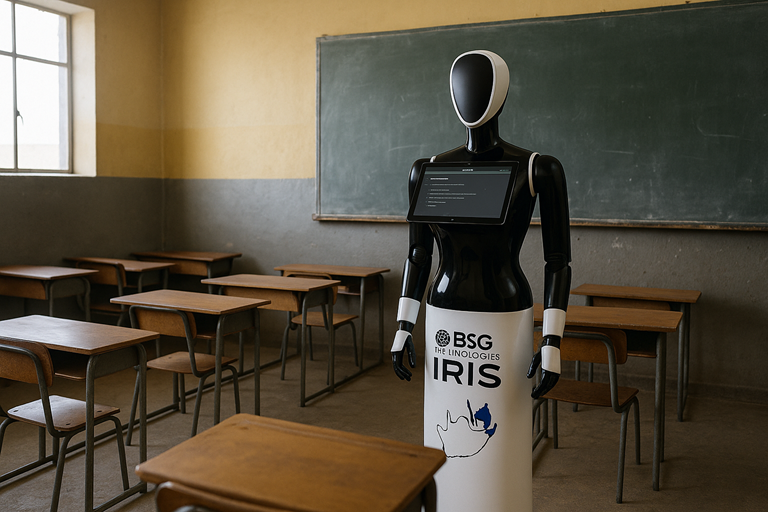
South Africa has taken a bold leap into the future of learning with the launch of its first artificial intelligence (AI)-powered teaching robot, named Iris. Introduced at a ceremony in Durban on 19 August 2025, the innovation marks a milestone in the country’s efforts to address chronic teacher shortages and improve access to quality education across all 11 official languages.
The launch, hosted by Deputy Minister of Science, Technology and Innovation Nomalungelo Gina, celebrated not only the potential of AI in education but also the role of women in shaping Africa’s digital future.
“Iris is not just a robot, it’s a symbol of what our nation can achieve when we invest in home-grown talent,” said Ms Gina. “We must not simply join the global AI revolution; we must lead it.”
The Idea Born in the Classroom
Iris was conceived by KwaZulu-Natal innovator Thando Gumede, founder of BSG Technologies. The idea first took shape while Gumede was teaching maths and physical science in a rural school, where she saw first-hand how limited resources and a shortage of qualified teachers held back learners’ potential.
Determined to find a solution, Gumede combined her background in digital innovation with her passion for education. Her creation, Iris, can teach subjects from grade R to university level, and crucially, it can do so in all of South Africa’s official languages.
Powered by advanced natural language processing and emotional recognition, Iris interacts with students in real time using voice rather than text to explain complex concepts in simple, relatable ways. “My dream is to see Iris in every classroom, especially in rural areas where teachers and learning materials are scarce,” Gumede said.
Bridging the Gap, Not Replacing Teachers
While some have raised concerns about technology replacing educators, the Department of Basic Education has been quick to reassure the public that Iris is designed to support, not supplant, human teachers.
“Technology is not our competitor; it’s our collaborator,” said Mbongiseni Mazibuko, Deputy Director-General for Curriculum Management and Delivery. “Iris will help teachers personalise learning, especially in resource-strapped schools. Our goal is to upskill educators so they can confidently integrate AI into the classroom.”
Deputy Minister Gina echoed the sentiment, adding that AI must be a tool for empowerment. “Science does not discriminate, but society sometimes does,” she said. “That’s why we must create space for women to lead in innovation.”
From Prototype to Policy
The road to bringing Iris to life was not without obstacles. Gumede and her team faced challenges in securing funding, sourcing manufacturing equipment, and convincing stakeholders that AI could work within the South African education system.
Now, with government backing and growing private sector interest, Iris is moving closer to large-scale production. BSG Technologies is currently setting up manufacturing plants and preparing for a national rollout, with Gumede aiming to introduce Iris to classrooms by the end of October.
“Iris doesn’t belong to me, it belongs to all South Africans,” she said. “With the right partnerships, we can transform learning for every child in this country.”
A Glimpse of the Future
During the launch, Iris captivated audiences by explaining accounting principles in both English and isiZulu, a moment that delighted students and teachers alike. “I’ve used AI tools before,” said Grade 9 learner Suhani Singh, “but seeing a robot teach in our languages was incredible. Iris doesn’t replace thinking, it expands what we can do.”
As South Africa positions itself at the forefront of AI-driven education, Iris represents more than a technological breakthrough. It is a vision of a future where every child, regardless of language or location, has the opportunity to learn, grow, and thrive.