LEDs, or light-emitting diodes, are some of the simplest and most useful components you’ll meet when you start exploring electronics. They’re the tiny lights you see everywhere from phone screens to traffic signals, and they’re often one of the first parts beginners learn to work with. Despite their small size, LEDs are clever little devices with behaviour that’s different from ordinary bulbs.
How LEDs Create Light
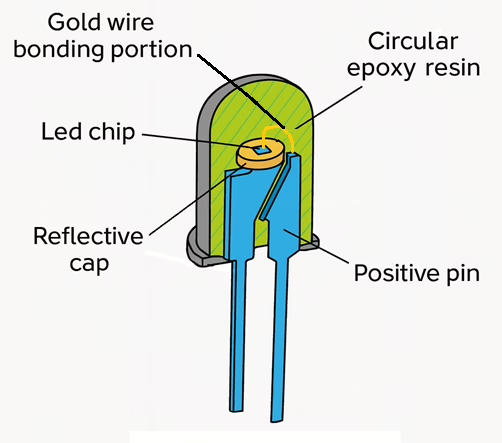
At their heart, LEDs are special electronic components that glow when electricity flows through them. Unlike old-style filament bulbs, they don’t rely on heat to create light. Instead, they use a semiconductor material that releases energy as light when current passes through. This makes LEDs incredibly efficient. They don’t get as hot, they last much longer, and they use far less power.
LEDs Are One-Way Components
One important thing to know early on is that LEDs only let electricity flow in one direction. If you imagine a tiny one-way gate, that’s roughly how an LED behaves. Connect it the right way around and it lights up instantly. Connect it the wrong way and nothing happens.
Finding the Correct Orientation
So how do you know which way is the right way? Most LEDs give you a couple of helpful clues. The simplest one is the leg length. The longer leg is usually the positive side, called the anode. The shorter leg is the negative side, known as the cathode.
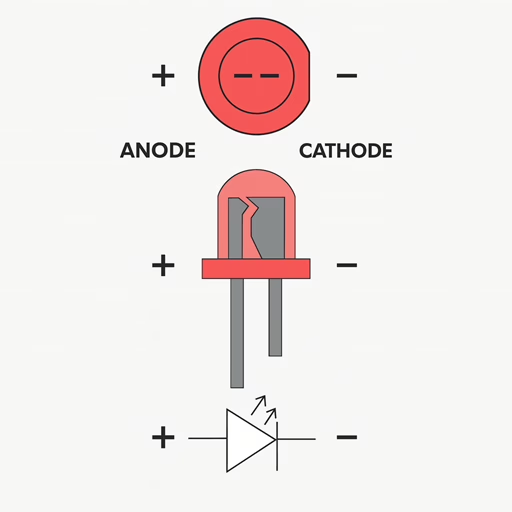
If the legs have been trimmed or are the same length, there’s another detail to look for. Many LEDs have a small flat edge on one side of the plastic body. This flat side marks the negative leg, making it easy to see how the LED should be placed in a circuit.
Why LEDs Need a Resistor
Although LEDs are efficient, they can be surprisingly sensitive. They like low currents, and giving them too much power can cause them to burn out quickly. That’s why almost every LED you’ll use needs to be paired with a resistor. The resistor limits the current, protecting the LED and ensuring it lights safely without damaging itself or your circuit.
Different LED Types
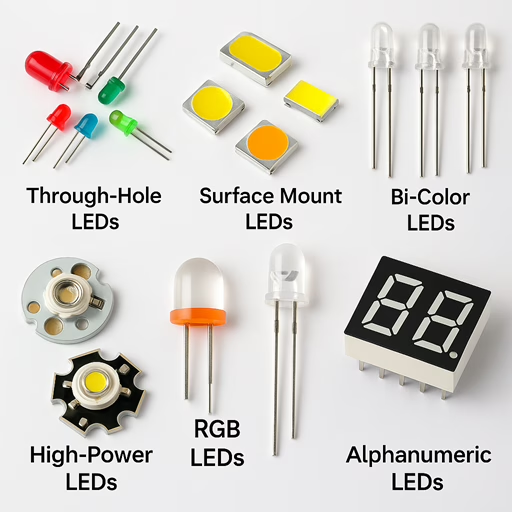
LEDs come in a huge range of colours and shapes. The classic 5 mm round LED is great for learning, but there are many others too. You’ll find surface-mount versions the size of a grain of rice, bright multi-colour LEDs, and even RGB LEDs that can mix red, green, and blue to create millions of shades. No matter the design, they all rely on the same basic principle of turning electrical energy into light.
Trying Your First LED Circuit
When experimenting with LEDs for the first time, a simple circuit is all you need. A battery, a resistor, and an LED will show you how current flows and how components work together. Watching that tiny light turn on is often the moment electronics clicks for people, and it’s a small glow that opens the door to much bigger projects.
Why LEDs Are a Great Starting Point
LEDs are a perfect starting point for beginners. They’re safe, visual, reliable, and endlessly useful. Once you understand how to use them, you’ll spot them everywhere and start to appreciate just how much of the modern world depends on these tiny glowing helpers.