If you want to understand how microcontrollers and robots work, it helps to look at the simple principles that sit underneath everything. Every circuit, from a flashing LED to a full robot, depends on three key ideas: voltage, current and resistance.
What Is Voltage?
Voltage is electrical potential. It is the energy difference that encourages charges to move. Think of it as the driving force behind every electronic action. Microcontrollers rely on stable voltages so their internal logic and communication signals stay reliable.
What Is Current?
Current is the movement of electrical charge. Nothing happens in a circuit until current flows. Motors spin because current moves through their coils, and sensors produce useful signals because changes in the physical world affect the current they let through.
What Is Resistance?
Resistance describes how easily current can move through a material or component. It is what allows circuits to be shaped and controlled. By increasing or reducing resistance, we can make a circuit behave in predictable, repeatable ways.
Popular Electronic Components
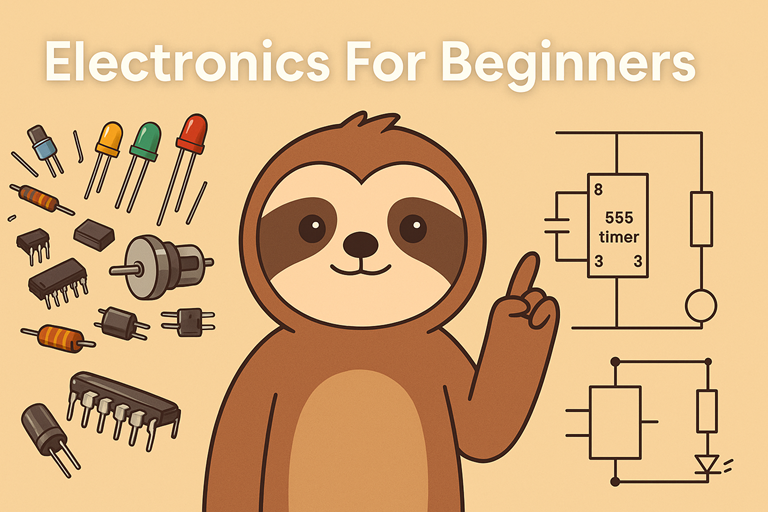
When you start building circuits, you will quickly come across a handful of components that appear everywhere.
Resistors
These control the amount of current flowing in a circuit. They protect LEDs, shape sensor signals and help divide voltage levels.
Capacitors
Capacitors store and release electrical energy, kind of like a battery. They smooth power supplies, help timing circuits and filter noise in microcontroller systems.
LEDs
Light Emitting Diodes convert electrical energy into light. They are widely used as indicators and often the first component beginners learn to control.
Transistors
Transistors act as switches or amplifiers. They allow a tiny signal from a microcontroller pin to control a motor, relay or other higher power device.
Integrated Circuits (ICs)
These are tiny electronic systems packed into one chip. Popular examples include the 555 timer, motor drivers and logic chips used to handle signals.
How These Principles Work Together
Voltage, current and resistance always influence one another. This relationship allows engineers to design circuits that behave consistently. It also ensures that sensors, microcontrollers and motors all receive the right electrical conditions.
Why This Matters for Microcontrollers and Robotics
Inside any microcontroller based robot, you will find these ideas at work. Power circuits keep the voltage steady. Input circuits turn small changes in voltage or current into digital data. Output circuits boost tiny signals so they can drive motors or LEDs safely.
Bringing It All Together
Robotics and embedded systems might seem complicated, but they are all built on a small set of elegant principles. Voltage provides potential, current creates movement and resistance shapes behaviour. Once you understand these basics and the common components involved, the rest becomes far easier to explore and experiment with.