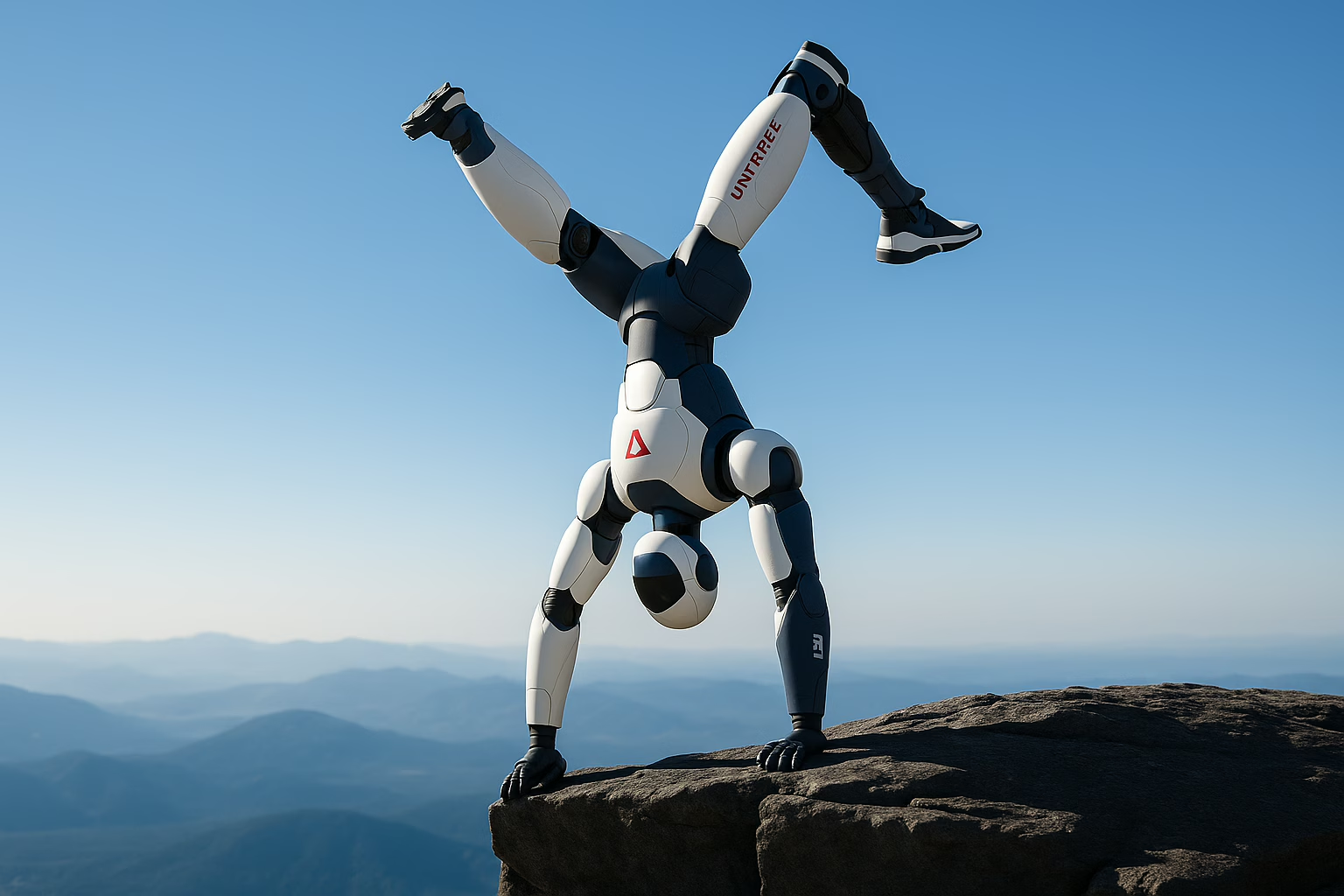
China’s Unitree Robotics has unveiled its latest humanoid, the R1, with a starting price of just $5,900 (£4,600), a fraction of the cost of most humanoid robots on the market.
The low-cost design could help bring humanoid robotics out of laboratories and into classrooms and small research teams around the world.
Compact, capable, and surprisingly agile
Standing at 1.21 metres tall and weighing about 25 kilograms, the R1 is roughly the size of a small child. Despite its compact frame, it can move with remarkable balance and precision, as videos show it performing flips, handstands and boxing moves.
While such stunts attract attention online, they also highlight Unitree’s expertise in motion control. The company has a strong background in legged robots, having produced a series of agile quadrupeds used in both research and industry.
The R1 features up to 40 degrees of freedom, depending on configuration, and comes with an eight-core processor. An educational version can be fitted with NVIDIA’s Jetson Orin AI module, enabling advanced vision and voice processing.
Bringing costs down
Unitree says it has kept prices low by developing and manufacturing almost everything in-house, from motors to gear systems.
The firm’s previous humanoid, the G1, cost around $16,000, meaning the R1 is less than half the price.
“Our core components, including motors and reducers, are independently developed and produced in-house,” a company spokesperson told The Robot Report. “With large-scale production, we’ve been able to achieve better cost control.”
Founded in 2016 and now valued at around 12 billion yuan (£1.3 billion), Unitree has quickly become one of China’s best-known robotics firms. The R1 reflects its growing ambition to make humanoid platforms both useful and accessible.
For learning, not yet labour
Unlike some Western competitors such as Boston Dynamics or Agility Robotics, the R1 is not fully autonomous. It can be remotely operated or programmed for semi-scripted routines.
That makes it more suited to education and research than to commercial deployment. Its standard version lacks dexterous hands, though an optional pair is available for the educational model. Battery life sits at about one hour per charge.
According to robotics analyst Dr Jia Hao of Zhejiang University, this is a sensible step.
“It’s better to think of R1 as a teaching tool,” she says. “It gives students and engineers an affordable way to experiment with AI models, sensors and locomotion, things that were once limited to million-dollar labs.”
Managing expectations
Unitree’s launch video ends with a warning that current robots are still limited, a rare dose of realism in an industry often dominated by hype.
The company acknowledges that humanoids capable of domestic chores or factory work are still years away. “Global commercial adoption will take some time,” it said in a recent statement.
That honesty, experts say, helps build credibility at a time when public expectations of humanoid robots are running high.
A step toward everyday robotics
What the R1 may lack in autonomy, it makes up for in potential. Its open-source compatibility and low price could make it a new standard platform for AI and robotics research.
Dr Hao believes this accessibility could accelerate innovation.
“When more people can afford to experiment, breakthroughs come faster. The R1 could do for humanoid robotics what the Raspberry Pi did for computing education.”
For now, Unitree’s R1 is less a household helper than a stepping stone, an agile, affordable platform that might just bring the dream of everyday humanoid robots a little closer to reality.