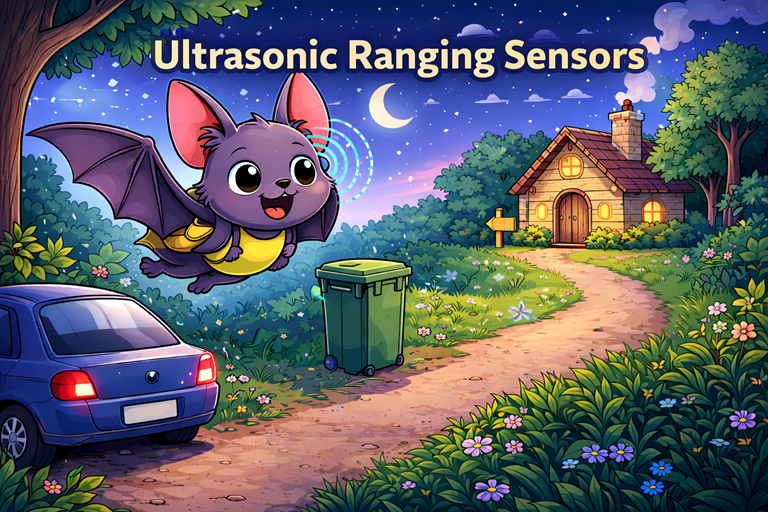
Ultransonic ranging sensors are quietly doing important work all around us. They help cars park safely, guide robots through warehouses and allow simple electronics projects to sense the world around them. But how do ultransonic ranging sensors work, and why are they designed the way they are?
What is an ultransonic ranging sensor
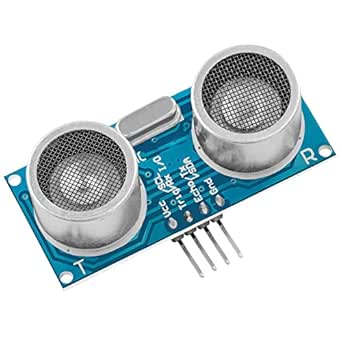
An ultransonic ranging sensor measures distance using sound. It sends out a short burst of high frequency sound, listens for the echo and calculates how far away an object is based on how long the sound takes to return.
The principle is similar to how bats navigate or how ships use sonar, but scaled down into a small and affordable electronic module.
Physical construction of ultransonic modules
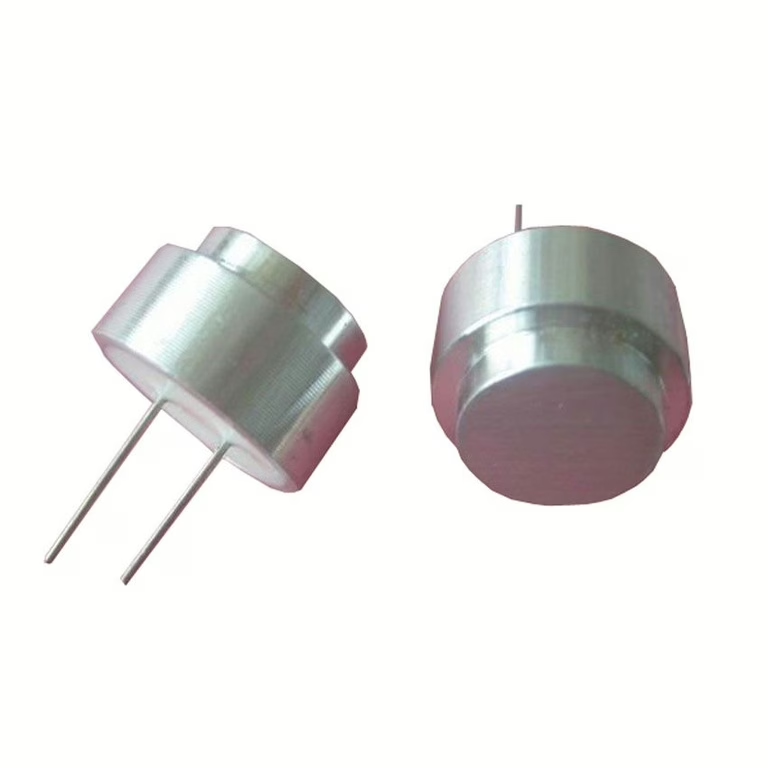
Most ultransonic ranging modules contain two circular metal components that look a bit like small speakers. These are piezoelectric transducers. One acts as a transmitter and the other as a receiver.
When an electrical signal is applied, the transmitting transducer vibrates and produces sound waves. The receiving transducer vibrates when reflected sound waves hit it, generating a tiny electrical signal that the sensor electronics can measure.
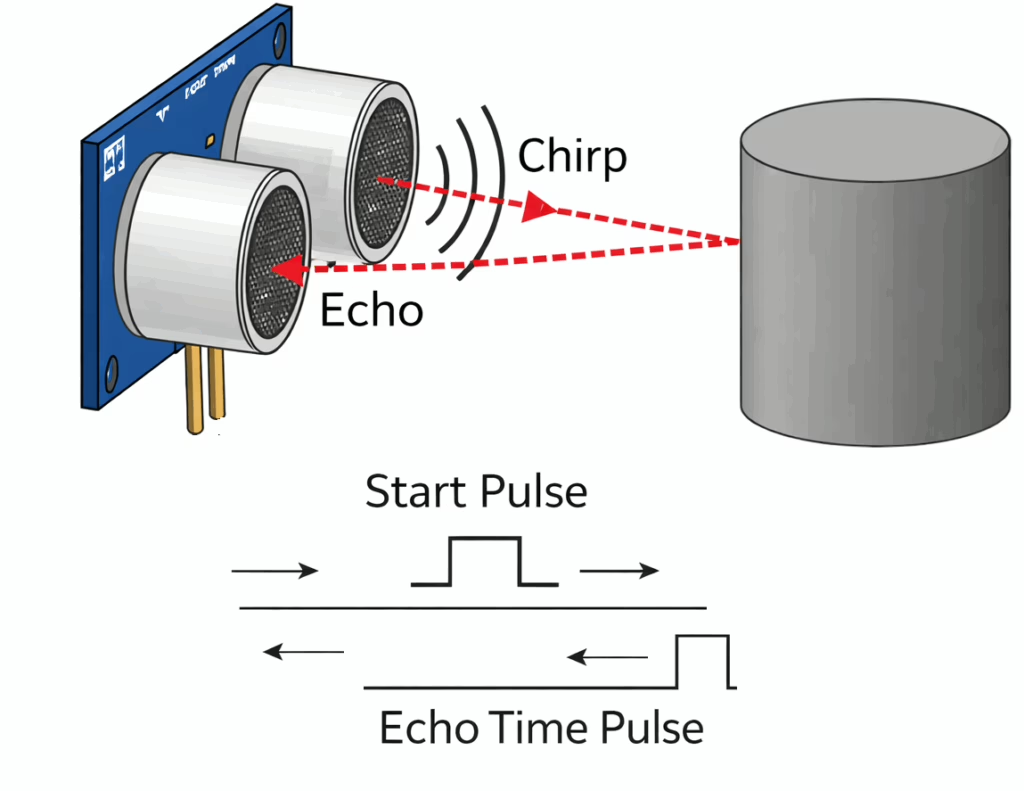
The module also includes control circuitry that handles timing, signal amplification and communication with a microcontroller or computer.
Why ultransonic sensors use high frequencies
Ultransonic sensors typically operate at around 40 kilohertz. This frequency is well above the range of human hearing, which avoids audible noise and interference.
Higher frequency sound waves have shorter wavelengths, which makes them better at detecting smaller objects and gives more precise distance measurements. At the same time, 40 kilohertz travels well through air without being absorbed too quickly, making it a practical balance between range and accuracy.
How distance is calculated
The sensor measures the time taken between sending the sound pulse and receiving the echo. Since the speed of sound in air is known, roughly 343 metres per second at room temperature, the distance can be calculated.
The sound travels to the object and back again, so the measured time is halved to find the one way distance. This simple calculation is fast, reliable and easy to implement in both hardware and software.
How accurate are ultransonic ranging sensors
Accuracy depends on sensor quality and environmental conditions. Low cost modules can usually measure distances from a few centimetres up to four metres with an accuracy of about one to three millimetres under ideal conditions.
Temperature, air movement and the surface of the target object can all affect performance. Soft or angled surfaces may reflect less sound, while temperature changes alter the speed of sound slightly.
Different types of ultransonic sensors available
There are basic single beam ranging modules commonly used in education and hobby electronics. Industrial ultransonic sensors are more robust, sealed against dust and moisture and designed for factory environments.
Some advanced sensors use multiple transducers or sweeping beams to detect object shape and position. Others are tuned for liquid level measurement or short range precision sensing.
Why ultransonic sensors remain popular
Ultransonic ranging sensors are inexpensive, simple to use and safe. They work in darkness, are unaffected by colour and require far less processing power than cameras or lidar.
For engineers, educators and developers alike, they remain one of the most accessible ways to add spatial awareness to machines and devices.