A brain implant developed by Neuralink has enabled a man who lost the ability to speak to communicate again, offering new hope for people living with severe neurological conditions.
Kenneth Shock, who has Amyotrophic Lateral Sclerosis, received the company’s experimental N1 chip in January 2026 as part of its VOICE clinical trial. ALS is a progressive disease that damages motor neurons, gradually taking away a person’s ability to move and speak.
In a demonstration shared by Neuralink, Mr Shock is able to form sentences in his mind, which are then translated into a computer generated voice. The development marks a significant step forward in efforts to restore communication for those affected by paralysis and speech loss.
How the technology works
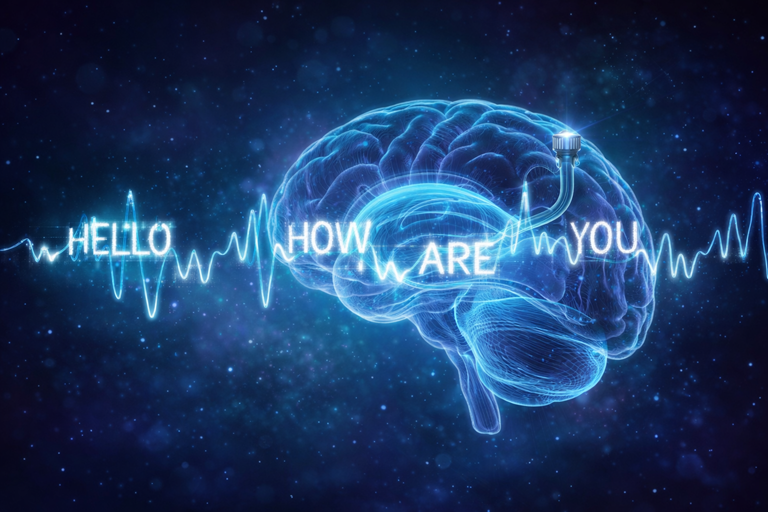
The implant records neural activity from regions of the brain involved in speech. In a healthy person, these signals would travel to the muscles of the mouth and throat. In ALS patients, that pathway is disrupted.
Neuralink’s system bypasses this by capturing brain signals directly and matching them to phonemes, the smallest units of speech. Software then reconstructs these into words and sentences that can be spoken aloud.
Training the system takes place in stages. Mr Shock initially spoke sentences aloud, then progressed to silently moving his lips. Eventually, the system was able to interpret speech based purely on imagined words, without any physical movement.
Researchers say the long term aim is to achieve near real time communication, allowing users to express themselves as quickly as natural speech.
Impact on patients and families
The loss of speech is often one of the most isolating aspects of ALS. Being able to communicate again, even through a digital voice, can significantly improve quality of life.
For Mr Shock, the technology has helped restore a sense of independence and connection. It also allows him to communicate more naturally with loved ones, reducing the emotional strain that often comes with progressive conditions.
For families, this kind of innovation can help maintain relationships and shared experiences that might otherwise be lost as the disease advances.
Mr Shock’s partner said the procedure itself was smooth, with him returning home the day after surgery, followed by a structured training process to adapt to the system.
Work still needed before wider use
Despite the breakthrough, the technology remains in its early stages. Current systems can introduce delays between thought and speech, and require extensive training to function effectively.
Engineers are working to improve both the speed and accuracy of decoding. This includes increasing the number of sensors and refining machine learning models to better interpret neural signals.
The VOICE clinical trial is ongoing, and wider availability will depend on further testing, regulatory approval, and long term safety data. Experts suggest it may take several years before such systems are widely accessible.
Risks and ethical considerations
As with any brain implant, the procedure carries medical risks, including infection and complications from surgery.
There are also broader ethical questions around privacy and data security. Brain computer interfaces rely on highly sensitive neural data, raising concerns about how that information is stored and used.
Questions around access and cost may also shape how widely the technology can be adopted in the future.
For now, the case highlights both the promise and the challenges of emerging neurotechnology. While still experimental, it offers a glimpse of a future where losing the ability to speak may no longer mean losing the ability to be heard.