A team of researchers from China and Brazil has developed a robot dog capable of detecting one of the world’s most destructive pests, the red imported fire ant. The innovative system, powered by artificial intelligence, could transform how experts track and control invasive species.
A Growing Global Threat
Red imported fire ants, or RIFAs, are known for their aggressive behaviour and painful stings. Originally from South America, they spread to the United States in the 1930s and have since invaded parts of Asia and Europe. These ants damage crops, harm wildlife, and cause costly infestations.
Eduardo Fox, a postdoctoral researcher at the State University of Goiás in Brazil, explained why identifying nests is so difficult. “Fire ant nests are challenging for untrained personnel to locate, and searching large areas under the hot sun is exhausting. A robot could automate the process and work at any time of day,” he said.
The Rise of the CyberDog
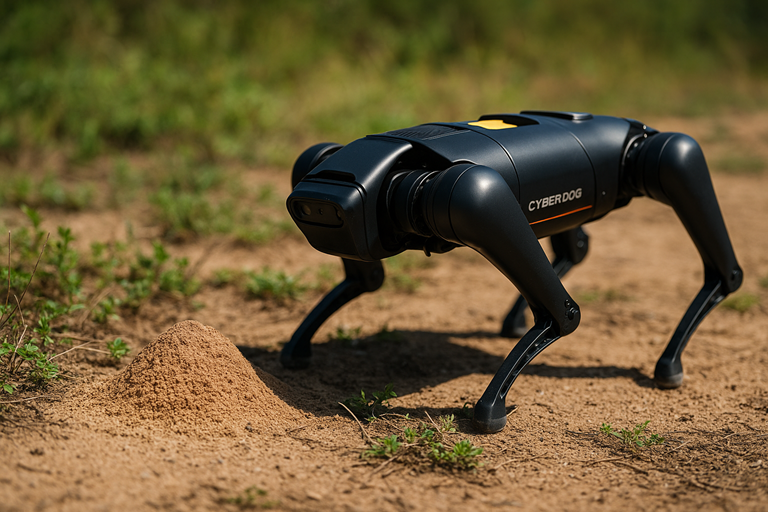
The project centres around Xiaomi’s CyberDog, a four-legged robot equipped with an AI model trained on more than 1,100 images of fire ant nests. The robot analyses the ground for signs of activity and has achieved a detection accuracy rate of over 90%.
To test its effectiveness, the researchers compared the CyberDog’s performance with that of trained human inspectors. The results were striking: the robot found three times more nests and did so with greater precision.
Training a Robot to Think Like a Dog
Unlike real detection dogs that rely on scent, the CyberDog uses vision and behaviour analysis. It was programmed to press its front paw onto potential nests. When an active fire ant mound is disturbed, the ants rush out aggressively, confirming the nest’s presence. This behaviour helps the AI distinguish active mounds from abandoned ones or those belonging to other species.
Dr Hualong Qiu, from the Guangdong Academy of Forestry, explained how the trials worked. “Students trained as quarantine inspectors searched for nests in a test field. The AI robot was then sent into the same area. The CyberDog consistently outperformed the human team,” he said.
Overcoming Technical Challenges
Despite its success, the CyberDog project still faces hurdles. The robot’s battery lasts only about 30 minutes, limiting its use over large areas. Cost is another issue. As researcher Zheng Yan from Lanzhou University noted, “It is currently more expensive to use the robot system than traditional methods, but production costs should fall over time.”
Beyond Detection: Raising Awareness
The researchers believe the CyberDog could do more than detect pests. By drawing public attention, it may also raise awareness about the risks of invasive fire ants. “Robot dogs attract attention wherever they go,” said Yan. “Most people are unaware of the danger these ants pose in public spaces. Seeing a robot at work could help change that.”
The study, published in Pest Management Science, marks a step forward in combining robotics and ecology. As technology advances, the team hopes to deploy fleets of AI-driven robots to monitor and manage pests across affected regions, reducing the environmental impact of traditional control methods.