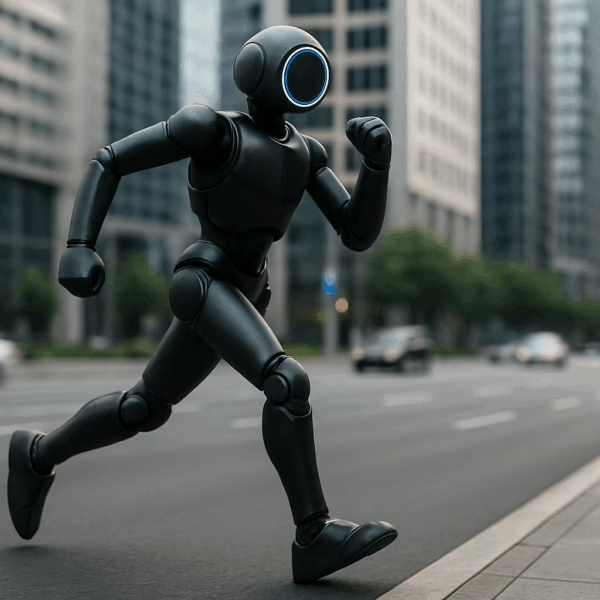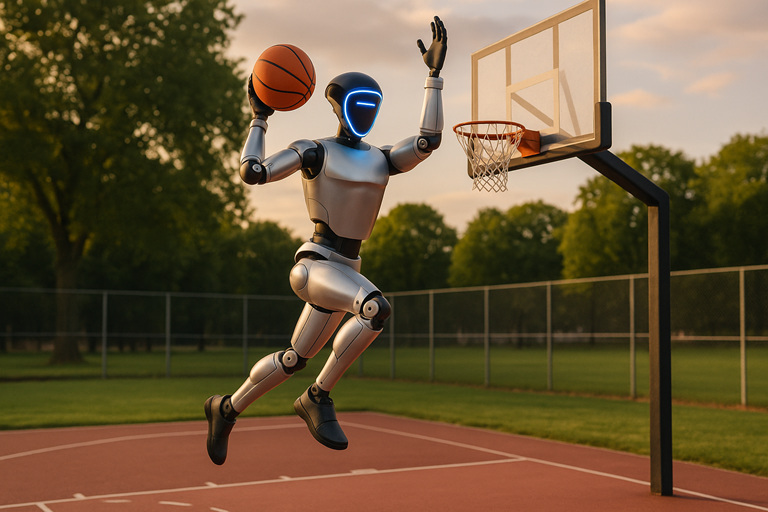
A humanoid robot in Hong Kong has been filmed dribbling, pivoting and scoring layups with striking human likeness, in what researchers say is the first real world basketball demonstration by a robot. The Unitree G1, nicknamed Little Potato, was trained by a team at the Hong Kong University of Science and Technology using a powerful imitation learning system that teaches machines to copy human and ball movements.
A robot with surprising skills
Footage shared by PhD student Yinhuai Wang shows the compact robot effortlessly moving across a small court. It bounces the ball with both precision and rhythm, lines up jump shots, and at one point pivots on a single foot to avoid Wang’s attempt to block it. The researcher jokingly declared himself the first person to ever block a humanoid robot. Supporters online hailed the milestone while others teased that robots may master basketball before they learn household chores.
The G1 has already drawn global attention for its agility. Previous demonstrations showed it performing kung fu routines and even absorbing a full force dropkick from an adult without losing stability. Yet its latest performance marks a turning point, demonstrating not just balance but judgement, control and fluidity.
Inside the SkillMimic system
At the heart of the achievement is SkillMimic, an artificial intelligence system that learns basketball motions by analysing human demonstrations captured on video or through motion tracking suits. These movements are then refined through vast simulated practice sessions. The unit trained on billions of virtual samples before attempting shots in the real world.
The approach is designed to cope with an unavoidable problem in robotics research. Human demonstration data is rarely perfect. It is often noisy, incomplete and lacking in the smooth transitions a robot needs to perform long sequences of actions. SkillMimic overcomes this by stitching together similar poses across different movements, allowing it to invent transitions never seen in the raw recordings. A further technique randomises starting positions during training so the robot becomes skilled at recovering from mistakes.
Researchers say this combination allows a single learned policy to manage a wide range of basketball actions, switching smoothly between dribbling, shooting, layups and ball pickup.
Obstacles on the road to robot sport
The team faced several technical hurdles. Real world demonstrations provided limited and messy data. Early attempts struggled to teach robots to maintain control of the ball during long sequences. Traditional reinforcement learning methods faltered because they could not combine body and object motion with enough accuracy.
Hardware limitations added further challenges. The G1 needed to perform rapid shifts of weight, maintain balance after collisions, and manage complex arm and leg coordination while manipulating a moving object. All of this had to be learned in simulation before being deployed safely on the real robot.
Towards a future of robotic athletes
While the researchers emphasise that the robot is far from competing in real matches, the demonstration marks steady progress. Online commentators have already imagined dedicated robot basketball leagues. For now, the HKUST team plans to expand SkillMimic so that robots can handle more objects, learn from smaller datasets and eventually attempt full games outside the lab.
Whether or not humanoids ever reach professional fitness, Little Potato’s layup may be remembered as the moment robot athletics truly took off.