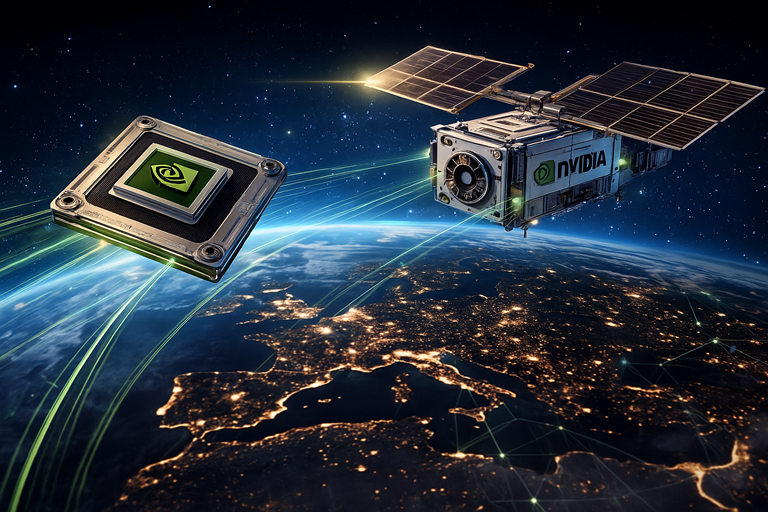
A US startup is taking a bold step towards moving some of the world’s heaviest computing workloads off the planet. Starcloud, part of Nvidia’s Inception programme for early stage companies, has launched a satellite carrying one of Nvidia’s most powerful GPUs. It is the first step in its plan to create large scale data centres in orbit.
A New Frontier for Computing
The Starcloud 1 satellite, roughly the size of a small fridge, lifted off in early November onboard a SpaceX Falcon 9. Inside sits Nvidia’s H100 GPU, a chip around 100 times more powerful than any previously flown in space. For now, it will test how advanced AI systems cope with the harsh conditions of orbit. The long term goal is far more ambitious. Starcloud hopes to build a five gigawatt orbital data centre, powered by vast solar panels stretching around four kilometres across.
The company argues that the vacuum of space offers natural advantages over the Earth. Sunlight is available almost constantly, meaning solar power can be generated around the clock without the need for battery storage. The cold of deep space also serves as an infinite heat sink, removing the need for water heavy cooling systems used by ground based data centres.
Environmental Benefits and Performance Gains
Data centres are responsible for rapidly increasing levels of electricity and water consumption. With demand for AI processing rising, analysts forecast that global data centres could use as much electricity as Japan by 2030. Starcloud believes shifting new facilities off planet could ease the strain.
In orbit, solar panels generate as much as eight times more power than they would on Earth. With no need for freshwater cooling or fossil fuel backup systems, Starcloud estimates up to 10 times lower energy costs across a data centre’s lifetime. Nvidia says this offers a potential breakthrough in reducing greenhouse gas emissions, avoiding land use and preserving water supplies.
Early Applications in Orbit
Starcloud’s first mission will process data from synthetic aperture radar satellites. These sensors produce huge volumes of imagery which normally take hours to download back to Earth. Processing the data in orbit allows the satellite to beam back only key insights, such as the location or movement of a ship, reducing the downlink from gigabytes to just a few kilobytes.
Future uses could include near real time wildfire detection, crop monitoring or weather prediction. The company also plans to run large language models in orbit, using the Nvidia H100 and eventually the Blackwell platform for even greater performance.
Challenges and Open Questions
While the potential benefits are significant, several obstacles remain. Launching heavy infrastructure into orbit is costly, even with falling prices from rockets such as SpaceX’s Starship. Maintenance is also a major concern. Satellites cannot simply be visited by engineers, so systems must be robust enough to operate autonomously for years. Remote software updates and modular hardware that can be replaced by future spacecraft will be essential.
Connecting users to orbital data centres also brings challenges. Although satellites can process information quickly, sending and receiving large volumes of data will depend on high capacity communication links.
What Comes Next
Starcloud is already planning a second satellite, expected to be ten times more powerful and fitted with Nvidia’s Blackwell GPUs. A larger 100 kilowatt system is targeted for launch in 2027, with the company aiming for a 40 megawatt orbital data centre by the early 2030s.
If successful, the concept could reshape the world’s digital infrastructure. Some believe that within a decade most new data centres could be built in space. Others warn that practical and regulatory hurdles will take much longer to resolve. For now, Starcloud’s latest mission marks a striking first step in a journey that could redefine how and where the planet’s data is processed.