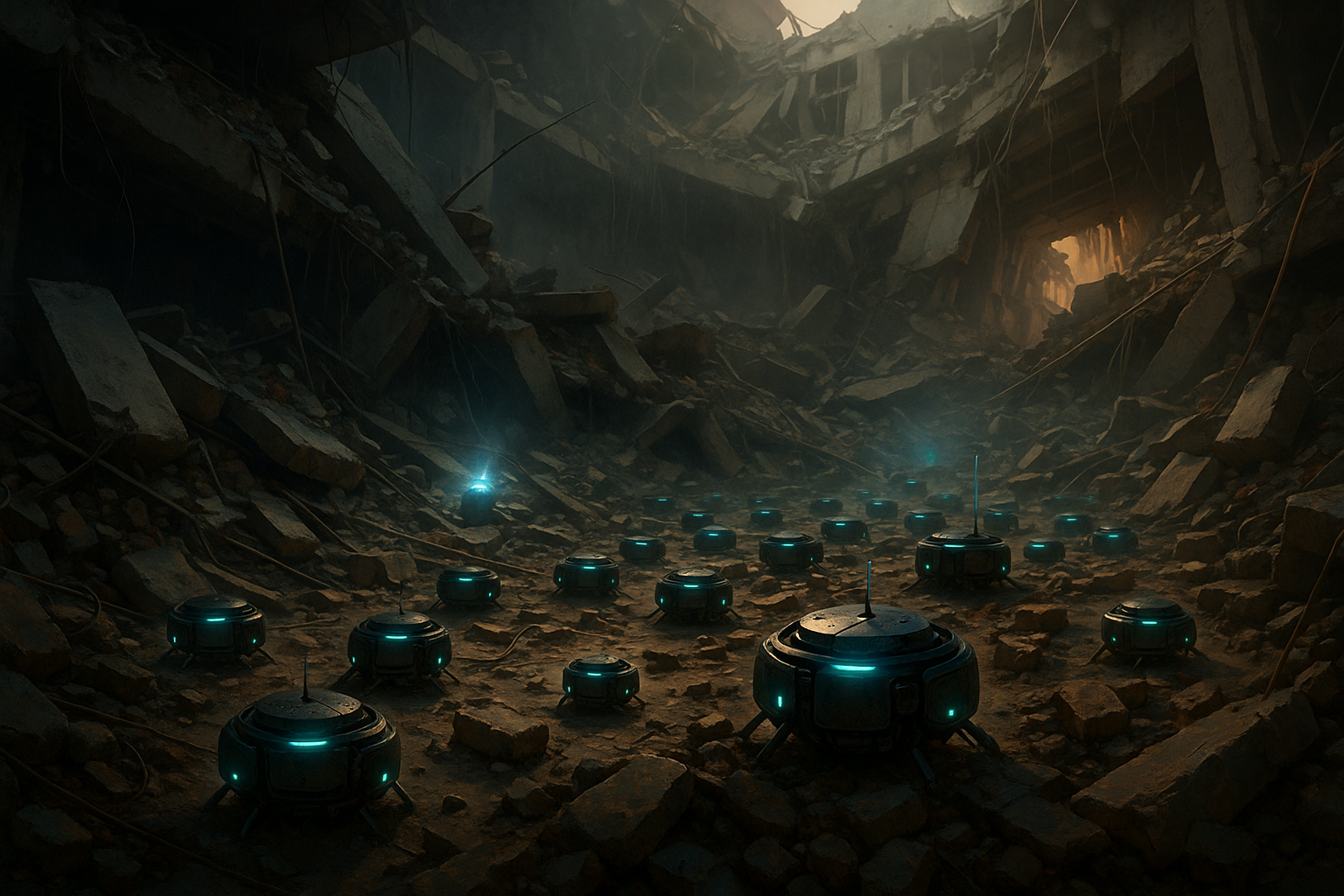
In a lab at the University of Sheffield, hundreds of small wheeled robots scuttle across the floor, flashing lights as they weave around one another. There is no single robot in charge, yet somehow, together, they make decisions, form shapes, and complete tasks.
This is swarm robotics, a field inspired by nature’s master collaborators: ants, bees and termites. Just as an ant colony can build intricate nests without a leader, scientists are teaching robots to work together using simple rules and local communication. The result is collective intelligence, with many small machines acting as one.
Why Build a Swarm Instead of One Super Robot?
It might seem logical to build a single, highly capable robot. But researchers are discovering that many small, simple robots can often outperform one complex machine.
Swarms are scalable and resilient; if one unit fails, the others adapt and carry on. They are cheaper to build, easier to replace, and can cover larger areas, ideal for search and rescue missions, environmental monitoring or exploring hazardous terrain.
“Nature shows us that complexity can emerge from simplicity,” says Dr Sabine Hauert, a robotics researcher at the University of Bristol. “Swarms can do more together than one robot can do alone.”
How Collective Intelligence Works
Unlike traditional robots, swarms do not rely on a central brain. Each robot follows a set of simple local rules such as moving towards light, avoiding collisions, or following the nearest neighbour. Through countless small interactions, complex group behaviour emerges.
But getting swarms to behave reliably is tricky. Communication between units can be noisy or delayed. Small errors can cascade through the group, and ensuring that the swarm always does what humans intend is one of the biggest challenges in the field.
Researchers at the University of Manchester have developed open-source, low-cost Mona robots for testing these systems in large groups. Others, like the Natural Robotics Lab in Sheffield, have created swarms of up to 600 robots to study teamwork, self-assembly and decision-making.
The Challenges Ahead
Building large swarms raises practical and ethical questions.
How do you ensure thousands of autonomous machines behave safely? What happens if communications fail? And as swarms become more capable, where should the line be drawn between human control and machine autonomy?
Hardware remains another obstacle. Each robot must be simple enough to mass-produce, but powerful enough to sense, move and communicate effectively. Power management, navigation, and avoiding interference between robots all become harder as the numbers increase.
A Future of Many Hands
Despite the hurdles, the potential applications are vast. Robotic swarms could one day inspect infrastructure, pollinate crops, map disaster zones, or even assemble structures in space.
Swarm robotics challenges how we think about intelligence and design. Instead of building one machine to rule them all, we might soon rely on many machines working as one, small, smart, and endlessly adaptable.
As one researcher put it, “The future of robotics may not lie in a single genius robot, but in a crowd of tiny helpers, each doing its part.”