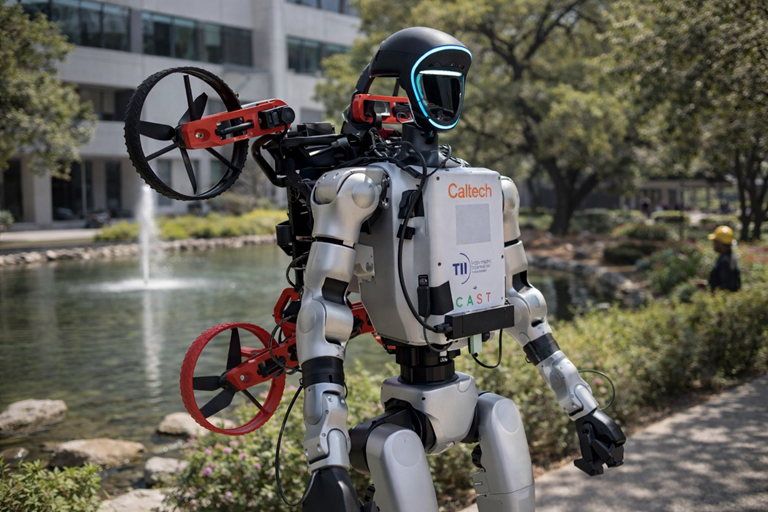
Researchers in California have unveiled the X1 Robot Duo, a new robotic system that brings together a walking humanoid robot and a transforming drone. Developed at the California Institute of Technology, the X1 Robot Duo is designed to operate in environments that are too dangerous or complex for people, such as disaster zones or damaged buildings.
The system combines two very different machines into a single coordinated unit. One robot walks on two legs, while the other can drive on wheels or fly through the air. Together, the X1 Robot Duo shows how different forms of movement can be blended to solve real world problems.
How the X1 Robot Duo works
At the centre of the X1 Robot Duo is a modified Unitree G1 humanoid robot. Unlike many humanoid machines, it does not simply repeat motions copied from humans. Instead, it plans its own movements and adjusts its walking in response to the terrain around it.
Carried on its back is M4, a morphing robot created at Caltech. M4 can fly like a drone, then fold its rotors to become a wheeled vehicle. This allows the X1 Robot Duo to move efficiently through tight indoor spaces, across rough ground, or over obstacles such as water.
During a recent campus demonstration, the humanoid robot walked through corridors, doorways and stairs before bending forward to allow M4 to take off. After landing, M4 drove toward a pond and then flew over it, completing a rescue style mission.
Technical challenges and breakthroughs
Building the X1 Robot Duo took three years of research and testing. One of the biggest challenges was balance. Engineers had to ensure the humanoid could walk stably while carrying another robot on its back.
To solve this, the team combined physics based mathematical models with machine learning. This approach allows the robot to learn how to walk based on physical principles, rather than relying on pre recorded human movements. As conditions change, the X1 Robot Duo can adapt its behaviour in real time.
M4 also represents a breakthrough in what researchers call locomotion plasticity. It can switch smoothly between driving and flying, giving the X1 Robot Duo far greater flexibility than single purpose robots.
A global effort behind the X1 Robot Duo
The project was a collaboration between Caltech and the Technology Innovation Institute in Abu Dhabi, with support from researchers at Northeastern University in the United States. Engineers at the Technology Innovation Institute contributed secure onboard computing, allowing the robots to operate autonomously even if communications fail.
Specialists in morphing robot design helped refine M4’s ability to change shape, while sensing experts integrated cameras, lidar and range finders. These sensors help the X1 Robot Duo understand where it is and plan safe routes without human control.
From demonstrations to real world use
For now, the X1 Robot Duo operates in controlled demonstrations. The research team is now focusing on safety critical control, ensuring the robots make safe decisions even when sensors are unreliable.
In the future, systems like the X1 Robot Duo could be used to scout disaster areas, inspect damaged infrastructure, or support emergency responders. By combining legs, wheels and wings, the X1 Robot Duo offers a glimpse of how robots may one day work together to keep humans out of harm’s way.