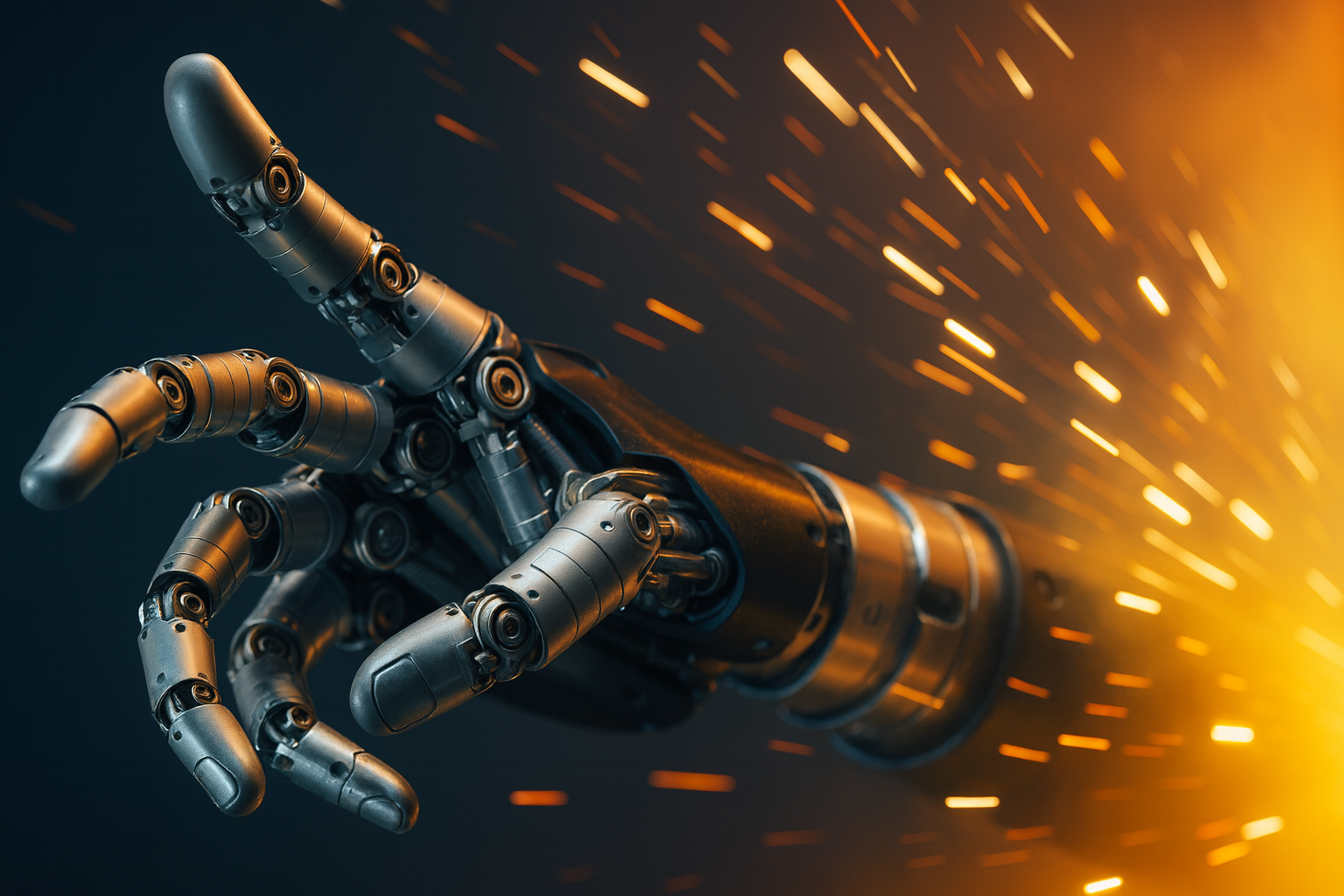
A Shenzhen start up has unveiled a robotic hand it says could challenge established players in humanoid robotics, thanks to a novel approach to finger actuation.
Wuji Tech’s debut product, the Wuji Hand, weighs less than 600g but packs 20 degrees of freedom, four joints per finger, making it one of the most dexterous robotic manipulators on the market. The company claims each unit is tested for at least 300,000 grasp cycles before shipping, with internal tests surpassing one million. These figures position it squarely for industrial use.
Breaking from rivals
Unlike Tesla’s Optimus hand or other tendon based systems, Wuji embeds micro actuators directly into each finger segment. This direct drive architecture removes the need for tendon routing through the forearm, a setup experts say often causes calibration issues and a “sim to real gap” between computer models and physical performance.
“They’re basically turning each finger into a tiny robot,” said robotics analyst Scott Walter, praising the design’s predictability. Hand surgeon Gustav Andersson highlighted its more natural palm shape, though he noted limitations in thumb rotation that still hinder fine motor control.
Performance figures
Promotional tests show the Wuji Hand executing a 5kg two finger pinch and a 20kg power grip, impressive benchmarks for a system of its size. For comparison, many tendon driven hands in research settings struggle with stable lifts above a few kilograms.
While Shadow Robot’s Dexterous Hand is known for its advanced tactile sensors and anatomical accuracy, it is also bulky and expensive. Tesla’s humanoid hands, meanwhile, favour tendon simplicity but trade off predictability. Wuji’s more compact, integrated design could offer a middle ground between performance and cost.
Missing features
For now, Wuji’s base model lacks advanced tactile sensing, relying instead on positional encoders. Experts believe this could be added later via glove like skins. If paired with robust sensing, the direct drive platform could form a strong foundation for future iterations.
Looking ahead
Backed by its parent company Pan Motor, Wuji is betting that vertical integration and a simpler mechanical approach can lower costs in a market where high performance robotic hands often run into six figures. Pricing and availability are yet to be disclosed.
With humanoid robotics accelerating globally, Wuji Tech’s first outing positions it as a credible competitor. If its claims hold up, the Wuji Hand could push the field closer to affordable, human like manipulation, a capability long seen as the missing link in general purpose robots.