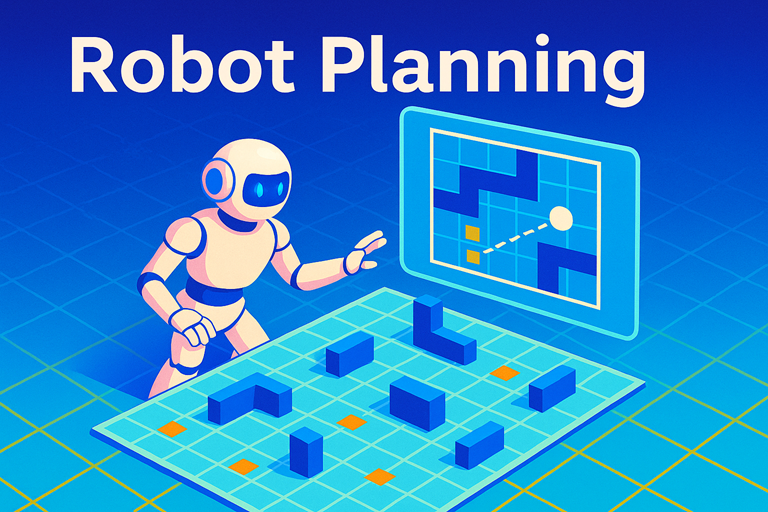
Robots do not just move around aimlessly. They need to understand their surroundings, decide on a route, and move in a controlled way.
To do this, they rely on three key skills:
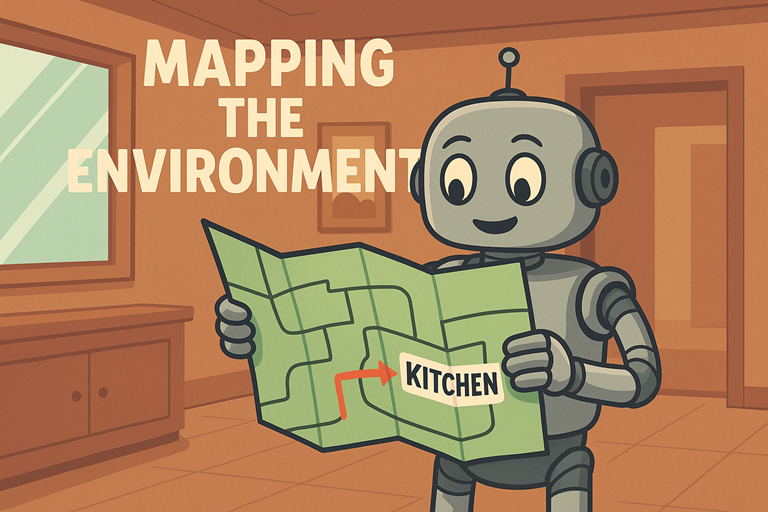
- Mapping: understanding the environment
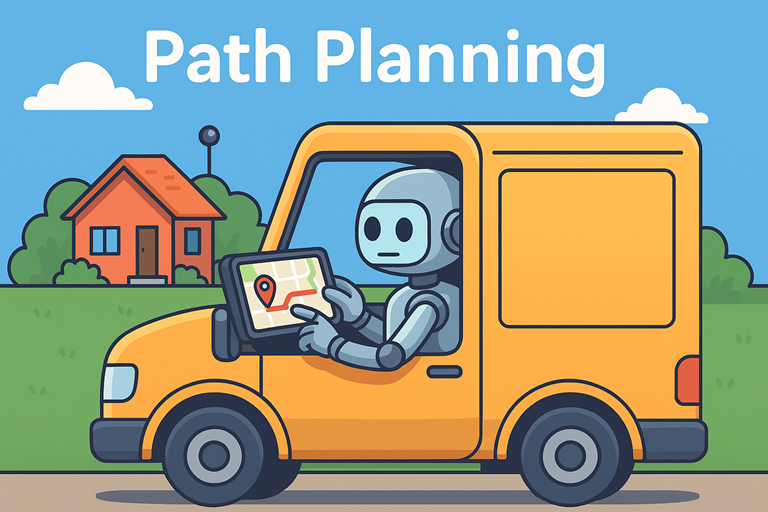
- Path planning: choosing a safe and efficient route
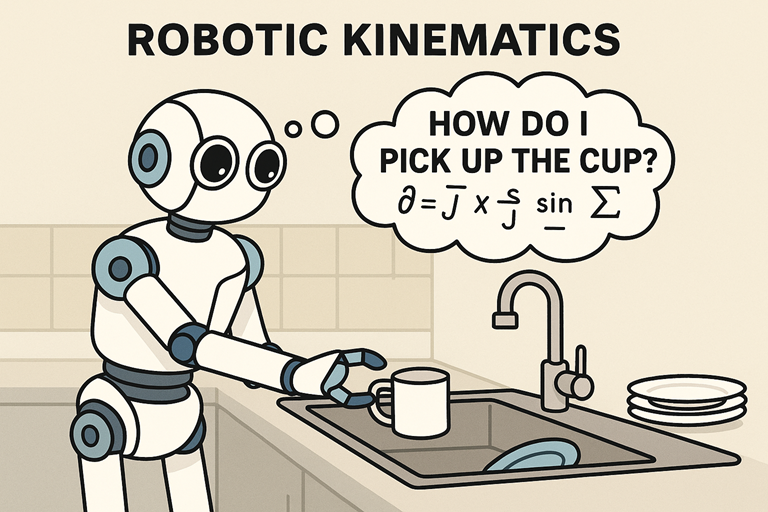
- Kinematics: moving accurately along that route
These three ideas work together to help robots navigate safely and intelligently.
Understanding the Environment
Before a robot can move, it must first know what the world around it looks like.
This process is called mapping. A robot can be given a map, or it can create one itself using sensors, cameras, or lasers.
Types of Maps
There are two main types of maps that robots use.
Discrete maps break the world into small squares, like a grid or chessboard.
Continuous maps describe shapes and boundaries with smooth lines and coordinates.
Most robots use grid based maps, also called occupancy grids. Each square in the grid is marked as either empty, meaning it is safe to move, or full, meaning there is an obstacle.
To save memory, these maps can be stored efficiently using a data structure called a k d tree, which keeps detailed information only where it is needed.
Finding the Best Route
Once a robot has a map, it must decide how to get from its starting point to its destination.
This is called path planning. It helps the robot choose the best route while avoiding obstacles.
Classic Algorithms
Early path planning used mathematical algorithms to find the shortest path.
- Dijkstra’s algorithm, created in 1959, checks all possible routes to guarantee the shortest one. It is very accurate but can be slow.
- A star, developed in 1968, improves on this by using heuristics, which are educated guesses that help the robot focus only on promising directions.
- D star, introduced in 1994, builds on A star, allowing the robot to adjust its route quickly if something changes, such as a new obstacle.
Algorithms like A star are also used in everyday technologies such as video game characters and online map navigation.
Sampling Based Planning
For more complex spaces, robots use randomised or probabilistic methods.
Rapidly Exploring Random Trees, known as RRT, grow a tree of possible paths by connecting random points until the goal is reached.
An improved version called RRT star also refines the tree to find a shorter route.
These methods are common in self driving cars and drones, which must plan routes quickly in changing environments.
Moving Accurately
Mapping and path planning tell the robot where to go. Kinematics explains how it actually moves to get there.
It focuses on the position, speed and motion of the robot’s parts such as its arms or wheels without worrying about the forces involved.
There are two main types.
- Forward kinematics calculates where the end of a robot’s arm will be if the joint positions are known.
- Inverse kinematics works backwards, finding the joint angles needed to reach a specific position.
Kinematics is essential for tasks that require precision, such as welding, surgery, or picking and placing objects in factories.
Key Points to Remember
- Mapping helps robots understand their surroundings.
- Path planning helps them find safe and efficient routes.
- Kinematics ensures they move accurately and smoothly along those routes.
Together, these three areas form the foundation of robot movement, combining sensing, mathematics and motion to create the intelligent behaviour seen in modern robotics.