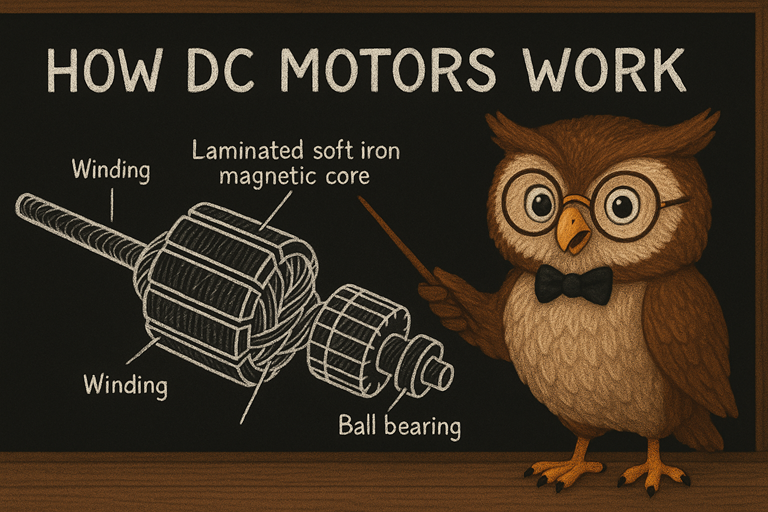
Understanding how dc motors work begins with one essential idea: electricity and magnetism are linked. When they interact in the right way, they create a turning force that makes a motor spin. You don’t need any engineering background to grasp the basics — just a clear picture of what happens inside the motor.
The Heart of the Motor Effect
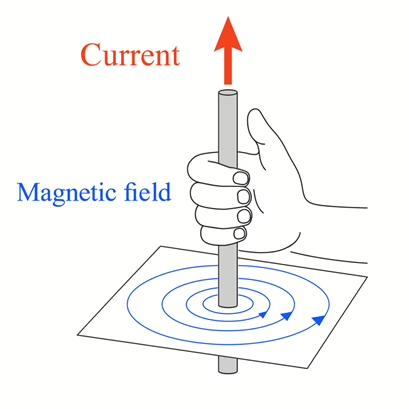
When an electric current flows through a wire, it produces a magnetic field around that wire. This field is invisible, but it wraps around the wire in circular loops. If you place this current-carrying wire inside another magnetic field, the two fields interact. In some places they reinforce each other, and in others they oppose each other. This imbalance creates a push on the wire.
This push is called the motor effect, and it is the foundation of how dc motors work.
Using Magnets to Create Motion
Inside a simple DC motor, the stator provides a steady magnetic field. This usually comes from permanent magnets arranged so that one side of the rotor sees a north pole and the other a south pole. The rotor sits inside this field and contains a coil of wire.
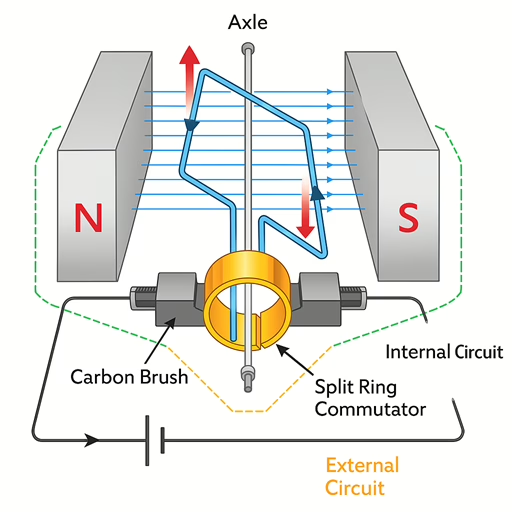
When current flows through the coil, the coil develops its own magnetic field. One side of the coil becomes slightly like a north pole and the other like a south pole. These new poles don’t sit alone — they interact directly with the fixed magnets in the stator. The result is a force on each side of the coil.
Why Forces Appear
To understand the direction of these forces, we use Fleming’s left-hand rule. Hold out your left hand so your thumb, index finger and middle finger are all at right angles:
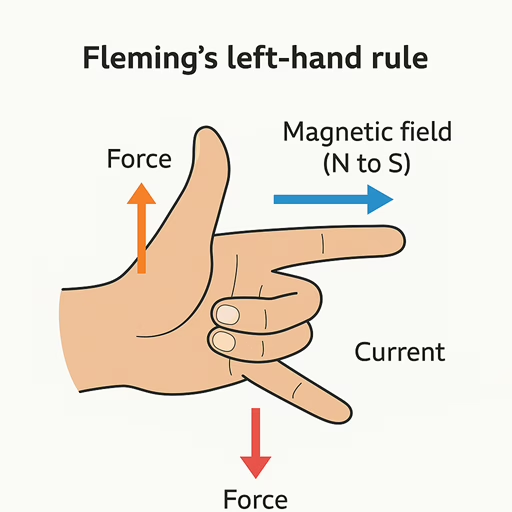
Index finger: direction of the magnetic field (from north to south)
Middle finger: direction of the current in the coil
Thumb: direction of the force acting on the conductor
When the current flows through each side of the coil, the rule shows that one side is pushed up and the other is pushed down. This creates a turning effect known as torque. This torque is what starts the rotor spinning.
What Happens as the Coil Turns
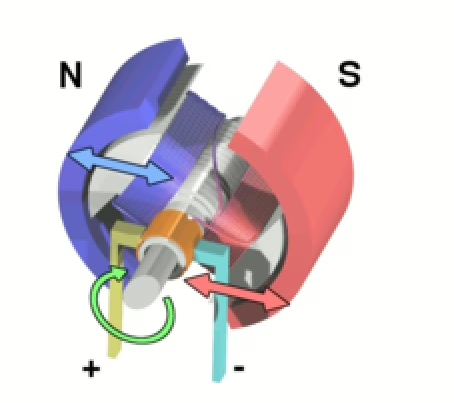
If the coil stayed in one position, the forces would eventually line up in such a way that no turning effect is produced. This would normally stop the motor. But motors use a clever trick to keep the rotation going.
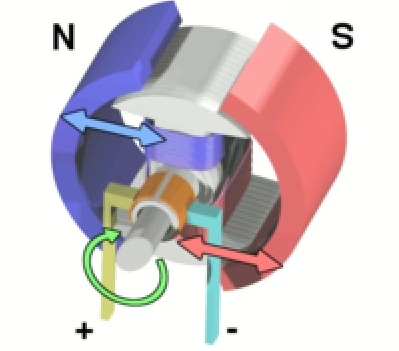
As the coil rotates, it eventually reaches the vertical position, where the force drops to zero because the current flows parallel to the magnetic field. Momentum keeps the coil moving past this point, but the most important part comes next.
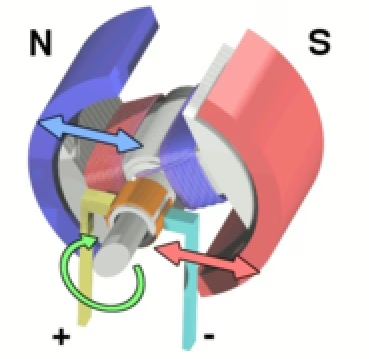
A commutator flips the direction of current every half turn. When the current reverses, Fleming’s left-hand rule shows that the forces reverse too. This means the push on each side is always arranged so the coil continues turning in the same direction. The rotor never loses its turning effect.
Torque and Speed
The strength of the turning force depends on two simple factors:
Stronger current creates a stronger magnetic field around the coil.
A stronger magnetic field produces a larger force.
The result is more torque. This is why increasing the current makes the motor turn harder against a load.
As the motor speeds up, it generates a back voltage called back EMF. This naturally reduces the current and limits the speed. Once again, this behaviour comes straight from the physics of magnetic fields interacting with moving conductors.
Back EMF appears in a DC motor because the spinning coil moves through the magnetic field. As it does, the magnetic flux through the coil constantly changes. This changing magnetic field induces a voltage in the coil, but the induced voltage always pushes against the supply voltage. At low speed the effect is small, so the motor draws lots of current and produces high torque. As the motor speeds up, the changing magnetic field becomes stronger, the induced voltage rises, and the back EMF grows. This reduces the net voltage across the coil and naturally limits the motor’s speed.
The reason this induction happens is the same reason a generator works. Whenever a magnetic field around a coil collapses or changes, it creates a current. In a motor this induced current opposes the supply and becomes back EMF. In a generator the same effect becomes the output voltage. The physics is identical, with a changing magnetic field creating electricity, but in motors it limits the current while in generators it produces useful power.
Bringing the Science Together
At the simplest level, how dc motors work can be reduced to three steps:
- Current in the rotor coil creates a magnetic field.
- That magnetic field interacts with the stator’s magnetic field.
- Fleming’s left-hand rule explains the forces that spin the rotor.
This small chain of interactions — current, magnetic field, force — is the reason electric motors turn. Whether powering a toy car or a conveyor belt, every brushed DC motor relies on the same elegant bit of physics discovered in the 1800s.