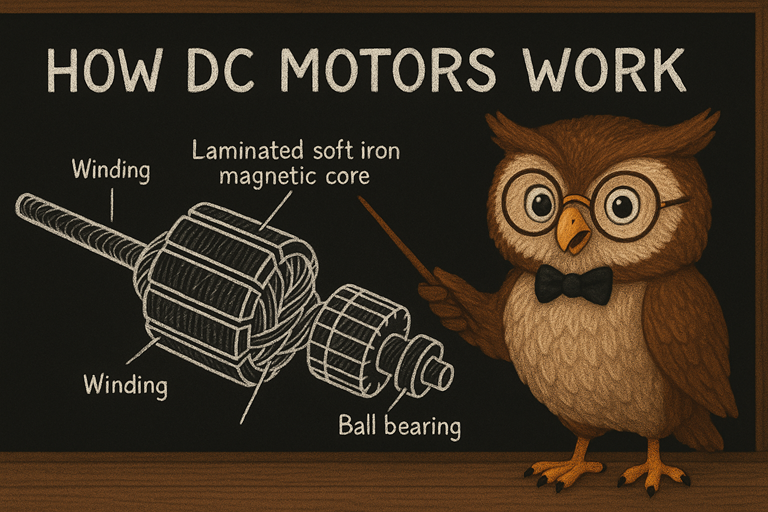
If you are just starting out and wondering how DC motors work, this page gives you the big picture in plain, conversational language. It is designed as a hub page that you can split into smaller, more detailed sections later.
What a DC motor is
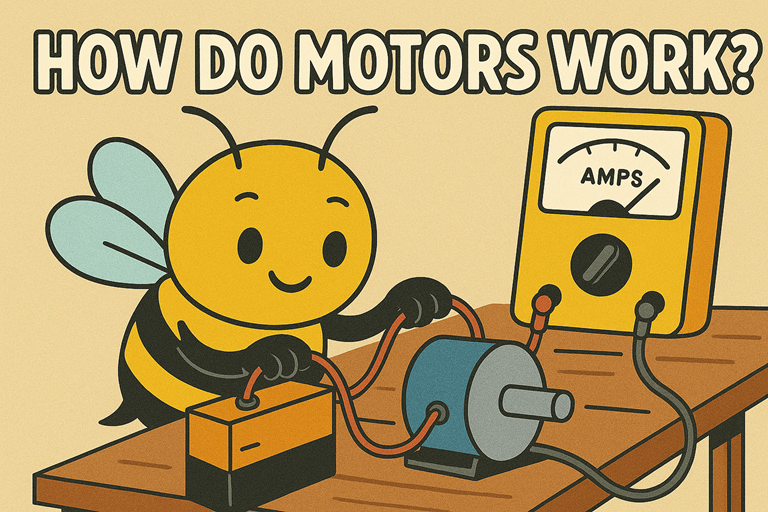
A DC motor is a machine that takes direct current and turns it into movement. You supply it with power from a battery or DC power supply, and it produces a spinning shaft that can drive wheels, fans, pumps or tools.
The main idea is simple: electrical energy goes in, mechanical rotation comes out.
How DC motors work in principle
At the centre of every DC motor is the interaction between electricity and magnetism.
Inside the motor you will find two things working together: a magnetic field and electric current flowing through coils of wire. When these two interact, they create a turning force called torque. A DC motor uses this force to spin its rotor continuously.
The important thing at this level is not the fine detail, but the basic concept: magnets and current create motion.
Key parts at a glance
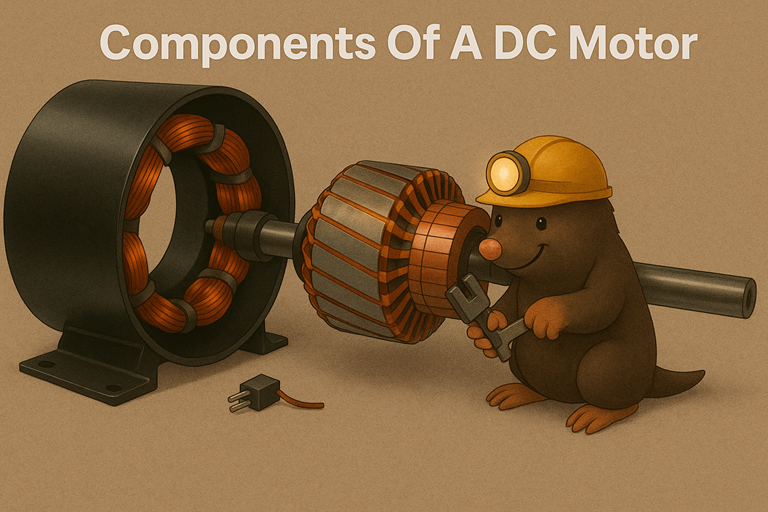
Even though DC motors come in many shapes and sizes, they all follow the same core layout:
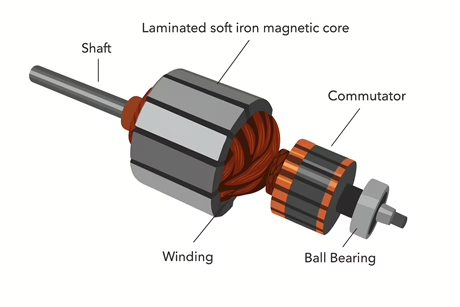
- A stator that stays still and provides a magnetic field
- A rotor that spins inside the stator
- Windings of wire that carry current
- A method of switching the current at the right moment so the rotor keeps turning
Brushed DC motors use a mechanical commutator and brushes to switch the current. Brushless DC motors use electronics. This is a good example of a topic you can explore on a dedicated page.
A short history and evolution
DC motors were among the first practical electric motors in the 1800s, but early versions relied on expensive, unreliable batteries. Once rechargeable batteries and the electrical grid became widely available, DC motors became central to industrial machines and early electric vehicles.
Over time, engineers refined DC motors and developed other motor types. Today, brushed DC motors are still popular for simple and low cost applications, while brushless DC motors and AC motors are more common when efficiency or low maintenance are important.
Main types of DC motor
When people talk about how do DC motors work, they may mean one of several designs. At a high level, the main families are:
- Permanent magnet DC motors
- Series, shunt and compound DC motors
- Brushed DC motors
- Brushless DC motors
Each of these uses the same basic principles but connects or controls the magnetic fields differently. Each type fits different applications and is best explained on its own page.
Where DC motors are used
DC motors appear in many everyday and industrial products. Smaller motors drive toys, hobby robots, fans and tools. Larger ones are used in cranes, conveyors, pumps, vehicle starters and some older industrial drives.
Their popularity comes from how easy they are to control. Change the voltage and the speed changes. Reverse the connections and the direction reverses. This simplicity makes DC motors ideal for beginners and widely used in real systems.
Advantages and challenges
From a high-level view, DC motors are valued for their simple control, good starting torque and wide speed range.
Brushed DC motors do have limitations. The commutator and brushes constantly rub against each other, which causes wear, sparks and maintenance needs. Brushless DC motors remove these moving contacts and are often chosen when long life or efficiency is important.
This balance of simplicity versus maintenance is a common theme in choosing the right motor.
DC motors as generators
Another useful idea is that a DC motor can act as a generator. If you turn the shaft mechanically, it produces DC electricity. This is the basis of regenerative braking in electric and hybrid cars, where slowing down feeds energy back into the battery.
Seeing motors and generators as the same machine in different modes helps build a deeper understanding.
What to explore next
This high-level overview sets you up to explore more focused topics, such as:
- Components of a brushed DC motor
- The physics behind torque and rotation
- Differences between series, shunt and compound motors
- How brushless DC motors are controlled
- Basic speed and direction control
From here, you can zoom in on whichever part of how do DC motors work is most relevant to your project or learning path.