When people talk about DC motor types, they are really talking about how the magnetic field is created and how it is wired to the spinning part of the motor. That wiring changes the motor’s “personality” – how hard it pulls at start, how well it holds its speed, and where it is most useful.
There are lots of DC motor types in industry, including series, shunt, compound and permanent magnet DC motors. In this beginner guide, we will focus on three classic wound-field DC motor types used in many textbooks and real machines: series, shunt and compound motors.
How DC motors work in simple terms
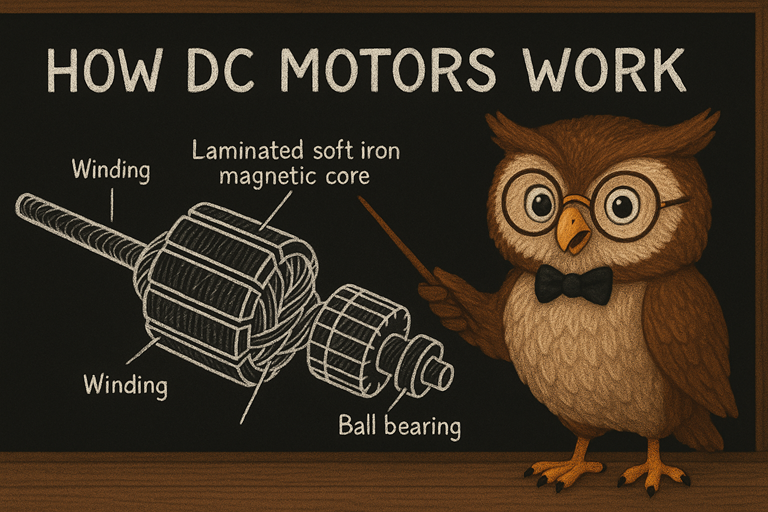
A DC motor turns electrical energy into mechanical energy. When current flows into the armature (the rotating coil), it creates a magnetic field. This interacts with the magnetic field from the stator (fixed part), creating a force on the conductors and making the shaft turn.
In series, shunt and compound DC motors, that stator field is created by field windings. The way those windings are connected to the armature gives each DC motor type its own behaviour.
Series DC motor
In a series DC motor, the field winding is connected in series with the armature. That means the same current flows through both the armature and the field.
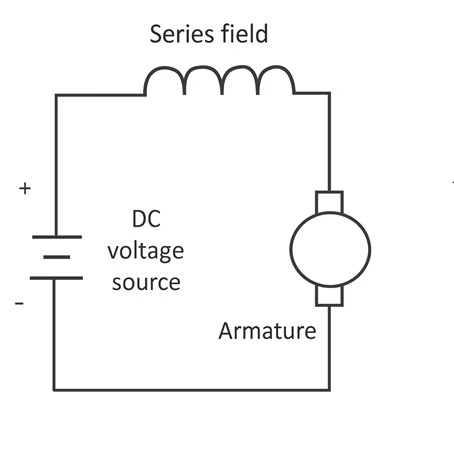
Because the field uses thick wire with low resistance, a large current can flow when the motor starts. This produces a very strong magnetic field and very high starting torque. That is why series DC motors are popular in heavy-duty applications such as cranes, hoists, electric trains and some types of elevators.
However, the speed of a series DC motor changes a lot with load. Under heavy load, the current and flux are high, and the motor runs more slowly. If the load is removed, the current drops, the flux weakens, and the motor can speed up to a dangerously high value. For this reason, a series DC motor should never be run with no load or lightly loaded, and it is not suitable where constant speed is important.
You can think of a series DC motor as the “strong but excitable” type: great at pulling heavy loads from standstill, but not calm and steady.
Shunt DC motor
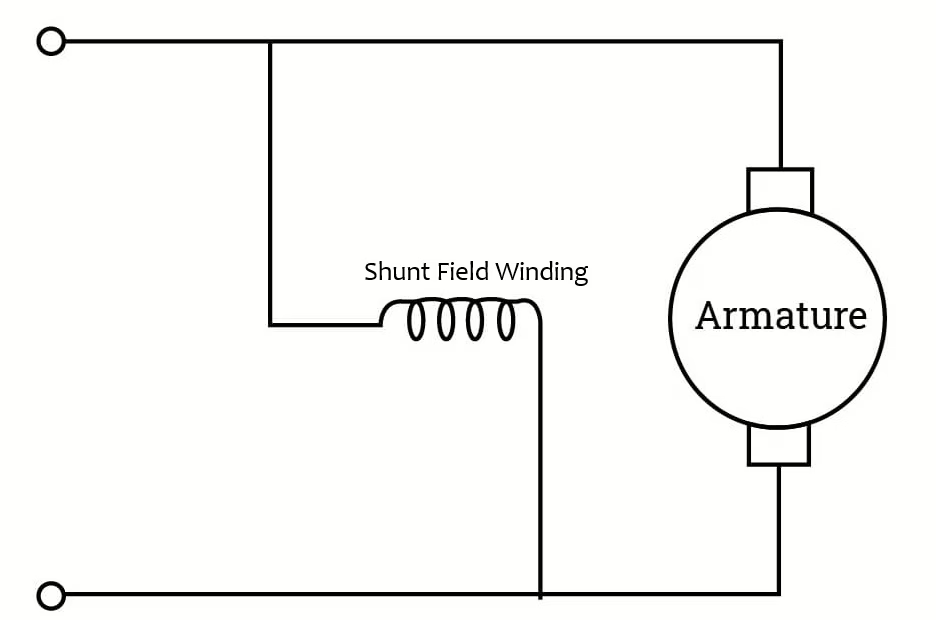
In a shunt DC motor, the field winding is connected in parallel (in shunt) with the armature. Both armature and field see the same supply voltage, but the currents are separate. The field uses many turns of fine wire, so it has high resistance and takes a small, almost constant current.
Because the field current and flux stay nearly constant, the shunt DC motor naturally keeps a nearly constant speed. When the load increases, the armature current rises to produce more torque, but the speed only falls slightly. When the load reduces, the speed rises only a little. This “self-speed regulation” is one of the key advantages of shunt DC motor types.
Shunt motors do not have the dramatic starting torque of series motors, but they are smooth, predictable and easy to control. They are widely used in conveyors, fans, pumps, plastics and wire extrusion, and machine tools such as lathes and mills, where constant speed is more important than brute pulling power.
You can think of a shunt DC motor as the “calm and steady” type: not the strongest at starting, but very good at keeping the same speed as the load changes.
Compound DC motor
A compound DC motor combines both shunt and series field windings on the same machine. Most of the field is provided by a shunt winding, with a few turns of series winding added on top.
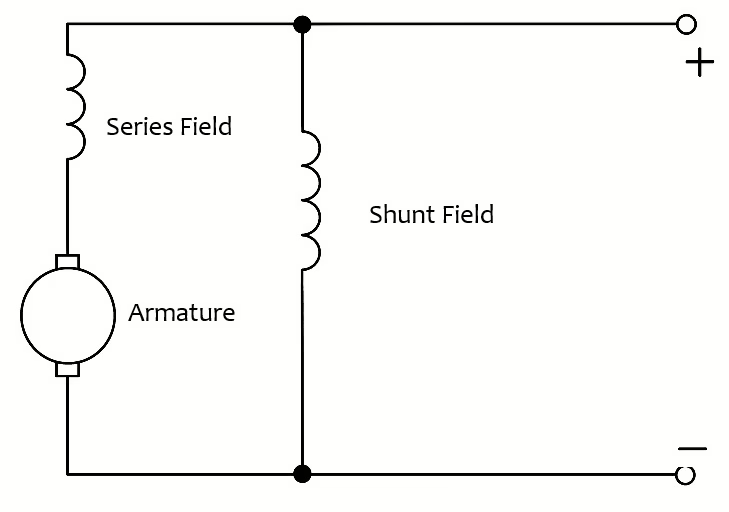
The shunt winding gives the motor good speed regulation, like a shunt DC motor. The series winding adds extra torque when the current (and load) increases.
The result is a DC motor type that sits between a pure series and a pure shunt motor:
- Higher starting torque than a shunt motor
- Better speed regulation than a series motor
Compound motors are used where both good starting torque and reasonable speed control are needed. Typical applications include rolling mills, presses, mixers, unwind brake generators, conveyors and some elevator systems.
There are different versions of compound DC motor types. In a cumulative compound motor, the series and shunt fluxes help each other, boosting torque. In a differential compound motor, they oppose each other, which can be used for special speed control tasks. For beginners, it is enough to remember that compound motors blend the benefits of series and shunt designs.
You can think of a compound DC motor as the “balanced all-rounder”: a good compromise between strong start and stable speed.
Comparing DC motor types in plain language
Here is a simple way to remember the differences between these three DC motor types.
A series DC motor is best when you need very high starting torque and the load is always connected. It pulls hard from standstill but its speed is very sensitive to load and it must not run with no load.
A shunt DC motor is best when you need a nearly constant speed over a range of loads. It starts more gently, has moderate torque, and naturally regulates its own speed, making it ideal for conveyors, fans, pumps and many machine tools.
A compound DC motor is used when you want a bit of both: extra starting torque compared to a shunt motor, but better speed regulation than a pure series motor. It is a good choice for mixed or fluctuating loads in industrial settings.
In short: series is strong, shunt is steady, compound is balanced.
Choosing the right DC motor type
When you choose between series, shunt and compound motors, you are really matching the motor’s behaviour to your application:
- If your priority is very high starting torque for heavy loads, a series DC motor is often the best fit.
- If your priority is constant speed under varying load, a shunt DC motor is usually the right choice.
- If you need a balance of both, a compound DC motor can offer the right mix of starting torque and speed regulation.
By understanding these core DC motor types and how they differ, you can make more confident decisions in projects, designs and troubleshooting, even if you are just starting out in electronics and motor control.