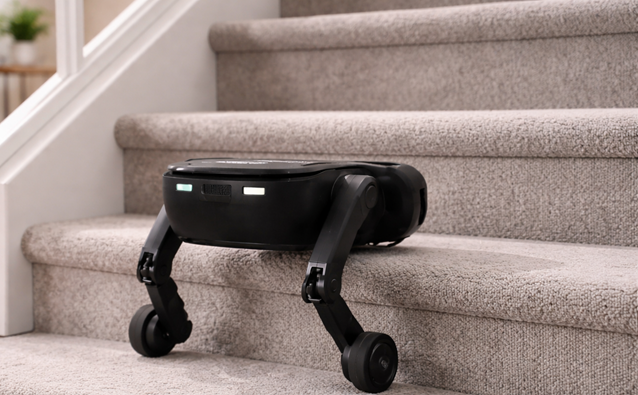
At the Consumer Electronics Show in Las Vegas, one device stood out from the sea of smart home gadgets. The Saros Rover shown at CES 2026 marks a significant shift in how household robots move and clean. Developed by Roborock, the Saros Rover replaces traditional wheels with articulated wheel legs designed to mimic human movement.
Unlike conventional robot vacuums that are confined to a single floor, the Saros Rover can climb stairs while actively cleaning them. During live demonstrations, the robot was seen lifting itself step by step, bracing one leg below while cleaning the surface above. It was also able to handle ramps, slopes and uneven thresholds without losing balance.
How the Saros Rover works
The Saros Rover uses a two wheel leg architecture, with each leg able to lift, bend and adjust independently. This allows the robot to navigate obstacles that would stop most robot vacuums, including cables, raised door frames and complex stair designs.
Under the surface, the Rover relies on a combination of artificial intelligence, motion sensors and 3D spatial mapping. These systems allow it to understand its surroundings in real time and decide how to move safely and efficiently. Roborock says this approach enables the robot to clean straight stairs, curved staircases and even carpeted steps with overhanging edges.
While pricing and a release date have not been announced, the fully working unit on display suggested the Saros Rover is more than a concept and is already well into development.
How it differs from existing robot vacuums
Most robot vacuums today rely on wheels and small suspension systems. Even advanced models that can cross thresholds or thick carpets are limited to flat surfaces. Some competing stair climbing concepts use external platforms or separate lifting devices, meaning the vacuum cannot clean while moving between levels.
The Saros Rover removes that limitation. It cleans continuously as it climbs, reducing the need for multiple robots or manual intervention. This could be particularly useful in older homes and multi storey buildings where steps and level changes are common.
What the future holds for household robotics
The Saros Rover points to a broader shift in household robotics away from novelty features and towards real mobility. Roborock has previously experimented with robotic arms, but the focus in 2026 appears to be on movement, stability and practical cleaning performance.
Alongside the Rover, Roborock announced new high power robot vacuums and LiDAR guided robot lawn mowers, suggesting a future where autonomous machines handle both indoor and outdoor chores.
A changing home robotics landscape
The Saros Rover shown at CES 2026 highlights how rapidly household robotics is evolving. As sensors, AI and mechanical design improve, robots are beginning to adapt to human homes rather than forcing homes to adapt to robots.
If the Saros Rover performs as promised outside controlled demonstrations, it could redefine expectations for robot cleaners and push the industry beyond single floor living. For consumers, it signals a future where smart home robots are more capable, more adaptable and far more independent than before.