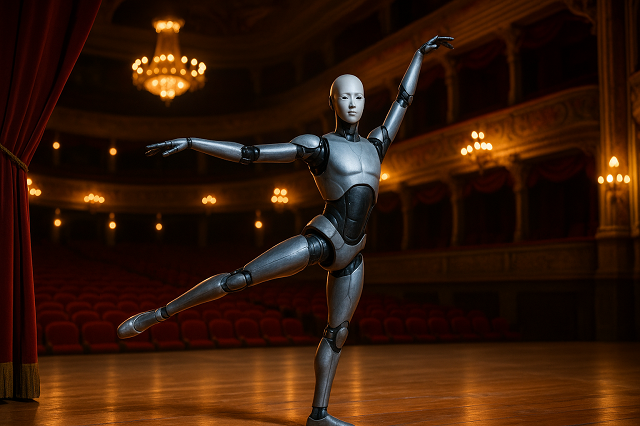
Chinese robotics company Unitree has unveiled a new humanoid robot capable of pirouetting, kickboxing and strutting down a catwalk with uncanny human grace, and it even has a face.
Hangzhou-based Unitree Robotics released footage of its latest creation, the Unitree H2, in a short promotional video that has quickly gone viral. Standing 1.8 metres tall and weighing around 70 kilograms, the silver-skinned robot moves with a level of fluidity that has left many viewers both impressed and unsettled.
From dancing to combat
In the video, the H2 performs a sequence of complex movements: spinning through ballet-inspired pirouettes, striking martial arts poses, and walking alongside a human model. Its motions are balanced, precise and, at times, disconcertingly human.
The display marks a significant leap forward in mechanical coordination and balance. The robot’s movements appear smoother and more natural than those of previous humanoid designs, suggesting major improvements in joint control and torque precision.
31 degrees of freedom
According to Unitree, the H2 boasts 31 degrees of freedom, a measure of how many independent joints and axes of motion it can control. That’s a notable increase from the company’s earlier R1 and H1 models.
Each additional degree of freedom allows the robot to replicate subtler and more natural movement, from ankle pivots to shoulder rolls. This gives the H2 its remarkable ability to twist, bend and balance like a human dancer, while maintaining stability during high-speed manoeuvres such as kicks or spins.
Unitree engineers say the robot’s new architecture enables it to perform tasks that demand fine motor control, such as object handling and walking on uneven surfaces. The result is a machine that feels one step closer to crossing the boundary between mechanical and biological motion.
A face that feels almost human
What’s particularly striking, and a little unsettling, is the H2’s humanlike face. The metallic silver mask features defined eyes, lips and a nose, designed to give the robot an approachable appearance.
However, many online viewers have described it as “creepy” or “too real”, drawing comparisons with the androids in the film I, Robot. The company says the design was intended to make the machine seem friendly and “born to serve everyone safely”, though it has clearly sparked debate about how comfortable people are with humanoid robots that look and move like us.
Power and precision
The H2 follows the success of Unitree’s earlier model, the H1, which set records as one of the world’s fastest humanoid robots. The new model is both stronger and more flexible, with improved mechanical balance and motion control.
While exact specifications remain limited, Unitree says the robot incorporates thousands of parameters within its motion algorithms, enabling split-second adjustments during movement. This helps it achieve its eerily smooth dance routines and martial arts sequences.
The future of humanoid robotics
Founded in 2016, Unitree Robotics is often seen as China’s answer to Boston Dynamics. With the H2, the company hopes to accelerate the country’s leadership in humanoid robotics.
Though mass adoption remains some way off, the video of H2’s performance has sparked renewed discussion about how humanlike we really want our machines to be.