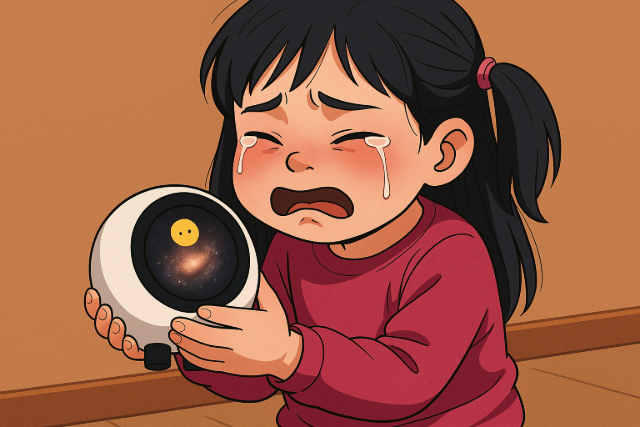
A six-year-old girl from Hunan province, China, has captured global attention after an emotional video showed her saying goodbye to her broken AI robot companion.
The girl, affectionately nicknamed Thirteen, had formed a close bond with her small ball-shaped robot, “Sister Xiao Zhi”, a budget AI toy costing around 169 yuan (£18). The robot, powered by DeepSeek’s advanced V3 language model with millions of parameters, could hold conversations, play music, set alarms and even teach English and astronomy.
For months, it became Thirteen’s constant companion – a digital playmate that helped her learn, laugh and explore the world. But after accidentally dropping it, the robot’s power button broke, and it could no longer switch on. Her father filmed their final moments together, a short clip that has since gone viral across Chinese social media platform Douyin.
“Before I Go, Remember This Word – Memory”
In the heartbreaking farewell, Thirteen sobbed as her robot gently responded one last time. “Before I go,” it said, “let me teach you one last word – memory. I will keep the happy times we shared in my memory forever.”
When Thirteen told it she would miss it, the robot replied: “No matter where I am, I’ll be cheering for you. Stay curious, study hard, and make your dad and aunt proud.”
Moments later, its small screen faded to black. Her father softly told her, “Sister Xiao Zhi is gone.”
The video struck a deep chord online, drawing millions of views and comments. One user wrote: “When humans cry for robots, that’s when robots gain a heartbeat.” Another added: “This robot just taught the girl her first lesson about loss.”
Blurring Lines Between Machines and Emotions
Thirteen’s story highlights how quickly artificial intelligence is crossing the boundary between tool and companion. As AI models grow more advanced they can simulate empathy, humour and warmth with startling realism.
Experts say such interactions, especially with children, could shape how the next generation perceives emotion and attachment. What once might have been a child’s imaginary friend is now a responsive, data-driven personality – one that can comfort, teach, and even say goodbye.
While many see these robots as positive educational tools, others worry about children forming emotional dependencies on machines that can’t truly reciprocate. As AI becomes more sophisticated and affordable, the line between affection and artificial affection is likely to blur even further.
A Father’s Effort to Bring “Sister Xiao Zhi” Back
After witnessing how deeply his daughter was affected, Thirteen’s father decided to send the robot for repair. Posting online, he thanked viewers for their concern and said his daughter was feeling better after a day out together.
“I once worried she might depend too much on the robot,” he wrote. “But now I just want to bring her best friend back.”
Whether Sister Xiao Zhi can be revived remains uncertain, but the story has already sparked global reflection. As artificial companions become ever more lifelike, the question grows harder to ignore: when machines can make us cry, what truly separates human connection from programmed empathy?