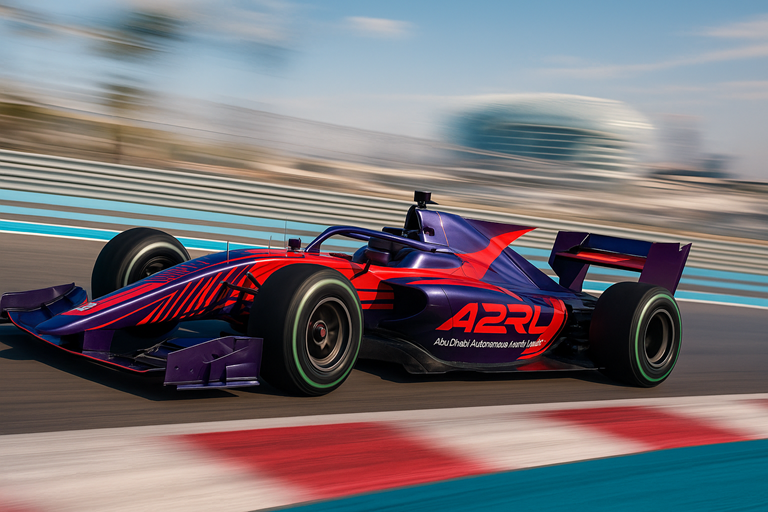
The Abu Dhabi Autonomous Racing League (A2RL) has set its sights on redefining the future of motorsport. Created by ASPIRE, part of the UAE’s Advanced Technology Research Council, the league brings together teams from around the world to test artificial intelligence in extreme racing conditions. The inaugural car race took place at the Yas Marina Circuit in April 2024, marking the first major autonomous racing event outside the United States since the now defunct Roborace series.
Three Categories of Racing
A2RL features three distinct racing formats: car, drone and buggy. The flagship car race follows a standard formula racing setup with driverless vehicles competing at speeds of up to 300 kilometres per hour. The drone race, launched in April 2025 in partnership with the Drone Champions League, showcases high speed quadcopters competing indoors. The buggy race, which will see autonomous dune buggies tackling off road desert terrain, is still in development.
Early Success and Technical Hurdles
The first car race drew 10,000 spectators and global attention, with eight university and research based teams competing for a 2.25 million dollar prize. Despite the excitement, the technology faced growing pains. Only two of the four cars that qualified completed the full eight laps. The rest struggled with navigation, braking and collision avoidance, key challenges when racing autonomously at high speeds.
Germany’s Technical University of Munich team took the victory after Italy’s PoliMove spun out midway through the race. The event was hailed as a milestone in autonomous technology, even as organisers acknowledged the complexity of getting AI drivers to match human precision and reflexes.
The Teams and Global Collaboration
Teams represent some of the world’s leading research institutions, including Constructor University from Germany, Unimore and PoliMove from Italy, HUMDA Lab from Hungary, Fly Eagle from China and the UAE, and Kinetiz from Singapore and the UAE. For 2025, new entrants such as SEVRUS Japan, Aladin Innovation from France and UAE based TII Racing will expand the grid to 12 teams.
The drone category also features international representation, with entries from South Korea, Mexico, Singapore and the Netherlands, highlighting the league’s global reach.
Inside the Technology
The A2RL cars are based on modified Dallara Super Formula chassis, fitted with advanced systems that replace the human driver. Where a driver’s seat would normally sit, the cars house powerful computers that process data from a network of cameras, radar and lidar sensors. The drive by wire system, provided by Meccanica 42, translates AI instructions into real time control over steering, braking and acceleration.
Each vehicle includes seven cameras, four radar units and three lidar sensors, enabling it to interpret the track and respond to obstacles. Despite these advancements, managing high speed decision making remains one of the greatest engineering challenges. Even a millisecond delay in processing can mean the difference between a smooth corner and a crash.
Looking Ahead
Races are planned to take place annually, with the next car race scheduled for November 2025. Organisers hope improvements in AI algorithms and mechanical reliability will deliver closer, faster and safer competition. A2RL’s long term ambition extends beyond entertainment; it aims to accelerate the development of autonomous driving systems that could one day make roads safer for everyone.
For Abu Dhabi, A2RL is more than just a sporting event. It is a statement of intent, positioning the city as a global hub for innovation in robotics, AI and future mobility.