Robots that punch, kick and even keep fighting after losing their heads might sound like something from a science fiction film. But that is exactly what happened at a remarkable new robotics event in China.
The competition has amazed people around the world. While the action looked dramatic, the real goal was not to build better fighters. Instead, engineers were testing how well robots can move, balance and cope with difficult situations. The lessons learned could one day help create robots that work alongside people in factories, hospitals and even schools.
A New Kind Of Competition
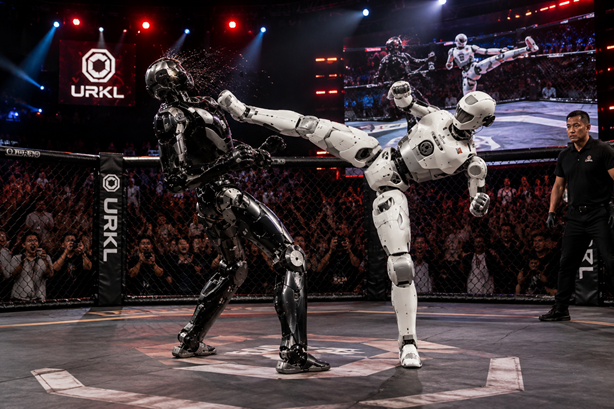
The event took place in Shenzhen, China, and was called Ultimate Robot Knock out Legend, or URKL. Organisers describe it as the world’s first freestyle fighting competition for full sized humanoid robots.
Thirty two teams from around the world took part. Every team used the same robot, called the T800, before making changes to improve its performance. This meant that success depended on clever engineering and computer programming rather than simply building a completely different machine.
The robots exchanged punches, kicks and quick movements while a live audience watched from the stands.
A Fight Nobody Expected
One moment quickly became the biggest talking point of the event.
During one match, a robot called White Eagle landed a powerful kick to the head of its opponent, Matador. The impact knocked the head loose and it eventually fell off completely.
What surprised everyone was that the robot did not stop immediately. It continued throwing punches for a short time, even without its head attached.
This happened because many of the robot’s important systems were built into its body rather than only inside its head. Engineers said this showed how modern robots can continue working even when part of the machine is damaged.
That kind of backup design is important in many real world situations where robots need to stay safe and reliable.
More Than Just Punches
Although the event looked like a sporting contest, winning was not simply about landing the biggest hit.
The robots were judged on several different skills. These included how well they stayed balanced, how accurately they moved, how well they defended themselves and how much damage they could survive.
This gave engineers valuable information about how their machines performed under pressure.
Every movement also tested complicated software that helps the robots understand their surroundings, react quickly and keep themselves upright after being pushed or knocked over.
Meet The T800
The robot used in the competition stands about 1.7 metres tall, which is similar to the height of an adult person.
It can perform impressive movements including spinning kicks, quick recoveries after falling and carefully controlled punches. To make this possible, it uses powerful motors, cameras, laser sensors and artificial intelligence to understand what is happening around it.
Its designers say the robot can process information extremely quickly, helping it decide how to move in just a fraction of a second.
That technology may sound futuristic, but many of the same ideas are already used in everyday robots that move around warehouses or help inspect dangerous places.
Why Build Robots Like This?
At first glance, robot fighting might seem like little more than entertainment.
However, competitions like this give engineers a safe way to push machines to their limits. If a robot can stay balanced after a powerful kick, it may also be better at walking across uneven ground or carrying heavy equipment.
Testing robots in demanding situations helps researchers discover weak points, improve designs and build more reliable machines.
Many experts believe these lessons could help robots work safely with people in the future.
Technology For Good
As exciting as these robots are, it is also important to think about how they should be used.
Many scientists believe robots and artificial intelligence should always be designed to help people. They can assist with difficult jobs, support rescue teams after disasters, help doctors and nurses, or carry out tasks that are too dangerous for humans.
At the same time, experts around the world continue to discuss the risks of using advanced robots for military purposes. The United Nations has called for strong international rules to make sure decisions about taking human life always remain under human control.
This reminds us that every new technology brings both opportunities and responsibilities.
The Future Of Humanoid Robots
Robot competitions are becoming an exciting way to inspire new ideas.
Just as Formula One racing has helped improve everyday cars, events like URKL could help make future robots safer, smarter and more capable.
For teachers and students, this is also a reminder that robotics is much more than building machines. It brings together science, engineering, computing, mathematics and creative problem solving.
The robots may have been throwing punches in the arena, but the real winners could be the engineers, programmers and young inventors who use these discoveries to build technology that makes life better for everyone.