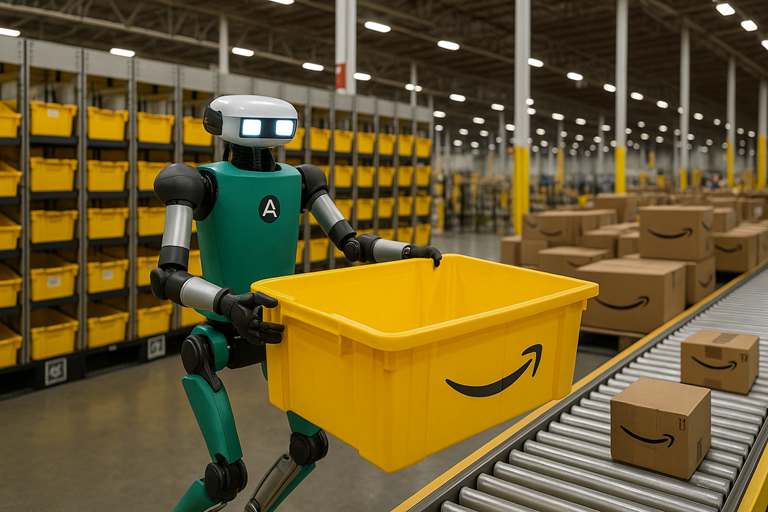
Amazon is reportedly working towards automating as much as three quarters of its warehouse and logistics operations over the next decade, according to leaked internal documents reported by The New York Times.
The documents suggest that by 2033, automation could allow the company to avoid hiring around 600,000 additional workers in the United States that it would otherwise need to meet growing demand. By 2027, that figure could reach 160,000 avoided hires, saving about 30 cents per item shipped.
Amazon has already deployed more than a million robots in its fulfilment and delivery network, roughly two thirds the size of its human workforce. New machines, including bipedal robots such as “Digit”, are being tested to take on physically demanding tasks traditionally carried out by people.
Not a plan for mass layoffs
While the leaked papers outline the potential financial and operational benefits of automation, Amazon has strongly rejected the suggestion that it is preparing to lay off hundreds of thousands of existing workers.
A company spokesperson said the documents reflected the perspective of one internal team and did not represent the company’s broader hiring plans. Amazon said it remains one of the largest job creators in the United States and is actively hiring across its operations, with 250,000 seasonal positions being filled for the holiday period.
The company added that improvements in efficiency allow it to invest in new areas and higher skilled roles. “Our track record shows we have consistently created jobs while investing in upskilling our workforce for evolving roles,” it said.
Economic impact and public perception
Amazon is the third largest employer in the United States, behind Walmart and the federal government. Analysts say that while automation could help the company save billions of dollars by the end of the decade, it may also have wider implications for the labour market.
Economist Daron Acemoglu warned that if Amazon successfully automates most of its operations, one of the biggest employers in the United States could become a net job destroyer rather than a job creator.
The leaked documents reportedly also included discussions on how to handle potential public backlash. Suggestions included avoiding terms such as “automation” or “AI” in favour of “advanced technology”, and using “cobot” to describe robots that collaborate with people. Amazon has denied instructing executives to use specific language.
Balancing innovation and employment
Automation is not new to Amazon, but the scale of the plans described in the documents indicates a significant acceleration. The company says its technology strategy aims to improve safety, speed up delivery, and reduce costs, while continuing to create new forms of work in robotics and AI.
For now, there is no evidence of imminent mass redundancies, but the leaked material highlights how rapidly automation is reshaping warehouse work. As robots take on a growing share of the heavy lifting, the challenge for Amazon and for policymakers will be to ensure the future of work remains both efficient and fair.