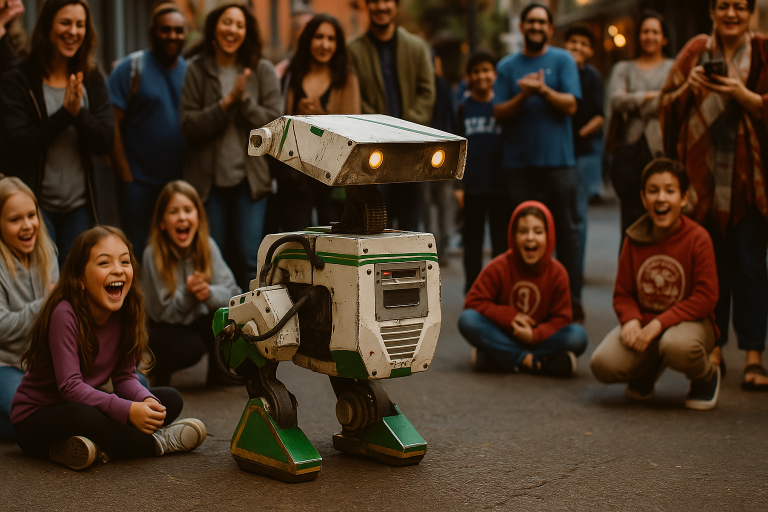
A pair of pint-sized droids developed by Disney have captured hearts and headlines after making surprise appearances at major tech events this year, including Nvidia’s GTC conference in California and VivaTech in Paris.
The expressive robots, named Besh and Grek, are part of a new wave of AI-powered creations blending storytelling with cutting-edge robotics. Developed by Walt Disney Imagineering Research & Development, they have been hailed as the next generation of Disney’s iconic animatronics, only this time they move, emote, and even interact with people in real time.
Meet Grek, Disney’s Emotional Droid
Grek, a small green robot reminiscent of a Star Wars sidekick, took to the stage alongside Nvidia CEO Jensen Huang in Paris, where she jumped, danced, and posed for photos with the audience. “Can you dance?” Huang asked. Grek obliged, before politely declining a request to crash into her sibling Besh, demonstrating both charm and programmed restraint.
Disney says Grek and Besh belong to the company’s BDX droid series, created to evoke the personality and warmth of Star Wars characters. Each is fitted with cameras, sensors, and an Nvidia graphics processing unit (GPU), allowing them to detect surroundings and respond with lifelike emotion, tilting their heads shyly or puffing their chests when “angry”.
How Disney and Nvidia Brought Them to Life
The robots’ movements were perfected using reinforcement learning, a training method where digital versions of the droids practised walking and emoting inside virtual environments until they mastered the task. This process, Disney says, allowed the real-world robots to move smoothly without toppling over during their first tests.
At the heart of this innovation is Newton, an open-source physics engine co-developed by Nvidia, Google DeepMind and Disney Research. Newton simulates how robots interact with real-world materials like sand, cloth, or food, enabling more realistic motion and safer navigation. Nvidia claims it can speed up robotic training by up to 100 times compared to conventional methods.
Collaboration, Control and the Magic Touch
While the technology behind Grek and Besh is highly sophisticated, Disney insists the goal is not total autonomy. “We want to retain control over interactions,” said Moritz Bächer, Disney’s robotics lead. The company’s creative teams currently guide the droids’ behaviour remotely, deciding when they should act curious, bashful or excited, all part of maintaining that signature Disney storytelling magic.
Disney plans to roll out the BDX droids to its global theme parks and cruises from 2026, including Tokyo Disney Resort, Disneyland Paris, and Walt Disney World.
When Disney Crashed Nvidia’s Big Moment
Despite Nvidia unveiling major new AI chips and models, including the Groot N1 for humanoid robots, it was Disney’s droids that dominated social media. The duo’s unexpected appearance effectively stole the spotlight from the tech giant’s product launches, as clips of Grek’s antics spread rapidly online.
Industry analysts say the collaboration hints at the long-term ambitions of both firms: for Nvidia, a push to dominate robotics training; for Disney, a future where AI-powered characters bring theme parks, and perhaps storytelling itself, to life in ways audiences have never seen before.