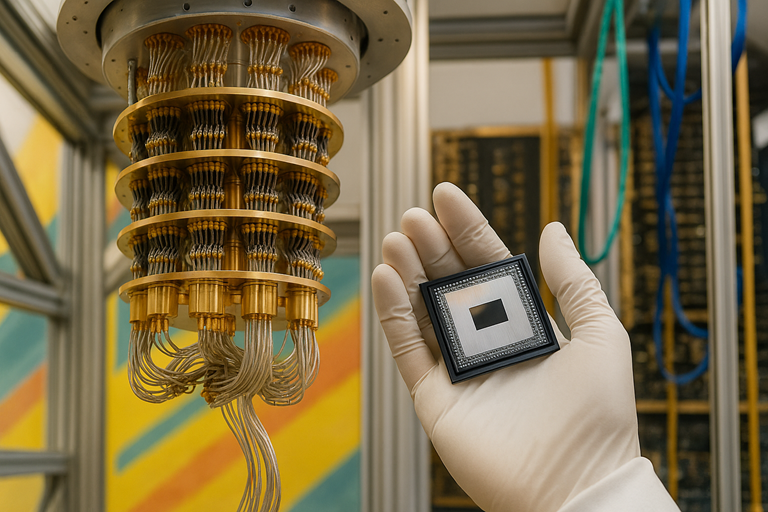
Google has announced a major leap in quantum computing with its new 105-qubit Willow processor. The chip can run certain calculations 13,000 times faster than the world’s most powerful supercomputers. The breakthrough, published in the scientific journal Nature, marks what Google calls a “verifiable quantum advantage”. This means the results can be independently confirmed by other quantum computers, showing they are reliable and repeatable.
The Quantum AI team achieved this using an algorithm called Quantum Echoes, which measures how disturbances spread through quantum systems. Unlike earlier experiments that only proved speed on abstract problems, this test has clear scientific uses, such as simulating molecular structures and electronic behaviours.
From theory to practical progress
Google first made headlines in 2019 when its Sycamore chip showed “quantum supremacy”, solving a random-sampling problem much faster than classical computers. That experiment proved a concept but had little real-world value. Willow, on the other hand, can model physical systems that matter to chemistry, biology and materials science.
The Quantum Echoes algorithm works by sending a carefully timed signal through the chip’s qubits, disturbing one of them, and then reversing the signal to detect the echo that comes back. This echo becomes stronger through constructive interference, allowing researchers to measure very small quantum effects with high precision.
Working with the University of California, Berkeley, Google used the technique to study two molecules, one with 15 atoms and another with 28. The results matched those from Nuclear Magnetic Resonance, or NMR, which is the same principle used in MRI scans. The experiment also revealed details that normal NMR methods could not capture.
Potential applications for science and industry
If developed further, this technology could change how scientists and engineers approach complex molecular modelling. Quantum computing could help design new materials, create more efficient batteries, and speed up drug discovery by showing exactly how medicines interact with the body.
Google’s Willow chip achieved single-qubit accuracy of 99.97 per cent and entangling gate accuracy of 99.88 per cent. These high levels of precision are vital for reducing errors, allowing experiments to be repeated with consistent results.
The company’s researchers say that Willow’s speed and accuracy mark a turning point for quantum computing. It shows a move away from theoretical experiments and towards practical tools that can solve real scientific problems. Quantum methods could also play a part in the future of artificial intelligence, making it possible to solve complex optimisation tasks using less energy.
Challenges that lie ahead
Despite the excitement, experts warn that quantum computing is still at an early stage. Quantum processors remain fragile and are easily affected by small changes in temperature or vibration. The next big challenge is to scale up the technology to create “logical” qubits that can detect and correct their own errors. This would make quantum computers stable enough for everyday use.
Google’s next goal is to create a long-lived logical qubit, a key step towards a fault-tolerant quantum computer.
For now, the Willow processor is a sign of how far the field has come. It may not yet replace supercomputers, but it shows that quantum hardware is starting to deliver real, verifiable results and could soon play a major role in scientific discovery.