For decades, artificial intelligence has dazzled in the digital world, mastering words, numbers and images with ease. Yet the physical world has remained stubbornly out of reach. Teaching a robot to fold laundry or pack a camera kit has proved far harder than getting an algorithm to write a poem. Now, researchers behind GEN-0 believe they have found a way to bridge that divide.
A new kind of foundation model
Developed by Generalist AI, GEN-0 is what the team calls an embodied foundation model, a system that does not just think about the world but interacts with it. Built on a new architecture called Harmonic Reasoning, it allows robots to process sensory information and act at the same time.
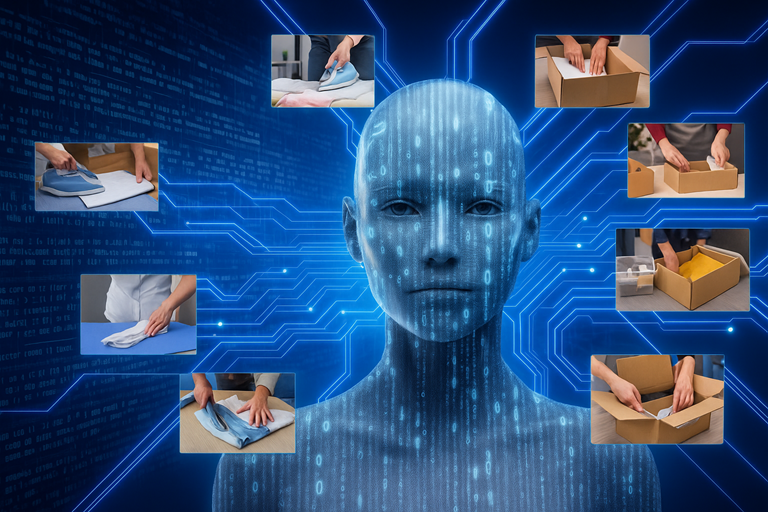
Traditional systems pause to plan each move. GEN-0 does not have that luxury. It reasons and reacts in parallel, mirroring the way living creatures handle continuous motion. This allows it to carry out complex, multi-step tasks such as assembling products or sorting clothing without being explicitly programmed for each action.
Trained 500 times faster than humans
What sets GEN-0 apart is the way it learns. The model is trained using an enormous dataset of real-world physical interactions, gathered from thousands of homes, factories and warehouses. In total, the dataset spans more than 270,000 hours of manipulation data and is expanding by around 10,000 hours every week.
That means GEN-0 effectively gains experience 500 times faster than a human worker. Each day of training exposes it to the equivalent of nearly seven years of hands-on practice. This internet-scale data operation is processing petabytes of video, sensor and motion data around the clock.
The intelligence threshold
As the team scaled up GEN-0, they noticed a striking change in behaviour. Smaller models with around one billion parameters quickly hit a wall, unable to absorb more knowledge. Researchers called this ossification. At six billion parameters, the models began improving. But beyond seven billion, something remarkable happened. The system appeared to cross an intelligence threshold, suddenly capable of flexible reasoning and fast adaptation to new tasks.
The pattern echoes Moravec’s Paradox, the observation that what humans find easy, such as balance, dexterity and perception, demands far greater computational effort for machines. In short, physical intelligence needs far more raw brainpower than digital reasoning.
Predictable progress
For the first time, the GEN-0 experiments show that physical intelligence follows clear scaling laws. As models grow and more data is added, performance improves in a predictable way. This allows engineers to estimate how much training data or computing power is needed to reach a given skill level, bringing long-awaited rigour to robotics development.
What is next for GEN-0
Having already surpassed 10 billion parameters, the next step is even larger embodied models trained on millions of hours of real-world data. The researchers believe this could unlock robots that handle new situations with human-like agility, from assisting in hospitals to working safely alongside people in factories and homes.
If the trend continues, GEN-0 may not just mark progress in robotics, but the dawn of scalable physical intelligence, where machines finally learn to move through the world as effortlessly as they think about it.