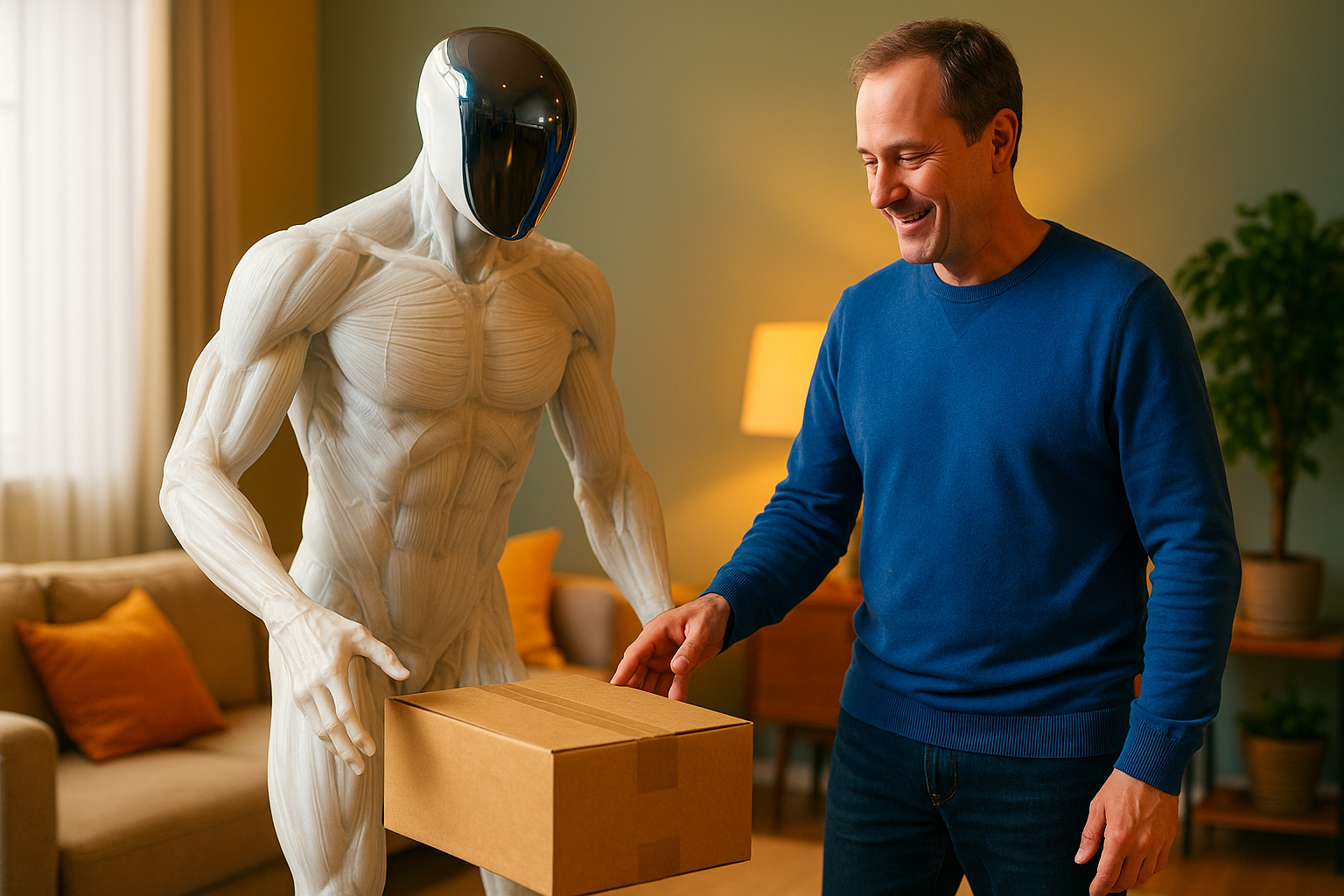
A Polish company says it has made a major step forward in building humanoid robots that move and act more like humans. Instead of relying on electric motors and rigid frames, Clone Robotics uses artificial muscles powered by pressurised fluid.
The company, co-founded by engineer Dhanush Radhakrishnan, has already revealed several lifelike prototypes, including Protoclone V1 and a full-body android named Clone Alpha. A third model, Neoclone, is currently in development.
Radhakrishnan says the aim is not to make incremental improvements to existing machines, but to create androids that can perform the same wide range of movements as humans, from opening heavy doors to slicing fruit.
Why start with the hand?
The team began their work by designing a robotic hand. Radhakrishnan explained that the hand is the body’s most complex part, with more degrees of freedom than any other. Developing it forced engineers to solve some of the toughest design challenges early on.
Within 18 months, Clone had built a hand capable of human-level dexterity. By designing artificial ligaments and muscle–tendon structures, they were then able to expand the concept to a full body in about a year.
Muscles instead of motors
At the core of Clone’s innovation is its use of artificial muscles. These “fluidic muscles” are based on the McKibben design, which mimics the way human skeletal muscles work. Each consists of an inner rubber tube wrapped in fabric. When the tube is filled with air or water, it contracts, pulling on artificial bones and creating movement.
Most humanoid robots today are powered by motors, which are heavy, expensive, and make joints rigid. By contrast, Clone’s muscle system is lighter, softer, and closer to human anatomy. It also makes the design process simpler: instead of engineering each joint from scratch, the team can copy directly from anatomy textbooks.
The “hydraulic heart”
Powering the muscles is a compact pump that the team calls a “hydraulic heart”. This circulates water through the system to make the muscles contract and relax. The design is closed-loop, meaning the same fluid keeps moving inside. If extra water is ever needed, the robot can simply be topped up, almost like drinking, Radhakrishnan says.
This system is not only more lifelike but could also prove cheaper to build and maintain than conventional robots, which require many motors, batteries and complex parts.
Cutting costs and speeding production
Clone Robotics believes its approach could dramatically reduce production costs. Traditional humanoid robots require hundreds of custom-made motors and electronics, which are time-consuming and expensive to assemble.
By replacing these with fluidic muscles and simplified designs, the company says robots can be produced faster and at lower cost. That could open the door to mass-market androids in the future, something that has so far remained firmly in the realm of science fiction.
Challenges ahead
Despite its progress, the company faces significant hurdles. One of the biggest is teaching the robots how to walk. Most motor-driven robots can be simulated relatively easily in computer programmes, which helps researchers test movements in virtual environments.
Clone’s fluidic muscle system is more complex and harder to model. The company is now working on creating accurate simulations, which it believes will be key to unlocking untethered walking.
Sensors and computing power are also critical. Clone uses advanced chips to control planning and movement, while sensors track position, torque and force. The company hopes eventually to add artificial skin that can “feel” pressure and texture, allowing robots to handle delicate objects with precision.
A vision from science fiction
For Radhakrishnan, building Clone Robotics is the fulfilment of a childhood dream inspired by early videos of Boston Dynamics’ robots. He imagined lifelike androids walking among humans, just like in science fiction films.
That vision has not yet materialised, but he believes the combination of artificial muscles and advances in artificial intelligence could make it a reality.
“Humans are the best blueprint we have,” he told interviewers. “If we can build androids that move like us, the possibilities are endless.”