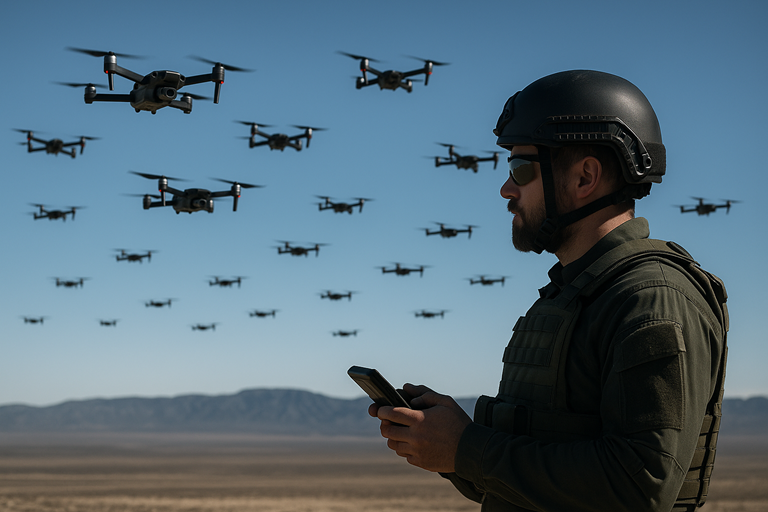
A new generation of autonomous tactical drones could change how military operations are carried out. Red Cat Holdings, a US based drone technology company, has partnered with Apium Swarm Robotics to create Red Cat drones capable of operating as intelligent swarms rather than single units.
The collaboration, formalised through a Memorandum of Agreement, brings Apium into the Red Cat Futures Initiative, a consortium of defence and robotics companies developing advanced, interoperable uncrewed systems for the battlefield. The goal is simple: to enable small drones to work together intelligently, even when communications are disrupted.
How drone swarms work
Unlike traditional drones that rely on a central command, Red Cat’s swarm enabled systems distribute intelligence across all units. Each drone carries its own swarm logic, allowing it to make decisions independently while remaining aware of nearby drones.
This means that if one drone is lost or its connection to the ground station is jammed, the others continue the mission. Communication happens directly between the drones, which share data in real time to coordinate movements and tasks.
Apium’s technology allows operators to select from a Swarm Library of behaviours using a touchscreen interface. Drones can orbit a target, scout terrain, or carry out collaborative missions without requiring constant human input. Commands can also be updated mid flight, and individual drones can temporarily break from the group for separate duties before rejoining seamlessly.
Autonomous, but not uncontrolled
Apium’s founder and chief scientist, Tyler MacCready, said the technology strikes a balance between autonomy and human oversight. “One to many swarming is the future of autonomous warfare,” he said. “Our system enables a single operator to launch, command, and adapt swarms in real time without complex pre mission planning or centralised control.”
The system is autopilot agnostic, meaning it can work with widely used drone control systems such as PX4 and ArduPilot. This makes it easier to integrate across different platforms, including Red Cat’s Black Widow and Teal 2 drones.
Proven in the field
The swarming system was recently demonstrated at the US Army’s ACM UAS Industry Day at Fort Rucker, Alabama. Red Cat’s Teal 2 drones equipped with Apium’s autonomy software completed multi agent missions without relying on a ground based control network.
Observers reported that the swarm successfully adapted to changing conditions and continued operating despite simulated signal interference. According to Red Cat’s Director of Special Programs, Jason Gunter, “Apium’s system brings distributed drone swarming out of the lab and onto the battlefield. It’s a major leap forward for tactical autonomy.”
Why swarms matter
Swarms offer clear advantages over individual drones. They can cover larger areas, share sensor data instantly, and react collectively to threats or changing objectives. If one drone is destroyed or disabled, others automatically adjust their positions to maintain coverage.
This kind of resilience is particularly valuable in contested environments where communications are jammed or GPS signals are blocked. The approach also aligns with the US Department of Defense’s push for attritable systems, cost effective, expendable drones that can be deployed at scale without risking pilots or high value assets.
From lab to deployment
While the Red Cat partnership is still developing, early demonstrations suggest the technology is ready for real world use. Compared with traditional single drone operations, swarms have shown greater flexibility, faster decision making, and improved mission resilience.
As global militaries race to integrate artificial intelligence and autonomy into their forces, Red Cat’s distributed swarm model represents a practical step forward, not replacing humans, but enhancing their reach and effectiveness on the modern battlefield.