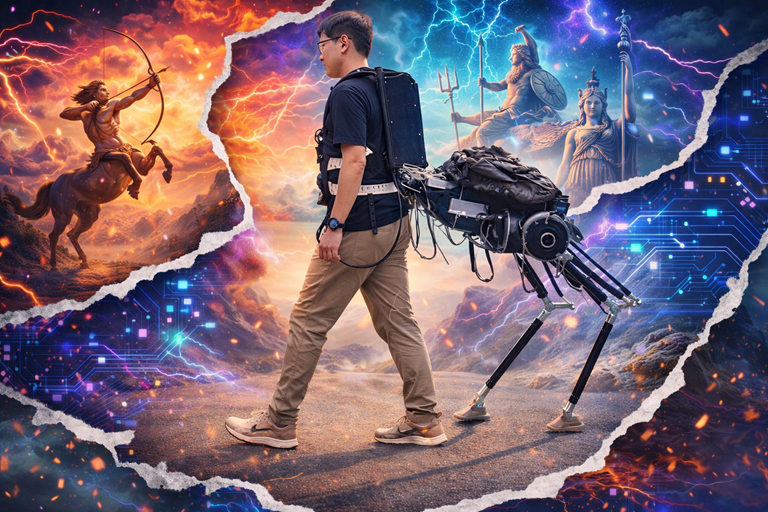
Scientists in China have developed a robot centaur system that gives people two extra mechanical legs to help carry heavy loads.
The wearable device, created at the Southern University of Science and Technology in Shenzhen, forms a hybrid system in which a person and robot move together in a four legged configuration. The robotic legs sit behind the user and are connected through a wearable backplate and elastic mechanism.
Unlike traditional exoskeletons, which attach directly to the limbs, this system operates as a separate robotic partner. The human remains responsible for balance and navigation, while the robot assists with strength and movement.
Why build a robot centaur
Carrying heavy loads over long periods can place significant strain on the body, particularly on the spine, joints and feet. Researchers say this can lead to fatigue and long term injury.
Existing technologies attempt to address this in different ways. Autonomous robots can transport equipment without human effort, but they can struggle in complex environments and are limited by battery life and payload capacity. Wearable systems such as exoskeletons assist movement but often do not remove enough of the load from the user.
The robot centaur was designed as a hybrid approach. It combines human decision making and adaptability with robotic strength, aiming to reduce physical strain while maintaining natural movement.
How the system works
The device uses two robotic legs and a supporting torso mounted behind the wearer. These legs move in coordination with the user, sharing the load and helping propel them forward.
A key feature is the elastic connection between the human and the robot. Under lighter loads, the system remains relatively firm to maintain coordination. As the load increases, the connection becomes more flexible, allowing the robotic legs to absorb more force and carry a larger share of the weight.
The researchers also developed motion planning and control systems so the robot can adapt to changes in walking speed, direction and terrain.
Early results from testing
In controlled experiments involving a small number of participants, the system showed promising results.
When users carried a load of 20kg, the robot supported more than half of the weight on average. Participants also used around 35% less energy compared with carrying the same load unaided. Pressure on the feet was reduced, and walking patterns remained close to normal.
Researchers say these findings suggest the system could improve comfort and efficiency during load carrying tasks. However, they emphasise that the results come from early stage testing.
Challenges and limitations
Developing the robot centaur presented several technical challenges. One key issue was ensuring stable movement while the robot is physically connected to a human whose motion changes continuously.
The system also needed to balance flexibility and control. A rigid connection would restrict movement, while too much flexibility could reduce coordination between the human and the robot.
As with many robotic systems, factors such as weight, power consumption and performance on uneven terrain remain important considerations for future development.
What the future may hold
The research team suggests that similar systems could one day support workers who regularly carry heavy equipment, including in industrial, military or disaster response settings.
However, the current robot centaur remains a prototype and has not yet been tested outside controlled conditions. Further research and development will be needed before it could be used in real world environments.
Even so, the project highlights a growing area of robotics focused on augmenting human ability, rather than replacing it, and offers a glimpse of how humans and machines may increasingly work side by side.