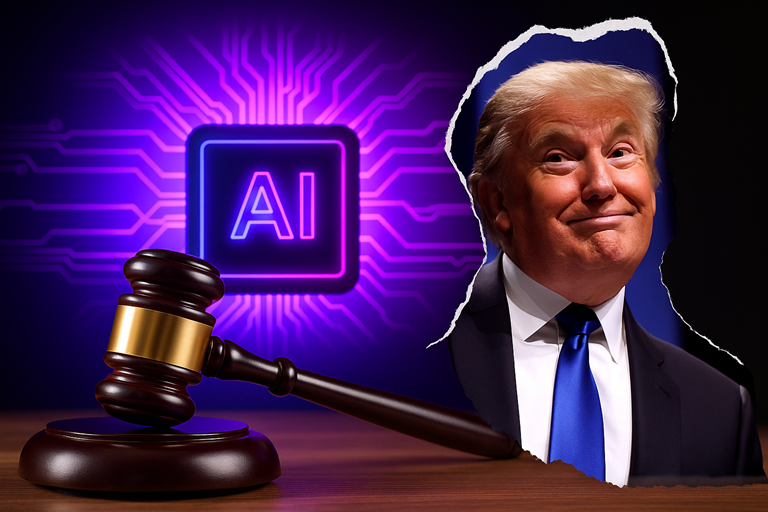
President Donald Trump is considering an executive order that would attempt to curb state-level regulation of artificial intelligence, setting up a significant legal and political fight over how one of the century’s most influential technologies should be governed.
A leaked draft, titled Eliminating State Law Obstruction of National AI Policy, outlines a federal strategy to challenge or override state measures that the administration views as restricting innovation. The document, described by officials as “pre-decisional”, has not been formally issued, and reports suggest the White House has paused action following internal debate and public criticism.
Even so, the draft gives the clearest indication yet of the administration’s direction: a push to replace emerging state laws with a single federal approach.
Why states moved first
States including California and Colorado have introduced more ambitious AI rules than those currently proposed at the federal level. Their measures focus on transparency, bias testing and consumer protection, reflecting concerns about AI systems already involved in decisions about housing, credit, hiring and access to services.
Supporters of state action argue these safeguards are urgently needed because AI can produce errors or discrimination that individuals cannot challenge or understand. They say federal inaction has left states to fill the gap.
However, Trump and several Republican leaders argue that differing standards across 50 states create burdens for developers and threaten the country’s position in global competition, particularly against China. The president has suggested that state rules risk producing inconsistent or politicised systems.
What the draft order proposes
At the heart of the leaked document is a plan to challenge state regulation through federal agencies and the courts.
A new AI litigation task force within the Department of Justice would examine state laws and pursue legal challenges where the administration believes they conflict with federal priorities or interfere with interstate commerce. The Commerce Department would review state regulations and could recommend limiting certain federal funds for states that maintain what it deems overly restrictive measures, although the legal scope of such funding conditions remains uncertain.
Other agencies, including the Federal Communications Commission and the Federal Trade Commission, would be directed to explore national standards that could pre-empt state requirements. Legal experts note that only Congress can fully override state laws, but the executive branch can influence the landscape by setting federal rules and engaging in sustained legal challenges.
Political pushback from unexpected quarters
Efforts to insert a temporary ban on state AI laws into the annual defence bill have also surfaced in Congress. Yet these proposals have met resistance not only from Democrats but also from prominent conservative figures who argue that federal pre-emption undermines states’ rights.
Republican governors including Ron DeSantis and Sarah Huckabee Sanders have criticised the move, saying it risks weakening protections for children and consumers. Others on the right warn it would benefit large technology companies at the expense of smaller developers and local communities.
This rare cross-party alignment underscores the high stakes of AI governance and the difficulty of achieving consensus on rapid regulatory change.
A defining moment for AI oversight
If the executive order is eventually signed, it would not automatically nullify state laws, but it would trigger immediate legal challenges and intensify the national debate over AI accountability. Supporters see the plan as necessary to ensure American leadership in AI, while critics warn it could weaken essential safeguards and give major technology firms disproportionate influence.
For now, the future of the draft remains uncertain. But the controversy surrounding it highlights a broader question facing the United States: how to balance innovation with public protection, and who should decide what responsible AI looks like.