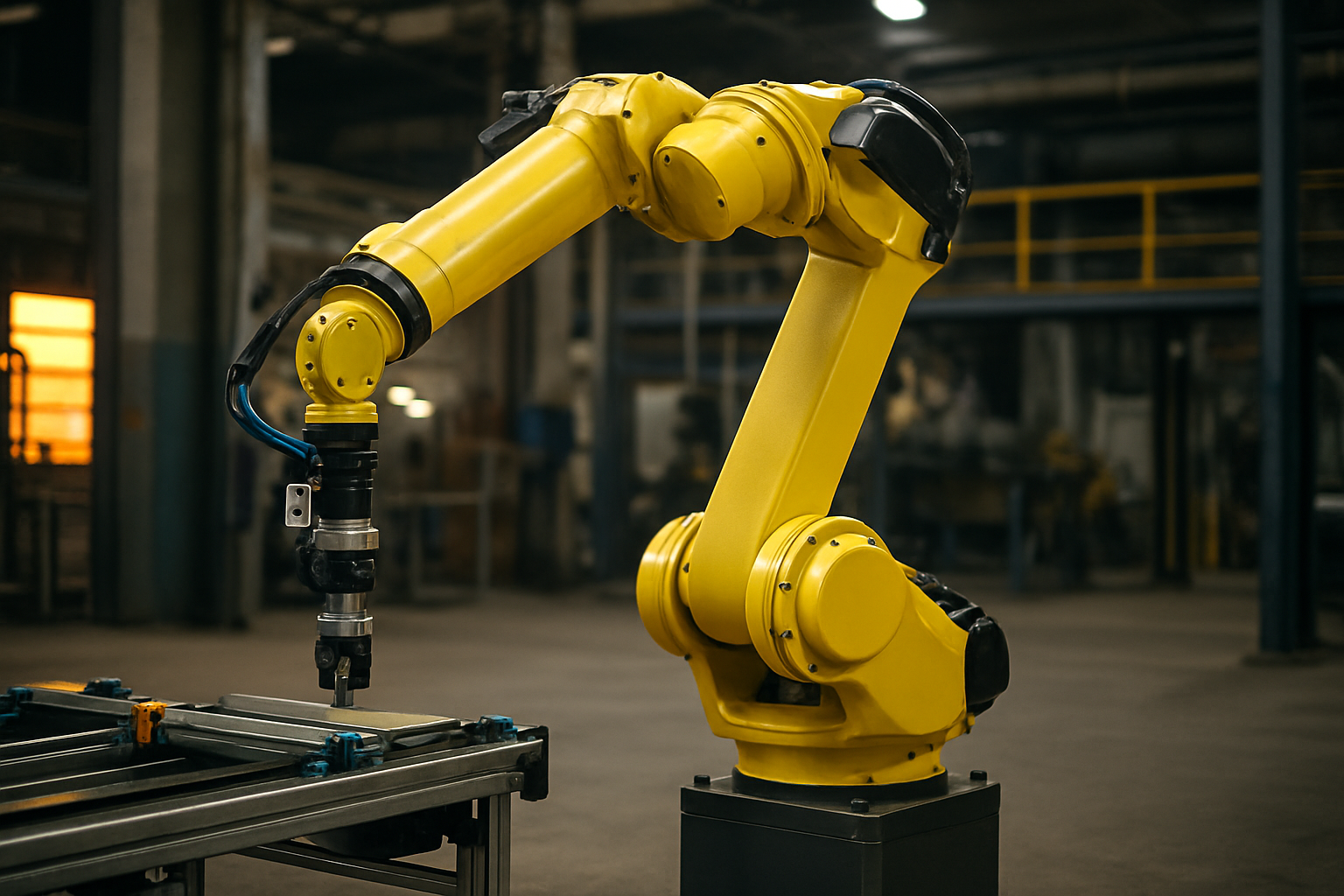
When we watch a robotic arm welding a car frame, placing components on a circuit board, or even picking up a toy in an arcade machine, one question arises: how do engineers design machines to move with such precision? The answer lies in a concept called degrees of freedom (DoF).
Defining Degrees of Freedom
In robotics, a degree of freedom refers to a single, independent way that a mechanism can move. This could be:
- Rotational movement around an axis, such as an elbow bending or a wrist twisting.
- Linear movement along an axis, similar to a drawer sliding open and shut.
Each joint in a robotic arm contributes one or more DoF, and by counting them we can describe the overall capability of the system. For example, an arm with six joints, each providing one movement, has six degrees of freedom.
The Six Fundamental Movements
Any rigid object moving in three-dimensional space has, at most, six degrees of freedom:
- Translation along the X, Y, and Z axes (up/down, left/right, forwards/backwards).
- Rotation about those same three axes, known as roll, pitch, and yaw.
A robotic arm that possesses all six is considered “fully free,” able to position its end effector at any point in space with any orientation. This makes 6-DoF arms the gold standard in industrial automation.
Robots by Degrees of Freedom
Different applications demand different levels of flexibility:
- 3-DoF robots move only along the three spatial axes. They are common in 3D printers, basic gantry systems, and arcade claw machines.
- 4-DoF robots add rotation, often around the vertical axis. These are widely used in assembly and packaging lines where orientation is important.
- 5-DoF robots provide greater dexterity, often seen in CNC machining, though they cannot achieve complete orientation control.
- 6-DoF robots offer full freedom, making them ideal for complex tasks such as welding, painting, or advanced assembly.
- 7+ DoF robots include additional joints beyond the fundamental six. While the end effector cannot exceed six true DoF, these “redundant robots” gain flexibility in avoiding obstacles, optimising motion paths, and reducing awkward locked positions known as singularities.
Degrees of Freedom vs. Functions

It is important to distinguish between a degree of freedom and a function. Opening or closing a robotic gripper, for instance, is a function, but it does not provide new freedom of movement for the arm as a whole. For this reason, a manipulator might be described as having six DoF and seven functions.
Choosing the Right Number of DoF
The required number of degrees of freedom depends on the task at hand.
- Simple pick-and-place operations may only need three.
- Machining or assembly tasks often require four or five.
- Six provides complete freedom and is the most versatile choice for industrial use.
- More than six is advantageous where space is limited, or where the ability to take multiple paths to the same goal reduces the risk of failure.
In short: more degrees of freedom bring more capability, but also more complexity, cost, and control challenges.
Conclusion
Degrees of freedom may seem an abstract concept, but they are the foundation of robotic motion. By understanding them, engineers can design machines that range from straightforward automated helpers to highly adaptable robotic arms that rival human flexibility.
The next time you encounter a robot in action, count the joints. You will quickly gain insight into its mechanical freedom—and the engineering decisions that shaped it.