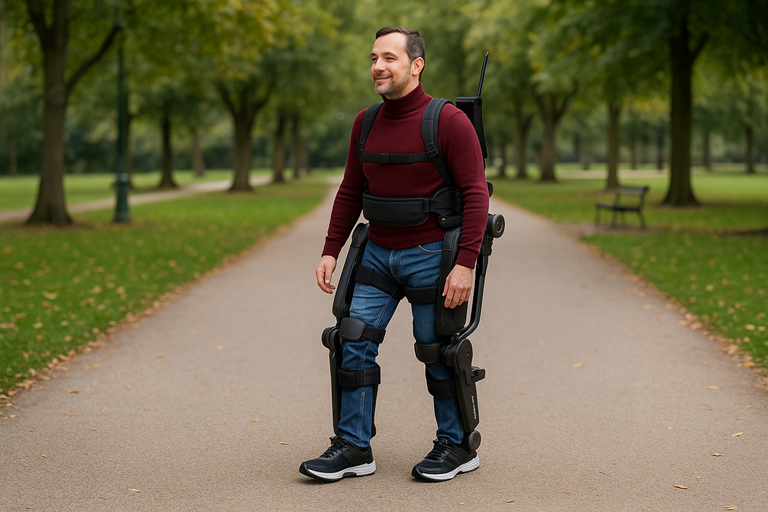
The U.S. Food and Drug Administration has expanded its approval for the Atalante X robotic exoskeleton, a self-balancing rehabilitation device developed by French company Wandercraft. The system, already in use at more than 100 rehabilitation and research centres worldwide, helps people with severe mobility impairments to walk again without the use of crutches or walkers.
The FDA’s latest decision allows the Atalante X to be used by individuals with spinal cord injuries from levels C4 to L5 and by people living with multiple sclerosis. This widens access to advanced, hands-free gait therapy that can help rebuild walking ability and improve posture.
How the exoskeleton works
The Atalante X is a robotic frame worn around the lower body and torso. Using a combination of artificial intelligence, powered joints and advanced sensors, it enables the user to walk with a smooth, natural gait. Unlike traditional exoskeletons that require arm supports, Atalante X is self-balancing, allowing people with limited upper-body strength to stand upright and move safely.
Each hip and knee motor can be tuned independently, giving therapists precise control over movement. The exoskeleton’s ankle joints are powered, allowing complex motion that closely mimics the human stride. Step length can be adjusted in small increments, ensuring that each session is tailored to the patient’s abilities and progress.
Data from each session is displayed through enhanced graphical reports, helping clinicians to track progress over time. The latest design also includes more durable foam supports for comfort during extended use.
Overcoming major challenges
Developing a truly self-balancing exoskeleton was no small feat. Earlier models of robotic walking aids required users to rely on crutches or parallel bars, limiting access for those with severe paralysis or reduced arm strength.
Wandercraft’s engineers had to create a system that could manage balance automatically while adapting to different body types and movement patterns. The device’s AI control system was trained through millions of real and simulated walking cycles, enabling it to anticipate shifts in weight and adjust instantly.
Another challenge was ensuring safety and comfort during long rehabilitation sessions. Extensive testing and clinical trials, including more than 500 training sessions across multiple centres, confirmed that the Atalante X could be used safely by patients with high-level spinal injuries.
Who it’s for and how long it can be worn
The Atalante X is primarily aimed at people with spinal cord injuries, multiple sclerosis and those recovering from stroke or other neurological conditions that affect mobility. In a clinical setting, patients typically use the exoskeleton during supervised sessions that last between 30 and 90 minutes, depending on their stamina and treatment goals.
For many, these sessions are about more than movement—they help improve cardiovascular health, muscle tone and mental well-being by restoring the experience of standing and walking upright.
Looking ahead
Wandercraft’s CEO, Matthieu Masselin, described the expanded approval as a milestone for neurorehabilitation, saying it allows therapists to “help even more people with severely limited upper-body strength to experience upright movement safely and confidently.”
With the company already working on a personal-use version of the exoskeleton, future patients could one day bring the technology home—turning what was once considered impossible into part of daily life.