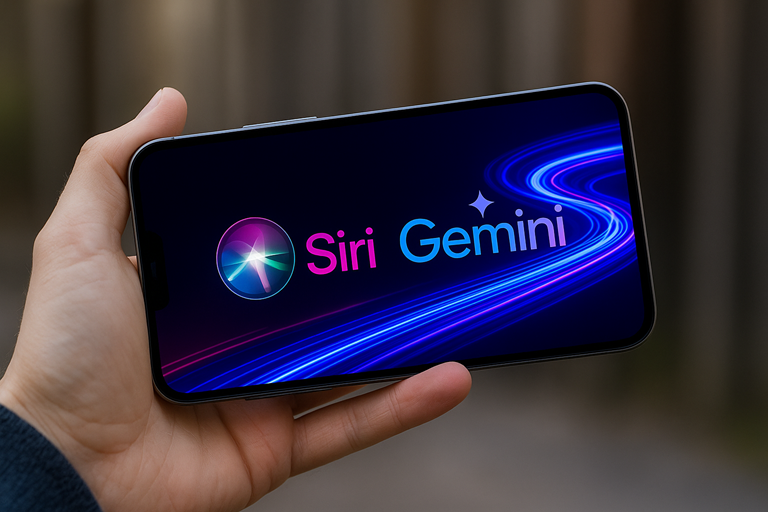
Apple has agreed a major partnership with Google that will see the next generation of Siri powered by a customised version of Google’s Gemini artificial intelligence model. The deal, reported by Bloomberg and Reuters, is understood to be worth around one billion dollars a year and marks a rare moment of collaboration between two of the technology world’s fiercest competitors.
A new engine for Siri
For more than a decade, Siri has been a central feature of the iPhone experience. Yet the voice assistant has often lagged behind rivals when handling complex requests or integrating with third party apps. Apple now hopes a significant upgrade will change that.
The company is set to deploy a special version of Google’s Gemini model, one with an enormous 1.2 trillion parameters. This makes Apple’s existing 150 billion parameter in-house model look modest by comparison. The upgraded system will run on Apple’s Private Cloud Compute servers, which the company says will allow it to maintain its long standing focus on privacy while tapping into far greater processing power.
The move follows delays to Apple’s own AI efforts. New capabilities for Siri had been pushed back earlier this year, and Apple is reported to have evaluated both OpenAI and Anthropic before deciding Google offered the most suitable path forward.
What this means for Apple users
For consumers, the shift is expected to deliver a noticeably more capable Siri. Tasks that previously confused the assistant, such as multi step instructions or more conversational queries, should see significant improvement. Apple says users will not interact directly with Google’s chatbot technology, and the agreement does not bring Google search results into Apple systems. Instead, Gemini will operate quietly behind the scenes to enhance Siri’s understanding and responsiveness.
The arrangement also allows Apple to keep personal data processed on device, reserving cloud-based Gemini support for more complex tasks. This hybrid approach reflects Apple’s continuing efforts to offer advanced features without compromising its privacy-led strategy.
Why Apple is partnering rather than building
Despite being one of the world’s most valuable companies, Apple has struggled to compete with the rapid advances made by dedicated AI firms. Training large scale models requires substantial expertise and investment, often running into billions of dollars. Apple’s long standing preference for on-device processing has also limited its ability to match the scale achieved by cloud based AI systems.
Analysts say the partnership provides a pragmatic shortcut. Apple gains access to state-of-the-art technology while continuing to develop its own models at a slower pace. Reports suggest the company still aims to replace Google’s technology with its own in the future, once its internal systems are ready.
Looking ahead
The revamped Siri is expected to launch next spring, giving Apple several months to test and refine the new capabilities. While Google’s technology will play a major role in the upgrade, Apple is understood to be keeping its options open, including the possibility of using additional third party AI systems.
For now, in one of the more unusual twists of the current AI race, the future of Siri is being shaped not in Cupertino alone but with the help of Apple’s biggest rival.