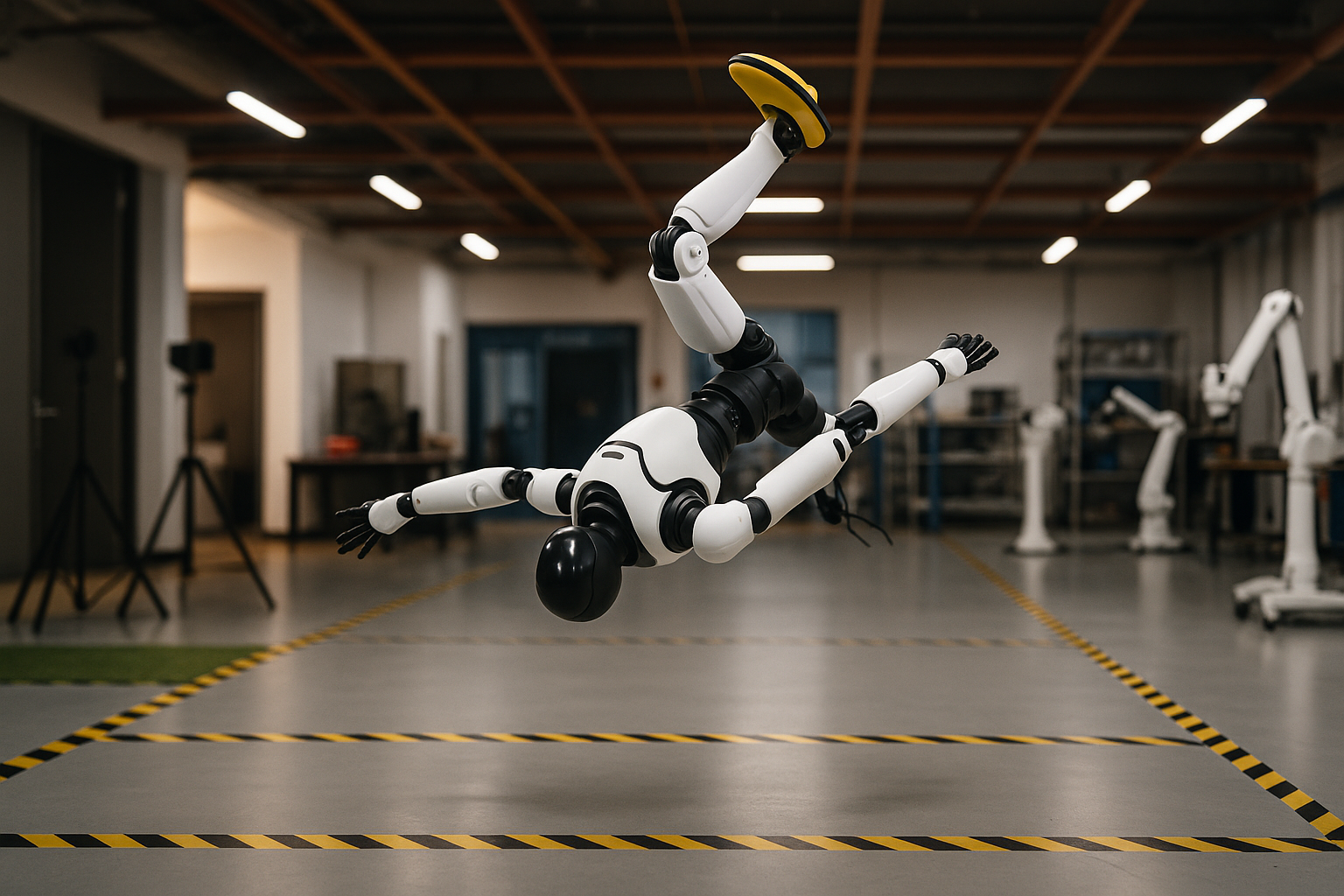
A humanoid robot has stunned the tech world by performing a Webster flip, a forward somersault taken off one leg. The move, normally reserved for elite gymnasts, demands perfect balance, timing and strength.
In a newly released 30-second video, Chinese robotics firm AGIBOT showcased its Lingxi X2 robot launching, rotating and landing the flip in ultra-slow 4K detail. Until now, no humanoid has ever managed the stunt.
Why this is a big deal
For decades, humanoid robots have struggled most with agility and balance. Walking across uneven ground is hard enough, let alone leaping, spinning and landing.
AGIBOT’s success shows how advanced control systems and sensors are reaching a point where robots can execute highly dynamic, human-like motions once thought impossible. Experts say it is a sign humanoids are moving beyond simple walking and lifting tasks into far more versatile roles.
The tech behind Lingxi X2
The Lingxi X2 uses:
- Multi-joint force control to allow each limb to adjust pressure and torque in real time
- Real-time perception with sensors that track motion and balance on the fly
- Proprietary motion algorithms that calculate how to launch, flip and land safely
These capabilities are part of AGIBOT’s broader vision of embodied intelligence, meaning robots that can adapt to unpredictable environments through movement.
Competition heating up
Other robotics firms are also pushing boundaries:
- Boston Dynamics’ Atlas has performed parkour, backflips and obstacle vaults
- Unitree’s G1 and R1 models can execute kung fu kicks, side flips and recover from being deliberately knocked over
- University projects such as Berkeley’s HITTER robot have demonstrated AI-driven table tennis rallies
But AGIBOT’s Webster flip stands out as a world first, combining explosive power with delicate coordination.
What’s next for humanoid robots?
AGIBOT launched a partner programme in May and plans large-scale production later this year, with several thousand units expected by the end of 2026.
The global humanoid robot market is forecast to be worth 38bn dollars by 2035. Feats like the Webster flip are more than showmanship, they demonstrate that humanoid robots are edging closer to operating in real-world settings where agility and adaptability are key.