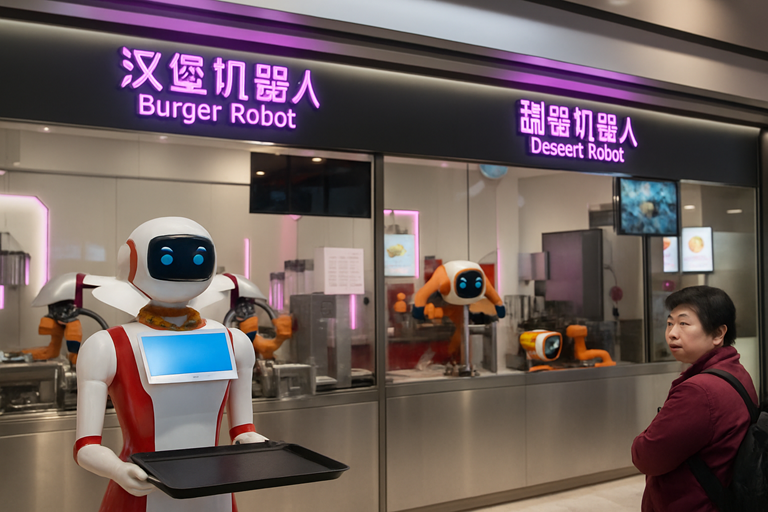
Shanghai has announced an ambitious strategy to usher in a new era of AI powered dining, unveiling plans for robot staffed kitchens, automated service and data driven menus. The city aims to position itself as China’s leading hub for smart restaurants by 2028, signalling a major shift in how food is prepared, served and consumed.
A vision for smart restaurants
The plan, released by Shanghai’s commerce commission alongside several municipal departments, outlines a sweeping adoption of intelligent technologies across the catering industry. Officials want more than 70 per cent of fast food chains and group dining services to use smart systems throughout their operations within three years. Full service restaurants are expected to integrate automation into at least half of their kitchen and service processes.
The city will introduce smart central kitchens, launch a series of AI and dining pilot projects, and support local restaurants looking to expand abroad by building intelligent international supply chains.
Robot drink dispensers, automated fryers, rice cooking machines and burger assembly robots are among the technologies being promoted. Larger chains will also be encouraged to set up centralised facilities combining automated washing, cooking and packaging systems.
How the technology works
Most of the systems being rolled out rely on a blend of robotics, machine vision, sensor technology and AI driven decision making. Cooking robots use precision temperature controls and real time monitoring to reproduce dishes consistently. Service robots typically use indoor mapping, obstacle detection and route planning tools to navigate busy dining rooms.
These technologies are designed to be scalable, allowing restaurants to automate individual tasks or entire workflows. Their flexibility also means they can be adapted for different cuisines, portion sizes or kitchen layouts.
Impact on small restaurants
While the move promises greater efficiency for larger chains, analysts warn that small, family run eateries could struggle. Many independent restaurants lack the funds or technical expertise to adopt AI systems quickly, potentially widening the gap between well backed brands and traditional businesses.
Some consultants say this shift may reshape the market, squeezing out owners who rely heavily on manual labour. Others argue it could create opportunities for tech firms that support smaller restaurants with affordable automation packages.
Concerns around flavour and tradition
Despite the city’s confidence, not everyone is convinced that robot kitchens can capture the subtleties of Chinese cooking. Diners often prize wok hei, the distinctive flavour created by high heat stir frying. Critics fear that over automation could lead to uniform dishes, a decline in regional culinary traditions and what some have called a machine taste.
Researchers warn that if flavour quality drops, customers may push back, affecting wider adoption of the technology.
A changing labour market
The rise of AI dining is expected to shift job roles rather than simply reduce them. Workers in routine jobs such as dishwashing, serving or prep cooking may face displacement. However, emerging roles in equipment maintenance, digital operations and data analysis could create new opportunities, particularly for those with technical skills.
As Shanghai positions itself as a testing ground for AI dining, the city’s experiment could shape the future of food service across China, influencing how meals are made and how restaurants operate for years to come.