Writing different Character Sets

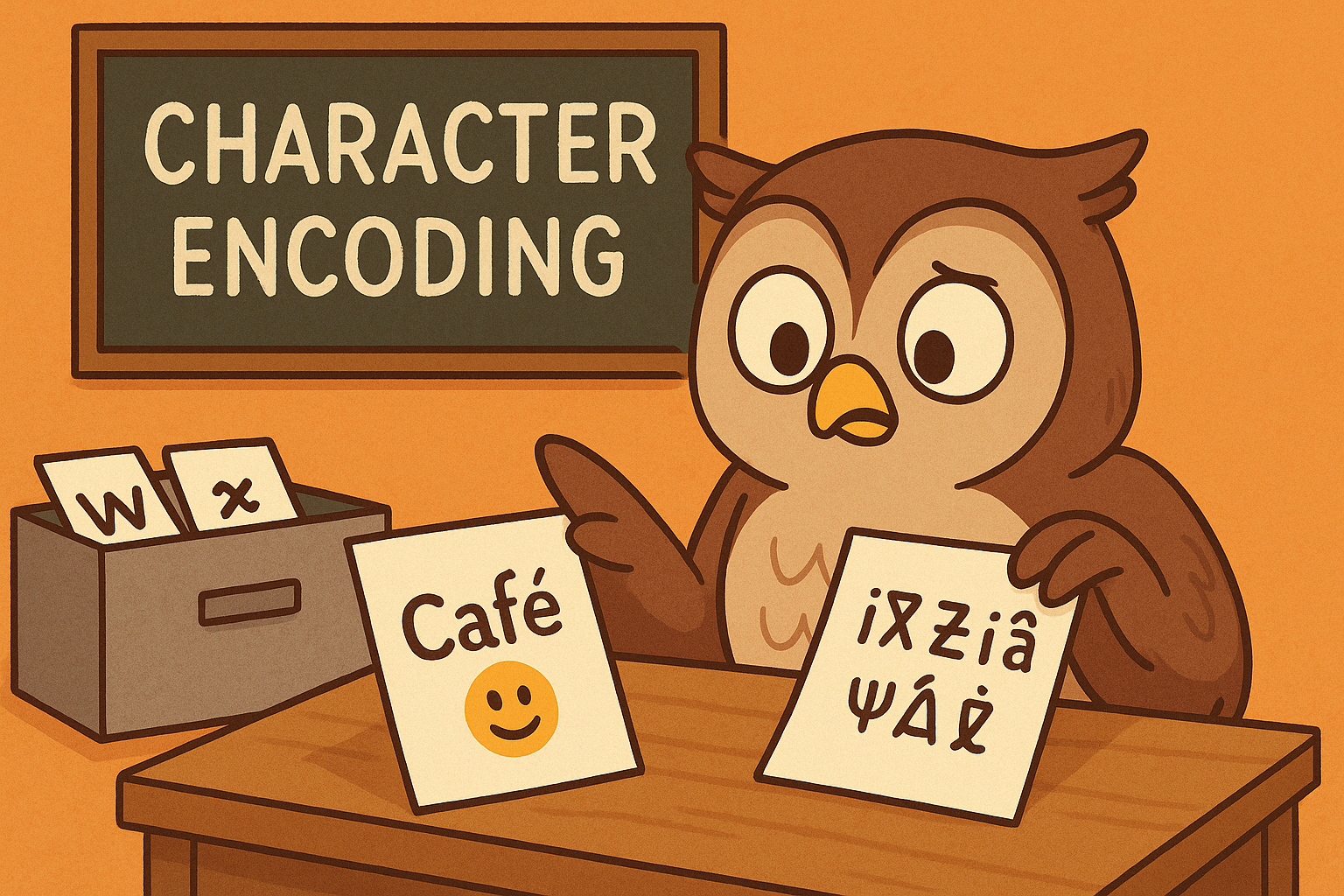
A cartoon owl sits at a desk holding two papers. One shows “Café 😊” clearly, the other displays scrambled symbols. Behind, a chalkboard reads “Character Encoding.”

Character Encoding

Text files are stored as bytes plus an encoding. The safe choice is UTF-8. Wrong encoding = strange characters or UnicodeEncodeError.

Why so many encodings? Early computers could only store simple alphabets (like English). Later, people needed accented characters, then whole alphabets like Arabic and Chinese. Each region invented its own system. UTF-8 solved the chaos by covering nearly every character in the world.

Try this:

  • Write a file with emoji in UTF-8, then try latin-1 and see what happens.

Appending with Care

Appending is perfect for logs. Don’t forget your newline.

Try this:

  • Append several lines and check they’re separated correctly.
  • Write a simple log(msg) function.

Safer Updates

If you’re updating a file, avoid half-written results. Write to a temporary file, then replace.

Wrap-up

The first tutorial on writing files taught the basics: writing, appending, and handling simple exceptions.
This tutorial explored encodings, appending logs, and safer update patterns.

Master both parts and you’ll be able to create, update, and extend files confidently in Python.

Main Topic

Python Files and Directories

A cartoon owl with wide eyes stands in front of grey filing cabinets. One drawer is open, filled with folders, and the owl is holding a single document. The background is a warm orange tone, and the words “PYTHON FILES” appear in large bold text above the cabinets.

A light-hearted intro to handling files and directories in Python, featuring an owl mascot and fun “Python Files” imagery.

Other Tutorials in this Topic

A cartoon owl shrugs at a table with three letters: one in English, one in Arabic, and one in Chinese. Above it, bold text reads “CHARACTER ENCODINGS.”

Reading different Character Sets

This tutorial explains character encodings, why they exist, handling decoding errors, platform newline differences, and reading binary…

A cartoon owl with wide eyes stands against an orange background, holding and reading a letter. Above it, bold text reads “READING FILES IN PYTHON.”

Reading Files in Python

This tutorial teaches how to safely open and read files in Python, explore different reading methods, and…

A cheerful cartoon owl writes in an open notebook with a quill pen beside a filing cabinet drawer labelled “w, a, x.” Above, bold text reads “Writing Files in Python.”

Writing to Files in Python

Part 1 introduces writing to files in Python using context managers, explains file modes w, a, x,…

A cartoon owl takes a document from a filing cabinet and drops it into a bin. Above, bold text reads “File Operations.”

Renaming and Deleting Files in Python

This tutorial covers renaming, moving, and deleting files in Python using pathlib, with examples, common exceptions, and…

A cartoon owl stands in front of a bookshelf, holding an old book while placing a new one on the shelf. Above, bold text reads “File Operations.”

More Python File Operations

This tutorial explores safer file operations, including overwriting with os.replace, moving across drives, creating backups, soft deletes,…

A cartoon owl stands at a crossroads holding a map. Signposts point to Linux (/home/), Windows (C:\Users), and Reports. Above, bold text reads “Navigating Directories in Python.”

Navigating Directories in Python

This tutorial explains navigating directories in Python with pathlib, covering creating, listing, deleting folders, handling exceptions, and…