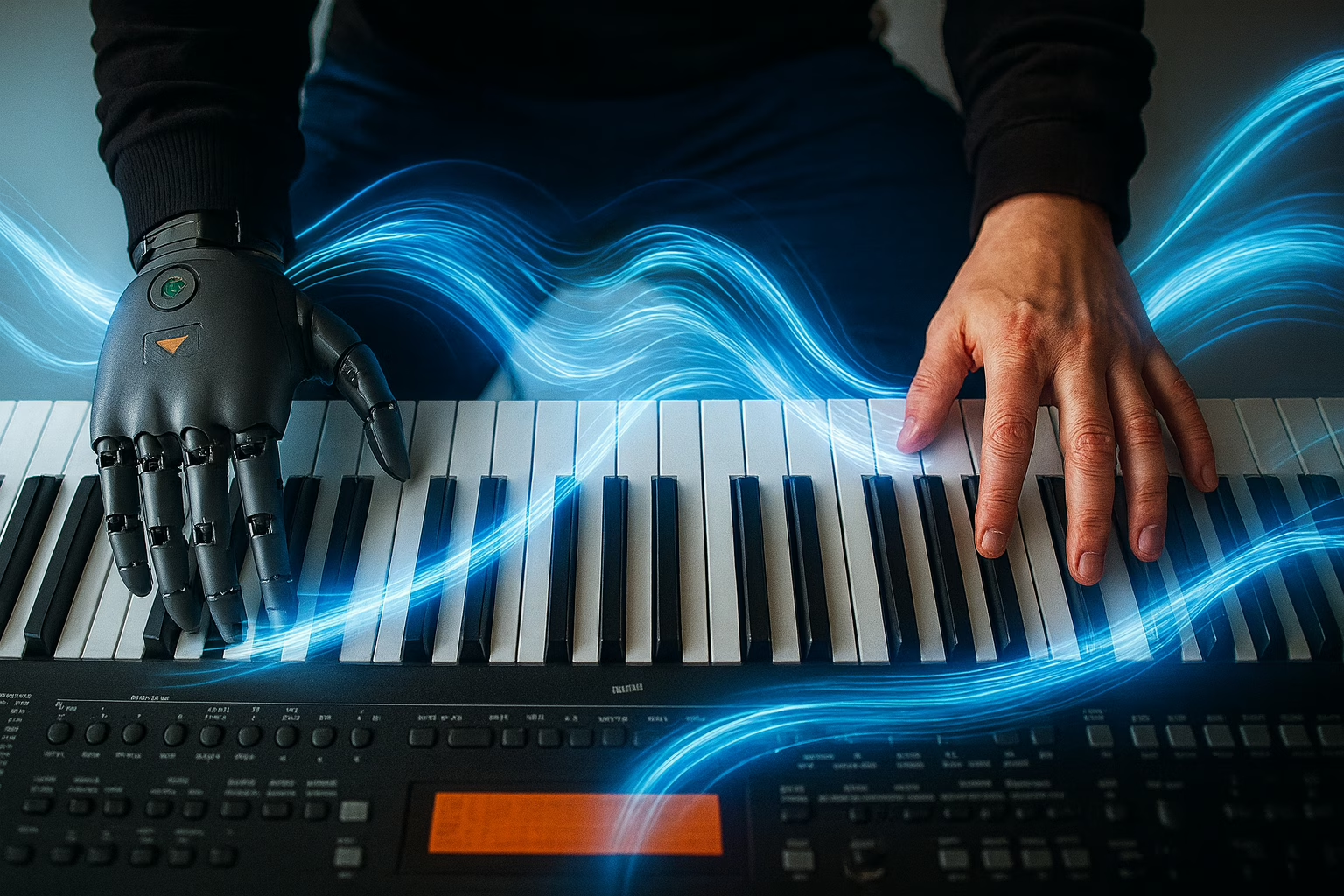
A Chinese technology company has developed a bionic hand that can be controlled purely by thought, a breakthrough that could help amputees regain skills they once lost, such as playing musical instruments or writing.
From Science Fiction to Everyday Life
At first, it sounds like something from a science-fiction film: a robotic hand that moves through the power of the mind. Yet at BrainCo, a Hangzhou-based firm specialising in brain–computer interface (BCI) technology, it is already a reality.
Zhou Jian, an experience officer at the company, recently demonstrated the hand’s precision by performing a melody on the piano using only his thoughts. “It moves exactly as I think, giving me back the feeling of my lost right hand,” he said.
The technology was first showcased at the Hangzhou Asian Para Games in 2023, when torchbearer Xu Jialing used the bionic hand to pass the flame.
Playing the Piano with Thought
One of the most striking demonstrations of BrainCo’s invention is its ability to restore the delicate control needed to play the piano.
Using sensors that detect brain and muscle signals, the prosthetic translates the user’s intention into finger movements accurate enough to strike individual keys and control tempo and pressure. The result is not just movement but music, a form of self-expression many amputees thought they would never experience again.
Experts say this level of fine motor control marks a major leap in prosthetic technology. Unlike older mechanical models that relied on shoulder or residual limb movements, this bionic hand responds directly to the user’s thoughts, allowing smoother, more natural coordination across multiple fingers.
How Thought Becomes Movement
The smart bionic hand works through non-invasive BCI sensors that pick up neural and muscular activity from the user’s arm. These signals are processed by artificial intelligence algorithms, which interpret them in real time and convert them into corresponding mechanical movements.
This allows users to perform complex tasks, from picking up fragile objects to tying shoelaces, with intuitive control. It effectively reconnects the brain to a limb that is no longer physically there, turning thought into precise motion.
Years of Research and Refinement
BrainCo was founded in 2015 by a team of researchers connected to Harvard, MIT and Tsinghua University. Development began after one team member lost a limb, inspiring the company to create a prosthetic that could mimic the natural movement of the human hand.
After eight years of research, the company overcame challenges in signal detection and algorithm training. Since its 2020 launch, the hand has undergone five major redesigns and is now the world’s first mass-produced neural-controlled prosthetic.
Lightweight, Precise and Powerful
The latest version, known as the Revo2, weighs only 383 grams, about the same as six eggs, yet can lift up to 20 kilograms. It features ten movable joints, six degrees of freedom, and tactile sensors that allow it to detect pressure, texture and even object hardness.
Quiet, compact and designed for everyday use, the Revo2 can help users regain not just function but confidence.
A Glimpse into the Future
BrainCo hopes to combine brain–computer interfaces with artificial intelligence and cloud computing to expand into rehabilitation, mental health and robotics.
“Our mission is to create personalised solutions that empower people to regain independence and rediscover abilities they thought were gone,” said co-founder He Xiyujin.
For users like Zhou Jian, the impact is deeply personal. With each note on the piano, his mind and machine move in harmony, proof that technology can help restore both skill and spirit.