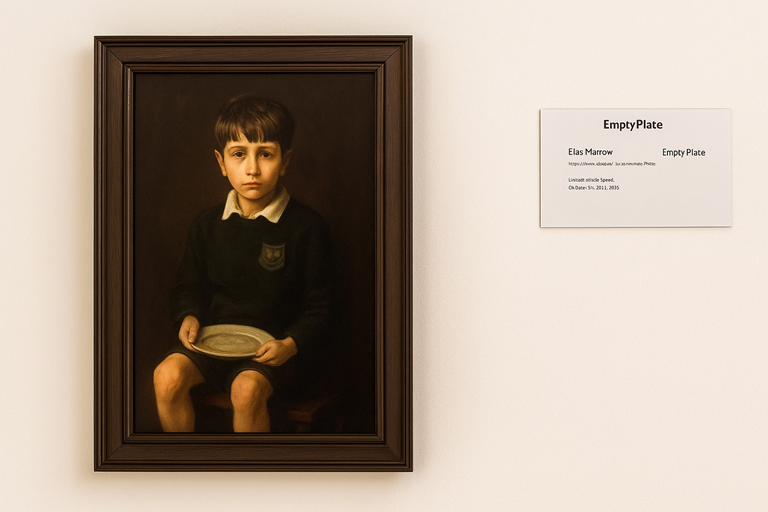
Visitors to the National Museum Cardiff were left puzzled after discovering a mysterious artwork that no one could explain. The digital print, titled Empty Plate, showed a young boy in a school uniform sitting with a book under his arm and an empty plate on his lap. For several hours, it hung unnoticed on the wall of the museum’s contemporary art section before curious visitors alerted staff.
The piece had not been part of the official exhibition. It was later revealed to have been secretly installed by conceptual artist Elias Marrow, who described the act as “participation without permission”.
An Amgueddfa Cymru spokesperson confirmed the incident, saying: “An item was placed without permission on a gallery wall in National Museum Cardiff. We were alerted to this and have removed the item in question.”
Who is Elias Marrow?
Little is known about Marrow, who has developed a reputation for guerrilla-style interventions in public galleries. He has previously carried out similar unsanctioned installations at Bristol Museum and Tate Modern.
Marrow said Empty Plate was created using artificial intelligence, following a hand-drawn sketch. The artist described the piece as a “digital print on paper, housed in a custom-made frame,” representing “the state of Wales in 2025”. He said the work also “references Victorian charity propaganda” and was intended as a “gift to Cardiff Museum”.
Explaining his motives, Marrow said he wanted to question “how public institutions decide what’s worth showing, and what happens when something outside that system appears within it”.
Art, AI, and public spaces
The use of artificial intelligence in Empty Plate has reignited debate about the role of AI in art. Marrow said the technology was “part of the natural evolution of artistic tools”, arguing that “AI is here to stay; to gatekeep its capability would be against the beliefs I hold dear about art.”
While some visitors were intrigued by the unexpected addition, others were less impressed. One tourist from Ireland said they first assumed it was a performance piece before realising it was a “guerrilla installation”. They described the print as “poor quality” and questioned why it had not been labelled as AI-generated.
Despite mixed opinions, Marrow said the stunt was well received overall. “People took photos and shared them. The work isn’t about disruption. It’s about participation without permission,” he said. “I’m not asking permission, but I’m not causing harm either.”
A fleeting moment on display
The museum confirmed that the unauthorised work was removed shortly after staff became aware of it. It is estimated that a few hundred people saw Empty Plate before it was taken down.
Although only on the wall for a few hours, the incident has sparked discussion about what counts as legitimate art in an age where technology blurs traditional boundaries.
For Marrow, the short-lived display was a success. “If people talked about it, even for a moment, that means it did its job,” he said.