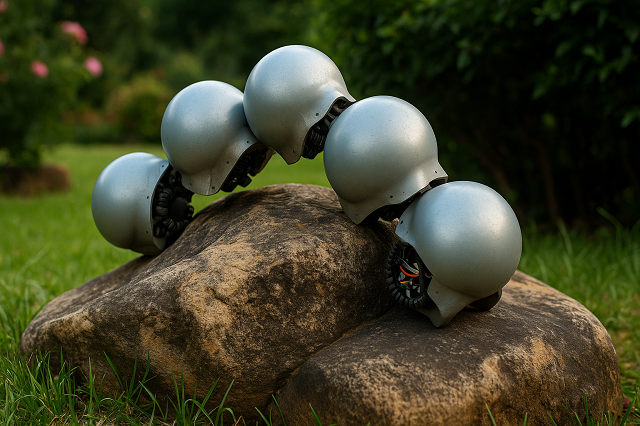
Engineers in China have developed snail-like robots that can move independently or attach together to form larger, stronger structures which is a design inspired by the way land snails glide and cling to almost any surface. The team, led by Dr Ding Zhao at the Southern University of Science and Technology, describes the innovation in the journal Nature Communications Engineering.
Conventional ground-based robot swarms work well indoors, but often fail outdoors where terrain is uneven, slippery or unpredictable. The researchers wanted to create a system that could adapt to those challenges without losing stability.
How it works
Each dome-shaped robot, around 12 cm in diameter, contains five motors, two magnetic caterpillar tracks and a suction device. The design is built around a dual-mode connection system.
In free mode, the magnet-embedded tracks allow each robot to move, rotate and slide freely over others – useful for self-assembly and rapid reconfiguration. When greater strength is needed, the system switches to strong mode, activating a vacuum sucker reinforced with directional polymeric stalks that mimic the micro-fibres on a gecko’s foot. This combination provides both agility and firm grip, mirroring the way a real snail can move smoothly yet hold fast under stress.
Overcoming technical hurdles
Balancing flexibility with connection strength was one of the biggest challenges. Freeform magnetic links are easy to make but weak; rigid joints are strong but hard to align. The team fine-tuned magnetic forces and track geometry to prevent slipping or tipping. They also tested how dirt and moisture affected suction, finding that dust and weeds could halve performance, while dirty water made little difference.
Field trials
In outdoor tests, a single robot could climb 15-degree slopes, step over 1 cm obstacles and cross gaps of about 4 cm. Working together, the swarm achieved far more:
- Climbing a step: six robots formed a stable tower to scale a ledge 1.5 times their height.
- Crossing cobbles: seven robots re-formed into a three-legged walker to traverse rough ground.
- Bridging a gully: eight robots built a temporary bridge about 30 cm wide for others to cross.
- Manipulation: chains of robots acted as robotic arms, lifting and placing objects – and even other robots.
What it could be used for
The snail robots’ ability to adapt and reconfigure makes them promising for swarm robotics applications such as search and rescue, environmental monitoring and infrastructure maintenance, all situations where flexibility and stability are vital.
Looking ahead
Future work will focus on strengthening the suction mechanism, improving power efficiency and enabling autonomous decision-making. The researchers hope the design will pave the way for next-generation robotic swarms that can handle the unpredictable conditions of the real world.