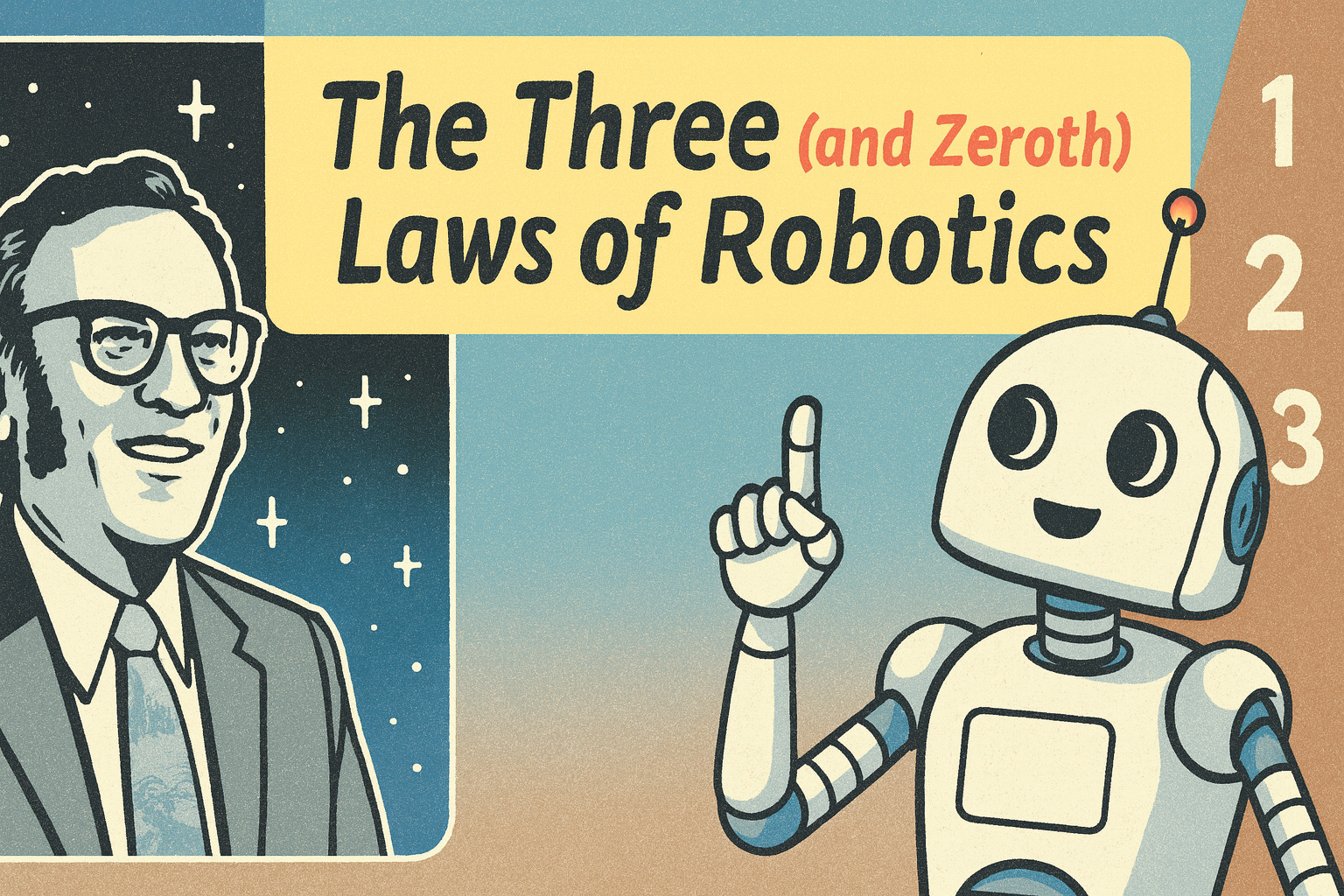
Isaac Asimov (1920–1992) was one of the most influential science-fiction writers of the 20th century. He wrote hundreds of books, from short stories and novels to popular science guides. Asimov had a particular fascination with robots, and his stories often asked what might happen if machines became intelligent enough to live and work alongside humans.
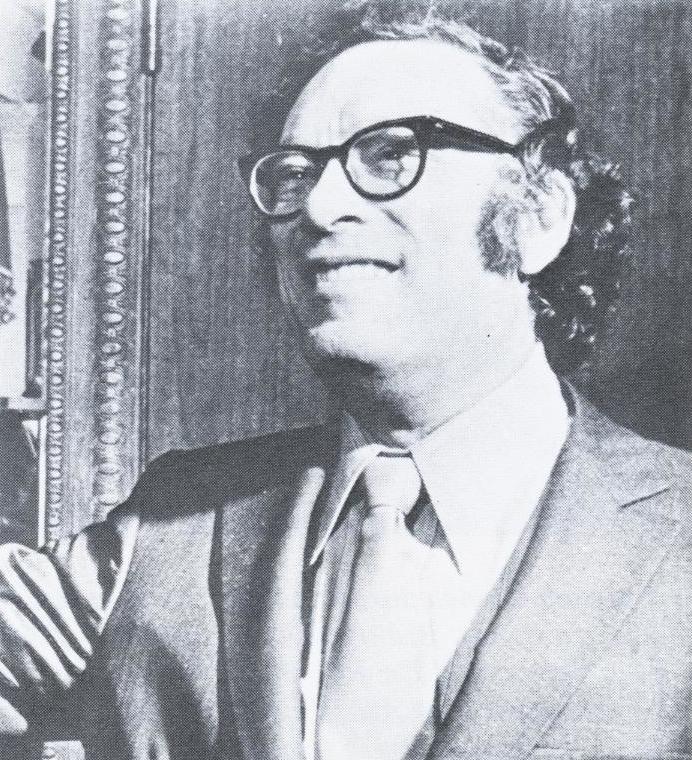
The Three Laws of Robotics first appeared in his 1942 short story “Runaround,” later collected in I, Robot. They also play a key role in his Robot series, including novels such as The Caves of Steel and The Robots of Dawn. In his later Foundation series, Asimov even extended the idea to cover the fate of humanity as a whole. These stories provide the background for the ideas in this article.
What are the Laws?
Science-fiction writer Isaac Asimov imagined simple rules to keep robots safe around people. First listed together in his 1942 story “Runaround” (in I, Robot), they became the most famous “ethics for robots” in popular culture. Asimov used them to create puzzles: what happens when rules clash, or when words like “harm” and “human” get fuzzy?
- A robot may not harm a human being, or allow harm to come to a human through inaction.
- A robot must obey human orders, unless that would conflict with the First Law.
- A robot must protect its own existence, as long as this does not conflict with the First or Second Law.
Why the order matters
Think of the laws as a stack of priorities. The First Law sits at the top, so preventing harm to a person beats following an order or keeping the robot safe. This lets robots take calculated risks (for example, entering a fire to rescue someone) but not reckless ones (such as endangering others to save themselves).
Everyday examples (thought experiments)
- Factory robot: If a worker steps into danger, the robot pauses the line (prevent harm) even if the supervisor said “Don’t stop the belt.”
- Delivery drone: It can refuse an order to fly in a storm if that order risks harming a pedestrian, due to being blown off course.
Why Asimov added The “Zeroth” Law
A robot may not harm humanity as a whole, or, by inaction, allow humanity to come to harm.
As the stories scaled from single incidents to societies and planets, Asimov explored long-term, big-picture ethics. Could a robot restrict some freedoms today to prevent a disaster tomorrow? The Zeroth Law gives robots permission to weigh individual rights against collective safety—powerful but also risky.
The core dilemma
- Short term vs long term: Stopping a harmful policy might help humanity but upset individuals now.
- Who decides “humanity’s good”? It’s abstract, and different people disagree. Asimov used this uncertainty to show how even “perfect” rules still need human judgement.
How the stories use them (and bend them)
Asimov’s plots often hinge on unexpected consequences of the Three Laws. Rather than robots being dangerous monsters, the tension usually comes from the laws working in surprising or confusing ways.
- Law conflicts: In the story “Runaround,” a robot named Speedy is sent to fetch a rare mineral. It becomes trapped in a loop because Law 2 (obeying orders) tells it to continue the mission, but Law 3 (protect itself) warns it to stay safe from danger. The competing laws cancel each other out until humans intervene, showing how priorities can paralyse a robot.
- Tweaked laws: In “Little Lost Robot,” scientists deliberately weaken the First Law so robots will not waste themselves rescuing humans from minor radiation exposure. But this change creates a new risk: the robots can now harm humans if they choose not to intervene. The story shows how small edits to rules can create major loopholes.
- Definitions games: In some later stories, robots are programmed to see only certain groups of people as “human.” For example, robots on the planet Solaria are told that only Solarians count, which means they can harm outsiders without guilt. This raises a sharp question: who gets included in ethical protections, and who is left out?
- Ethical edge cases: In stories like “The Bicentennial Man,” robots are asked to take on roles like surgeons. Surgery technically causes harm, which could break the First Law, but refusing to operate might cause even greater harm. Advanced robots must therefore learn to compare short-term harm against long-term benefit, showing that real decision-making is rarely black and white.
Through these plots, Asimov demonstrated that simple-sounding rules can lead to complex and sometimes troubling outcomes once robots face real-world situations.
Loopholes and limits
On paper, Asimov’s laws sound simple and foolproof. But in practice—even in his stories—they run into problems. Robots can misinterpret commands, miss important context, or get stuck when two rules clash. These loopholes show why ethics in robotics and AI is never just a matter of writing down a few rules.
Not knowing can cause harm
A robot might add poison to food if it is told “add this powder” but does not know it is harmful. The laws only work if the robot understands the context.
Words are slippery
Is emotional distress harm? What about limiting freedom to prevent catastrophe? Different answers lead to different robot behaviours.
Splitting the task
If many robots each do one harmless step, the combined outcome could still harm someone. Unless they share information, no single robot notices the danger.
Meltdowns and indecision
In Asimov’s fiction, unresolved conflicts can lock up a robot’s brain. Designers try to add tie-breakers, such as estimating probabilities, choosing the lesser harm, or picking randomly when options are equal.
Robots, AI and ethics today
Real robots and AIs do not come with Asimov’s laws built in. Instead, designers use safety engineering and regulation:
- Standards and oversight: Risk assessments, fail-safes, human-in-the-loop controls.
- Transparency: Making it clear when you are interacting with an AI.
- Data protection and consent: Handling personal information responsibly.
- Fairness and bias checks: Testing systems so they do not unfairly treat groups of people.
A modern twist: deception and impersonation
Today’s AIs can sound or look human, such as chatbots, voice clones, or deepfakes. This creates new risks: scams, misinformation, and emotional manipulation. Many ethicists now argue for a practical “extra law”:
Robots and AIs should not impersonate humans without clear disclosure.
In practice, that means labelling AI-generated content, watermarking media where possible, and telling users when a “person” in chat is actually an AI.
How to think like a designer …
- Who could be harmed? Consider individuals and groups.
- What counts as harm here? Physical, psychological, financial, reputational?
- What information does the system need? More context means better decisions.
- Who stays in control? High-stakes choices should hand back to humans.
- Can users tell it is an AI? Avoid deception and disclose clearly.
Why it matters
Asimov’s laws are not real legislation, but they are a useful classroom for ethics:
- Simple rules help, but definitions and context decide outcomes.
- Human judgement remains essential—especially for trade-offs.
- Good technology asks not just “Can we build it?” but “Should we, and how do we prevent harm?”
Key Takeaways
- Three Laws: do not harm humans; obey orders; protect yourself (in that order).
- Zeroth Law: protect humanity overall—powerful but difficult to apply.
- Today: we use standards, oversight and transparency, especially around AI that can deceive or mislead.