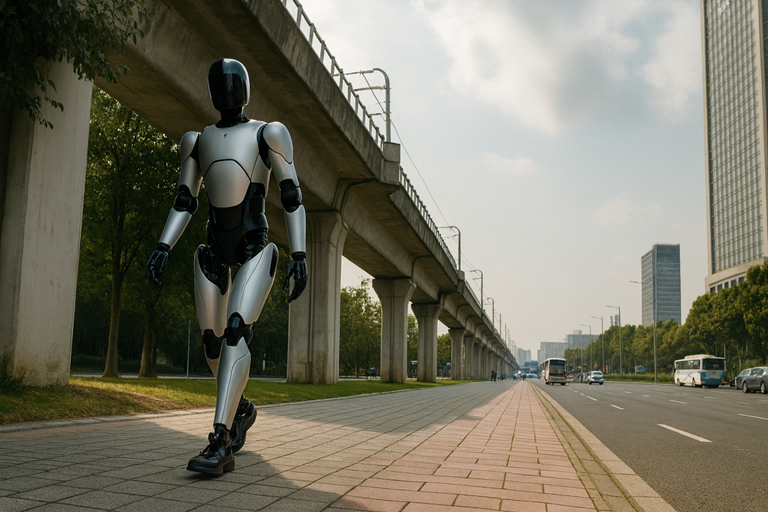
A humanoid robot has completed a three day, 66 mile journey across eastern China, setting a new Guinness World Record and offering a glimpse into the future of physical artificial intelligence. The AgiBot A2 machine, created by Shanghai based firm Zhiyuan Robotics, walked continuously from Jinji Lake in Suzhou to the North Bund in Shanghai without once powering down.
A Marathon on Two Metal Legs
The journey began on the evening of 10 November and ended at dawn on 13 November, when the robot announced its arrival with a simple message. Accompanied by the first ray of morning light, it had reached its destination. The trek covered a total distance of just over 106 kilometres and is now recognised as the longest ever walked by a humanoid robot.
Video footage released by the company shows the silver and black machine striding past cyclists, scooters and commuters. At five feet six inches tall, the robot kept a steady pace as it navigated highways, pavements and busy urban streets. Zhiyuan Robotics said the A2 handled varied surfaces while following local traffic rules, making it a model citizen throughout its journey.
How a Robot Walked for Three Days Without Stopping
One of the most remarkable aspects of the feat was the robot’s continuous operation. The A2’s standard battery lasts only around three hours, but the company used a hot swap system that allowed its power pack to be replaced without shutting the machine down. Engineers changed the battery repeatedly along the route, keeping the robot walking through day and night.
The company stressed that the unit used in the walk was a standard commercial model with no special modifications. More than one thousand A2 robots have already been sold this year.
A Symbolic Moment in the Race for Physical AI
Wang Chuang, partner and senior vice president at Zhiyuan Robotics, described the achievement as a demonstration of reliability and stability. He noted that many people would struggle to complete a similar journey in one go, yet the robot managed it.
The attempt comes amid rising global interest in humanoid machines. Governments and companies are investing heavily in robots designed to perform physical tasks in public spaces, factories and homes. Analysts predict that hundreds of millions of people will interact with autonomous robots every day by the end of the decade. One major investment bank has suggested that the world could have more than a billion humanoid robots by 2050.
China is seeking to take a leading role in this emerging industry. Earlier this year, Beijing hosted the first humanoid robot games, featuring more than five hundred robotic entrants competing in events from basketball to cleaning.
What Comes Next
Although the Suzhou to Shanghai trek is largely symbolic, experts say it highlights rapid progress in navigation, endurance and real world autonomy. The ability to operate for long periods in dynamic urban environments could open doors to new applications such as inspection, logistics and customer service.
For now, the record belongs to the AgiBot A2, which ended its long walk with a simple verdict on its achievement. It believed it could complete the challenge and, step by step, it did.